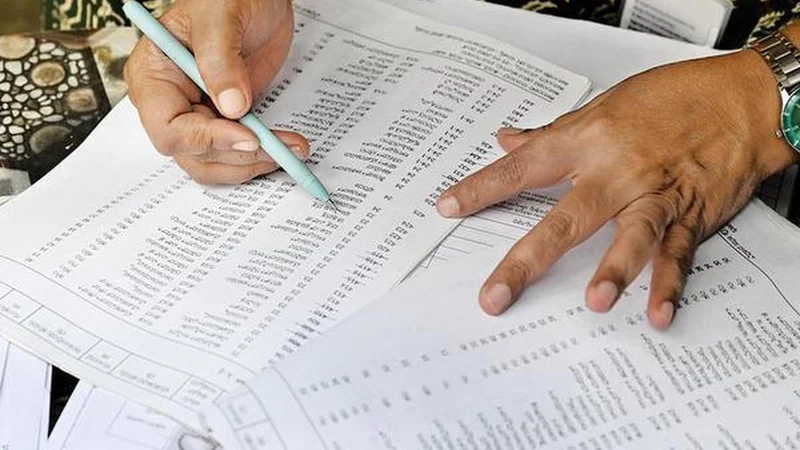
Political apathy, limited awareness of the Special Intensive Revision (SIR), and large-scale labour migration have together pushed Karnataka towards one of the country’s highest draft-stage electoral roll deletions. Nearly one in five voters in the State now falls under the Absent, Shifted, Duplicate, Dead and Others (ASDDO) category.
Migration explains only part of the story. Bengaluru, which attracts lakhs of workers from across Karnataka, is reporting some of the State’s highest ASDDO numbers because a large number of voters have been marked as permanently shifted or untraceable. However, the districts from which people migrate, including Koppal, Raichur, Kalaburagi, Yadgir and several other parts of north Karnataka, are also reporting some of the highest ASDDO figures.
It remains unclear where the lakhs of voters being marked as shifted are being accounted for in the electoral rolls.
Permanent shifts account for the largest share of the ASDDO list, with more than half of the 1.10 crore voters, 65.39 lakh, marked as permanently shifted. Another 15.92 lakh have been marked as absent.
So far, Uttar Pradesh has reported the country’s highest draft-stage deletions at 19.09%, largely attributed to migration. None of the Phase II States, nor Bihar, where the exercise was first carried out as a pilot, has recorded figures as high as Karnataka’s. Even in Phase III, Haryana and Andhra Pradesh have reported lower draft-stage deletions than what Karnataka is now headed towards.
In 2002, when the intensive revision of a special nature was conducted, Karnataka did not have the scale of internal migration it has today. Bengaluru has since become one of India’s largest employment destinations, drawing workers from across the State and the country. At the same time, districts such as Koppal, Raichur, Kalaburagi and Yadgir continue to witness seasonal migration because of drought, poor employment opportunities and chronic regional imbalance.
These are also among Karnataka’s most backward districts. Released earlier this year, the Govind Rao Committee on regional imbalances identified many of them as “most backward” or “more backward”, pointing to persistent gaps in education, employment, healthcare and access to government services. Those same gaps now appear to be playing out during the SIR.
Seasonal migration is a way of life in many of Karnataka’s backward districts. While the enumeration phase is under way, entire families are already in Bengaluru, Hyderabad, Mumbai or Goa, working as construction labourers, pourakarmikas, domestic workers or hotel staff. Many migrant workers told The Hindu they did not even know the SIR was under way.
Many also said they possessed little beyond Aadhaar and ration cards. Women in several of these communities have studied only up to primary school, while many workers said they could not even verify the spelling of their own names. For these families, a voter ID is proof of residence needed to access government welfare.
The Chief Electoral Officer, V. Anbu Kumar, has consistently maintained that multiple checks, including mahazars, are carried out before a voter is marked under ASDDO. He has also repeatedly defended the figures, arguing that he or Booth Level Officers (BLOs) cannot analyse why a voter is untraceable and are only carrying out the exercise as prescribed.
However, the people being marked absent or shifted do not even know they have been placed under the ASDDO category because of the design of the exercise. BLOs said they mark someone as shifted if the person has permanently moved. If the person is not present during the enumeration phase, they are categorised as “absent”.
Furthermore, the CEO has said that if a voter is not at home, a relative above the age of 18 can sign the enumeration form. But in many villages across north Karnataka, entire families migrate together for months at a stretch, leaving nobody behind to receive or sign the forms.
Political parties, too, have done little to bridge this gap.
Parties, including the Congress and the BJP, have appointed Booth Level Agents (BLAs), who are authorised to verify voters. On the ground, however, BLOs across several districts told The Hindu that BLAs were largely absent during field verification. More importantly, neither party mobilised migrant communities during the enumeration itself, despite these voters being among the most vulnerable to being marked absent or shifted.
Several BLAs said mobilisation could be taken up after notices are issued. But even these notices would reach voters’ native villages while they continued to work elsewhere. Even when workers respond, most migrant workers possess only Aadhaar or ration cards, documents that are insufficient for the verification process.
On July 29, the KPCC sought “double verification” of ASDDO cases to ensure genuine voters are not removed. The CEO, however, maintained that ASDDO lists are shared with political parties every two hours and that it is for the parties to verify them. The verification, therefore, has remained limited because of the passing of this responsibility.
For those marked under ASDDO, the burden now lies entirely on the voter. They must either approach election officials to establish that they are genuine electors or file Form 6 with one of the prescribed documents. The process, however, presumes that the voter knows they have already been marked absent or shifted. For thousands of migrant workers, daily wage labourers and other vulnerable voters who remain unaware of the SIR itself, that assumption does not hold.
The result is that many migrant workers are falling through the cracks. Several labour groups told The Hindu that workers could no longer find their names in their native constituencies, while others were unable to locate them in Bengaluru either.
The confusion has also spilled over into the field, highlighting a lack of awareness.
On July 29, a voter in Bengaluru’s D.J. Halli, a slum area, assaulted a BLO after believing the official was refusing to help him, when in fact his name had already been marked as shifted to South Bengaluru, where, according to the electoral rolls, he was claiming to be residing.
The ASDDO category has also triggered concern among civil society groups, which have demanded that the list be made public.
Several petitions and representations have been submitted to the Chief Electoral Officer (CEO), seeking details of the ASDDO list and an explanation for the unusually high number of voters placed under the category.
Another category that has drawn significant criticism is “Others”. While the BLO app records this as “refused to sign”, it is reflected in the public data simply as “Others”. As of August 3, more than five lakh voters had been placed under this category.
Several BLOs pointed out that they were also using the category for voters with “suspected eligibility”. The CEO, however, denied this, maintaining that “Others” refers only to cases where a voter refused to sign.
Published - August 04, 2026 03:44 pm IST