GHANA · COMMODITIES
What the Ghana cashew processing study found
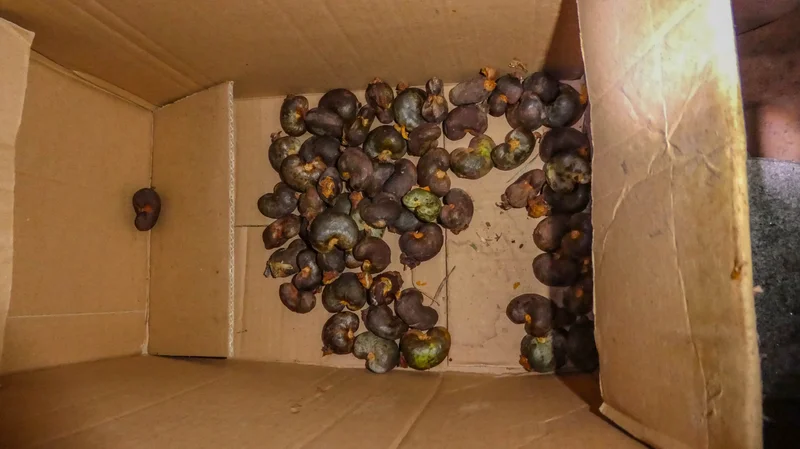
The central number is stark in its simplicity. Roughly 15,000 tonnes of raw cashew were processed inside Ghana in 2025, out of an estimated 262,000 tonnes of national production.
Everything else — more than 94% — was exported or traded unprocessed. The report was produced by Nitidæ, a French non-profit working on agricultural value chains, with support from the Association of Cashew Processors of Ghana, GIZ and the EU Delegation to Ghana.
Its title signals the intent: a roadmap for a supportive cashew public policy. This is advocacy research with a named client, which is worth stating plainly, even where the underlying volumes are not in dispute.
One figure complicates the picture. Ghana exported about 444,000 tonnes of raw cashew in 2025, considerably more than it grows.
Nitidæ attributes the difference to an estimated 165,000 tonnes brought in informally from Côte d’Ivoire, Mali and Burkina Faso and shipped out again through Tema Port. Ghana is a corridor as much as a producer.
Where the money actually goes
A raw cashew nut is a low-value object. The kernel inside is not.
Shelling, peeling, grading, roasting and packing are where the margin sits, and they are labour-intensive — though, as the study makes clear, far from cheap to build. That is precisely the kind of work a country with Ghana’s demographics would want to keep.
Historically most West African raw cashew has been shipped to Asia for processing and then re-exported to consumer markets. The growing country earns the farm-gate price; someone else earns the retail one.
That is the structure the study is aimed at. The 6% figure is the measure of how little has changed.
The squeeze on farmers
The report also records a price collapse at the bottom of the chain. Farm-gate prices opened 2025 at about GH¢16 per kilogramme, climbed to roughly GH¢20 in February, then fell to around GH¢7 by May — a drop of about 65% from the peak in four months.
Growers exposed to a single raw-export channel have very little pricing power. When international buyers step back, the price falls to whatever the trader offers.
A domestic processing base changes that dynamic by creating a second buyer. That is the practical argument for value addition, beyond the national-pride version of it.
It was not a one-off. In 2023 the same pattern ran harder still, from GH¢11 per kilogramme in March to GH¢2.80 in May.
Why raw-export dependence keeps repeating
Cashew is one instance of a pattern that recurs across African commodity chains. Gold leaves as doré, cocoa as beans, lithium as concentrate, manganese as ore.
Governments across the continent have begun legislating against it, from export bans on unprocessed minerals to local-content requirements in mining. Those measures work only where processing capacity actually exists to absorb the volume, which is why this study argues for financing rather than prohibition.
Cashew is not the easy case it looks like. The study puts a modern 20,000-tonne plant at about US$9.2 million in Ghana against US$5.3 million in Vietnam, with business borrowing near 20% against roughly 9%.
The technology is mature and the work is labour-intensive, employing about 120 full-time and 500 daily workers at that plant size. The capital and credit gap, not the know-how, is the binding constraint.
What to watch next
The first thing is whether the roadmap translates into policy. A study commissioned by processors and donors is a proposal, not a decision.
The second is financing. Processing plants need working capital to buy a crop that arrives in a short seasonal window, which is where most West African attempts have failed.
The third is regional competition. Côte d’Ivoire, the world’s largest raw cashew producer, ran 37 processing plants with 830,000 tonnes of installed capacity in 2025.
The study counts Ghana among the few producing countries with no policy framework for domestic processing, while Côte d’Ivoire, Benin, Nigeria and Togo have all introduced levies, incentives or industrial zones.
It stops short of recommending an export ban, warning that one would depress farm-gate prices and push trade informal. The gap between 15,000 and 262,000 tonnes is the opportunity; the financing gap is the obstacle.
Frequently asked questions
How much of Ghana’s cashew crop is processed locally?
About 15,000 tonnes in 2025, out of estimated production of 262,000 tonnes. That is under 6%, with more than 94% exported or traded unprocessed.
Who produced the Ghana cashew processing study?
The French non-profit Nitidæ, with support from the Association of Cashew Processors of Ghana, GIZ and the EU Delegation to Ghana. It is titled Ghana Cashew Processing Sector and Roadmap for a Supportive Cashew Public Policy.
What happened to cashew farm-gate prices?
Prices started 2025 at about GH¢16 per kilogramme, rose to roughly GH¢20 in February, then fell to around GH¢7 by May. That is about a 65% drop from the peak.
Why does local processing matter?
Shelling, roasting and packing are where the margin in the cashew chain sits, and they are labour-intensive. Processing at home also gives farmers a second buyer, which raises their pricing power.
What is stopping Ghana from processing more?
Capital and credit. The study puts a 20,000-tonne plant at about US$9.2 million in Ghana against US$5.3 million in Vietnam, with borrowing costs near 20% against roughly 9%.
Is this problem specific to cashew?
No. It repeats across African commodity chains, from gold doré to cocoa beans and unprocessed minerals, and several governments have legislated to force more local processing.
This article was produced by The Rio Times’ automated newsroom system. How we use AI · Report an error