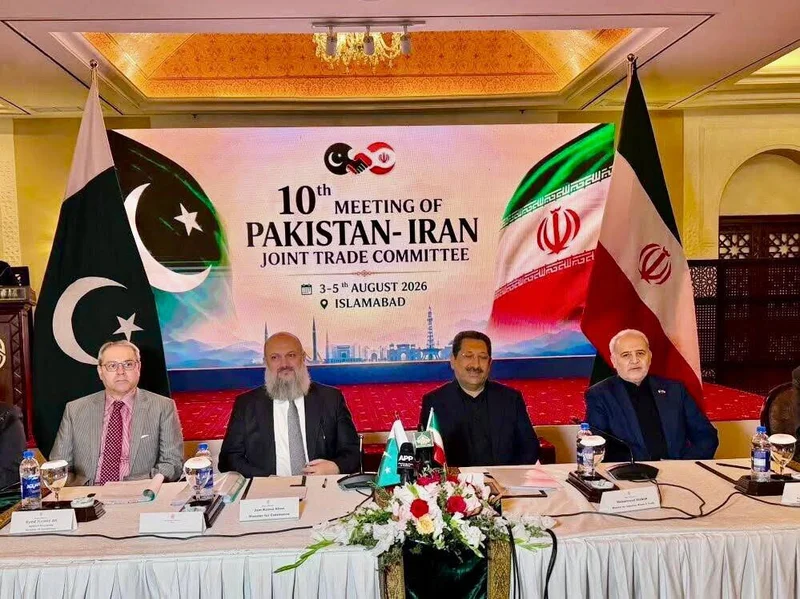
Iran, Pakistan forge path to $10b trade milestone as joint committee meets in Islamabad
TEHRAN- In a significant display of economic diplomacy, Iran and Pakistan have convened the 19th session of their Joint Trade Committee in Islamabad, with high-level delegations from both sides charting an ambitious course toward a $10 billion annual trade target that would fundamentally transform the economic landscape of the two neighboring countries.
The two-day meeting, co-chaired by Iran's Minister of Industry, Mining and Trade, Seyyed Mohammad Atabak, and Pakistan's Commerce Minister, Jam Kamal Khan, represents the most comprehensive bilateral trade negotiation in recent years, encompassing everything from finalizing a long-awaited Free Trade Agreement to resolving urgent logistical challenges at ports and border crossings.
Political will translates into economic action
Speaking at the inaugural session at Islamabad's Serena International Hotel, Minister Atabak emphasized that the strategic policy of Iran is the comprehensive development of cooperation with neighboring and aligned countries, particularly Pakistan. He noted that annual bilateral trade has already reached approximately $3 billion, demonstrating the real and extensive capacity that exists between the two economies.
Pakistan's Commerce Minister Jam Kamal Khan echoed this sentiment, declaring: "We are determined to finalize the Free Trade Agreement between Pakistan and Iran." Khan emphasized that the longstanding and brotherly relations between the two countries serve as a strong foundation for continuing friendship and neighborliness on the path to upgrading comprehensive cooperation.
"We believe that the time has come to finalize the Free Trade Agreement between the two countries," Khan stated, adding that "our common roadmap for greater trade must be operationalized."
Private sector takes center stage
Complementing the government-level negotiations, a high-ranking trade delegation from the Iran Chamber of Commerce, Industries, Mines and Agriculture, headed by Vice President Hossein Pir-Moazen, has arrived in Islamabad to ensure that private sector voices are fully integrated into the discussions.
The delegation includes the head of the Iran-Pakistan Joint Chamber, numerous chamber heads from across Iran, heads of specialized chamber committees, and private sector representing diverse fields including food industries, agriculture, transportation and transit, energy, automotive industries, and polymer and petrochemical sectors.
The business delegation is scheduled to hold meetings with members of the Islamabad Chamber of Commerce and Pakistani private sector, as well as participate in the Iran-Pakistan Business Conference at the headquarters of the Federation of Pakistan Chambers of Commerce and Industry.
Four working groups tackle key challenges
The Joint Trade Committee sessions are being conducted within the framework of four specialized working groups covering: trade, transportation and customs, free zones, and the Free Trade Agreement. Technical meetings began a day prior to the formal opening, allowing officials to make substantive progress on complex issues.
A critical item on the agenda is the resolution of problems affecting Iranian containers at Karachi Port. Following the naval blockade imposed against Iran, a portion of containers were diverted to Karachi, creating significant challenges including delays in cargo transfer, changes to bills of lading, and mounting demurrage costs for traders and cargo owners.
Minister Atabak has called for urgent follow-up on the issuance of permits for maritime transfer and transport, waiver of warehousing costs, and resolution of administrative and procedural issues for customs clearance. He emphasized that resolving these issues will smooth transit routes through Pakistani ports and strengthen the position of Karachi, Qasim, and Gwadar ports in regional trade.
Path to $10 billion within one year
Perhaps the most striking declaration came when Atabak asserted that achieving the $10 billion trade target within a one-year timeframe is entirely feasible—provided that existing obstacles are removed, a Free Trade Agreement is concluded, direct financial and banking links are established, and cumbersome regulations and bureaucratic red tape are reduced.
He welcomed Pakistan's recent initiatives including transit directives, the possibility of transporting essential goods through air routes, and exemptions for certain export items from financial and banking procedures, while calling for swift implementation and expanded scope of these measures.
The minister stressed the importance of diversifying transit routes—land, air, and sea—and noted that given regional circumstances and Iran's program to replace the UAE route with Pakistan, swift implementation of transit directives can play an effective role in developing bilateral and regional trade.
Border infrastructure under scrutiny
Atabak also raised concerns about excessive waiting times at the Mirjaveh-Taftan border terminal, noting that a sharp decline in traffic in recent days requires urgent review and resolution. The minister called for accelerating and facilitating border procedures to ensure smooth movement of commercial fleets.
Strategic implications for regional trade
The strengthening of Iran-Pakistan economic ties carries significant implications beyond bilateral relations. Enhanced transit cooperation could provide the groundwork for connecting European and Asian markets, positioning both countries as pivotal nodes in East-West trade corridors. Pakistan's ports—Karachi, Qasim, and Gwadar—could serve as complementary routes for re-exporting Iranian goods and supplying raw materials needed by industries across the region.
Looking ahead
As the 19th Joint Trade Committee continues its work, with a closing ceremony scheduled for Wednesday, expectations are high for tangible outcomes. Both sides have demonstrated genuine political will to transform their economic relationship from one of untapped potential to a dynamic partnership that delivers concrete benefits for businesses and citizens alike.
The coordinated steps taken by both governments in removing obstacles to trade, enhancing border infrastructure, and modernizing customs procedures signal that the $10 billion target is not merely aspirational but a realistic objective grounded in the shared determination of two brotherly nations to build a prosperous economic future together.