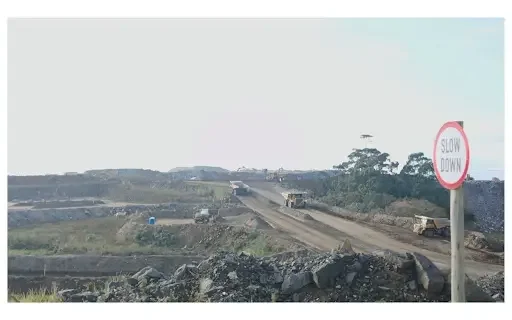
The Highbury open pit mine owned by SA Lithium has faced opposition by residents and civil society organisations since its mining right was granted in December 2023. The mine, in the Umzumbe area of the Ray Nkonyeni local municipality in KwaZulu-Natal, has applied to__ ____expand__ the mine’s footprint from about 40 hectares to 150ha and increase its mine dump from 56ha to about 180ha.
The planned expansion has led to objections by All Rise Attorneys for Climate and Environmental Justice who represent residents of the nearby Magog and Fairview communities and at least 10 supporting community organisations.
Instead of the promised economic development, residents say they experience environmental degradation, destruction of livelihoods and insufficient public participation.
All Rise Attorney Kirsten Youens__ told the Mail & Guardian __earlier this year that: “increased blasting, dust and heavy vehicle traffic will expose residents, schoolchildren and livestock to harmful particulates, which may include silica and metal-laden dust, with no air quality modelling conducted for the expanded activities”.
“They don’t see us as human beings, they just see us as things to be moved,” Zandile Cele, a resident and activist in the impacted areas, told M&G.
**Living with the mine **
The villages of Fairview, Quathlongu, Magog and Madala fall within 1km of the mine. Included in the land rezoning application dated May 2024, the traffic impact assessment completed for SA Lithium states that trucks pass through the rural farming villages on 98 trips every day, with each truck carrying 34 tonnes of lithium ore. At peak production, the assessment notes that the mine will move 100 000 tonnes of ore a month, roughly 2 941 truck loads.
Residents living in surrounding areas who spoke on condition of anonymity for fear of reprisals say the trucks start at 3am and end after 10pm.
Many of the rural areas in the Ray Nkonyeni municipality rely on subsistence agriculture and livestock rearing for food security.
Human rights campaigner for social justice non-profit groundWork Sifiso Dladla said the livelihoods were threatened by resource pressure and pollution: “Communities have to sacrifice their livelihoods for mining companies to make money that they do not benefit from.” Dladla, as a civil society organiser,is involved in opposing the mine.
Dated February 2023, the community health impact assessment completed for SA Lithium in line with mining legislation requirements notes that “to extract one ton of lithium, you need approximately 500 000 gallons, [or roughly 1.9 million litres] of water. Because of inadequate water supply, lithium extraction causes an acute water shortage.”
The mine’s water use licence was approved in February 2025.
Residents, who spoke to the M&G and asked not to be named for fear of reprisals, said that since the mine started pumping water out of the river under their water use permit, they had found it more difficult to access water and grow food because of the water and air pollution and increased water scarcity.
The assessment notes a “potential increase in communicable diseases like tuberculosis (TB)” from mining activities, as well as. “increased activity of vehicles and heavy machinery, and the blasting will all contribute to the increased local noise levels”. The increased noise levels cause adverse health effects like cardiovascular disease.
To mitigate the potential health impacts from noise, dust and water pollution, the assessment recommends SA Lithium undertakes mitigation methods like “good housekeeping such as storage of potentially hazardous material” and information campaigns.
However, when M&G visited the mine, the mine dump was in proximity to residential areas. Crops, plants and homes were coated in dust. Homes were visibly cracked, which residents say is due to the daily blasting.
Cele said residents temporarily evacuated their homes during blasting, the time of which was announced on a signboard outside the mine.
“When the mine is blasting you have to leave your house so your house doesn’t fall on you,” Cele said.
Another resident who spoke on condition of anonymity said: “The dust is so bad [we] can no longer hang our washing out.”
Many of the issues were raised in December 2025, after a petition by Umzumbe resident Micheal Sithole.
Community submissions to the NCOP select committee said: “Many households now have visible cracks due to vibrations and ground disturbances. These raise serious safety concerns.”
The committee said it had received several oral submissions from community members “regarding the lack of community health services and infrastructure (clinic) as set out in the international standards and best practice, except that the mine provides everyone who is sick as a result of mining activities with Panado pills”.
Among other recommendations, the committee concluded that: “SA Lithium be directed to establish a Compensation and Restoration Fund to address property damage, medical expenses and loss of water supply. This fund must be administered transparently under DMRE [department of mineral resources and energy] oversight, with independent auditing and community representation.”
SA Lithium denies wrongdoing.
“SA Lithium has conducted all of its activities in accordance with the applicable legal and regulatory framework. Every process undertaken has been lawful and compliant with the prescribed procedures … SA Lithium remains committed to protecting the environment and supporting the growth and development of its local communities,” spokesperson Ian Harebottle said In response to written questions.
M&G also sent questions to the department of mineral and petroleum resources (DMPR) to find out whether it had visited the mine recently to check environmental compliance but did not receive responses at the time of publication.
**Local employment **
Signed in 2024 on behalf of SA Lithium by Harebottle, the mine’s social and labour plan (SLP) required by mining legislation lists a staff complement of 206 at the end of the five-year period that started in 2023, with additional job creation from local economic development (LED) projects.
The SLP promises a programme of upskilling and training to ensure that locals will be able to work for the mine. However, mining at the Highbury mine is contracted to mining services company Trollope, which, according to Trollope’s website, operates the mine.
The Minerals and Petroleum Resources Development Act states that the holder of the mining right remains responsible for the SLP’s implementation.
As reported in the ____ Citizen, community members have protested against what they say is a failure of the Highbury mine to provide local jobs.
“They told them that this mine is for job opportunities, that everyone is going to get rich. But no one from the area gets the mine [jobs],” Cele told the M&G. “Less than 20 jobs were for the locals.”
SA Lithium contests the claim, writing in response to written questions that it has created “in excess of 1 000 direct and indirect employment opportunities”, but did not respond to questions requesting a breakdown of the figures.
**Local economic development **
Mining legislation also requires mining companies to undertake LED projects which are integrated into the municipality’s integrated development plan (IDP) after public consultation processes.
SA Lithium’s SLP, signed in 2024, pledges R43.1 million expenditure on inclusive procurement, LED and human resource management between 2023 and 2027.
The commitment to LED projects is easiest to track since it involves the building of physical infrastructure or the implementation of community programmes.
According to the SLP, SA Lithium committed to spending R15m on LED projects between 2023 and 2027. Of that, R10.5m was scheduled to have been spent by the end of 2026.
However, despite SA Lithium operating in the area since 2023, a review of the municipality’s IDPs does not show a record of any LED projects by SA Lithium.
Dladla and three sources familiar with the SLP process, who spoke to M&G on condition of anonymity, said that they were not aware of any LED projects that had started.
“Mining comes with a lot of promises, of improvement, of employment, of development but that’s not the case,” said Dladla.
A resident, who spoke on condition of anonymity, said the community was “never consulted about what our priorities were” in terms of local economic development.
To find further details on LED projects beyond publically available information, M&G sent written questions to the DMPR on the mine’s compliance and to SA Lithium.
The DMPR did not provide answers at the time of publication, despite promises to do so.
SA Lithium said it had channelled more than R1m a month into the local economy. However, it did not respond to individual questions regarding the breakdown and evidence of LED expenditure.
Ownership
The select committee report called for increased transparency around the mine, noting that Section 32 of the Constitution “guarantees access to information, which is crucial for indigenous communities in the context of mining operations on or near their land”.
However, activists say that the ownership structure of the Highbury mine makes it difficult to track the promised benefits, negative impacts and corresponding decisions from the mine management.
Looking into the ownership structure through publically available information reflects that SA Lithium is wholly owned by Australian mining company AVL, according to a 2025 AVL annual report.
Aligro Africa's branding is predominately displayed on the Highbury mine while its website lists the Highbury mine as a joint-venture project.
However, R-TEK International, an industry consulting group based from a tax-free zone in Dubai, “drives the sales and logistics efforts of the [Highbury] project”, according to its website.
In trying to untangle the structure to determine how to direct concerns, address issues and ask questions, Cele asked: “Who is the top one? We really want to know the top one [who makes the decisions], so we can go and talk to him.”
In line with obligations set out under the South African Mining Charter to broaden the economic benefits of mining, Amandla Consortium is the project’s broad-based black economic empowerment (B-BBEE) partner, according to Aligro Africa’s website. Aligro Africa operates the Highbury Community Trust in partnership with the Amandla Consortium, for the stated aim of local economic investment.
Aligro Africa’s website states that Amandla Consortium receives a preferential dividend from the Highbury mine. The SLP signed in 2024 states that the trust owns 5% of the Highbury mine.
However, the trust has no website and a review of the municipality’s IDPs reflects no mention of the trust or its activities to promote development.
Residents and campaigners say that there is no transparency around the trust: “I’ve never seen them do anything,” said Dladla.
SA Lithium did not answer requests for details on the trust’s activities for local economic development.
Mining campaigners say the lack of transparency around the SLP, company ownership and decision making around mining is part of a larger trend which makes it difficult for residents to track their right to public participation, economic benefit and a safe environment:
“It's always the case. [across mining ventures] Uzumbe is not a unique case. [In] how many of those projects [does] the community benefit?” asked Dladla.
Requests for clarification on the mine’s ownership structure went unanswered by SA Lithium.
The M&G sent detailed questions to the DMPR to find out whether the department has conducted compliance visits in relation to the trust and the SLP at the Highbury mine recently. The department did not provide answers at the time of publication, despite promises to do so.
However, SA Lithium says it complies with environmental laws and legal obligations of local socio-economic benefit:
“We reject the allegations levelled against the company and the mine management. The assertions are inaccurate, misleading and do not reflect the true position,” said Harebottle.