25 states sue Trump administration over forced labour tariffs
Mainly Democratic-states challenge tariffs of up to 12.5% that White House announced in early July
Twenty-five U.S. states sued Donald Trump's administration Monday over tariffs issued to root out forced labour in global supply chains, calling them a pretext for replacing import taxes the Supreme Court struck down in February .
The United States last month imposed double-digit tariffs on 59 countries and the European Union, charging that they had not done enough to crack down on imports produced by forced labour. The new tariffs took effect just as the clock ran out on temporary tariffs President Donald Trump had turned to after the Supreme Court defeat.
"After losing at the Supreme Court, the administration is once again trying to illegally raise taxes on families and businesses with a new round of tariffs," said Attorney General Letitia James of New York State, one of the 25 states suing.
Trump, who argues that high tariffs will revive American manufacturing, last year overturned decades of U.S. policy that favoured lower tariffs and ever-freer trade. Invoking the 1977 International Emergency Economic Powers Act, or IEEPA, he imposed double-digit tariffs on imports from almost every country, saying America's longstanding trade deficit amounted to a national emergency.
But the Supreme Court ruled that IEEPA did not authorize tariffs, forcing the administration to send refunds to importers who'd paid them. Eager to make up the lost revenue, Trump turned to temporary 10 per cent worldwide tariffs. But they expired on July 24.
The administration subsequently turned to Section 301 of the Trade Act of 1974 , which permits the president to impose import taxes and other sanctions against countries found to engage in unfair trade practices. Trump used Section 301 to impose big tariffs on China in his first term, and they survived court challenges.
The administration invoked Section 301 to impose the forced-labour tariffs, which range from 10 per cent to 12.5 per cent and hit countries that provide 99 per cent of American imports. Canada was hit with the 10 per cent tariffs, with exemptions for goods covered by the Canada-United States-Mexico Agreement (CUSMA), the federal government in Ottawa has said.
'No basis' for forced labour tariffs
The White House said in a statement Monday that Section 301 tariffs "have proven to be a legally durable tool since the President's first term, and they remain so now."
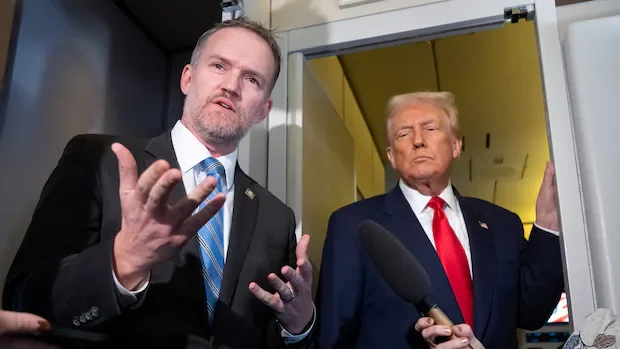
"The United States is using its lawful authority to obtain the elimination of unreasonable acts, policies, and practices that burden U.S. commerce," White House spokesman Kush Desai said.
The states' lawsuit follows two other lawsuits filed in the Court of International Trade in July by small businesses that also challenged the 301 tariffs. The business were represented by the Liberty Justice Center, a nonpartisan litigation firm that also sued over the IEEPA tariffs.
Both of those lawsuits argue that the government didn't adequately establish its case against each specific economy or spell how the tariffs will eliminate the specified practice they are being levied for, as required by Section 301.
Barry Appleton, a law professor and co-director of New York Law School's Center for International Law, said the challenges stem from the fact that the 301 tariffs are the third time the administration has tried to impose similar worldwide tariffs under different statutes, and their "nearly copy-pasted" nature could pose a challenge to defend in court.
However, he said while the statutes that the administration implemented tariffs under previously were novelties and hadn't been used before for that purpose, Section 301 has been used before.
"Presidents have used it for decades, and Congress built it with real guardrails: investigation, consultation, a public record," Appleton said. "The government's defence won't be 'I had no power to do this.' It will be, 'I stayed inside the lines Congress drew.' That is a real fight, not a formality, and it is the one that will decide this case."
The Canadian government, in a written submission to the United States Trade Representative's office, said there was "no basis for the imposition" of the Section 301 duties on Canadian goods. The Canadian Chamber of Commerce and the Canadian Federation of Agriculture were among the many other groups that submitted objections to the USTR's office.
Joining New York in the lawsuit announced Monday were states overwhelmingly led by Democratic administrations or governors at present: Arizona, California, Colorado, Connecticut, Delaware, Hawaii, Illinois, Kentucky, Massachusetts, Maryland, Maine, Michigan, Minnesota, Nevada, New Jersey, New Mexico, North Carolina, Oregon, Pennsylvania, Rhode Island, Virginia, Vermont, Washington and Wisconsin.
Separately, the Trump administration has invoked Section 338 of the U.S. Tariff Act to apply additional tariffs on Canadian goods, effective Aug. 19. The act gives the president the power to impose a maximum tariff of 50 per cent on imports from countries that are deemed to discriminate against U.S. industry.
The planned Section 338 tariffs won't exempt a wide range of goods presently compliant with CUSMA. Because it is known that the U.S. wants to renegotiate some aspects of CUSMA, one business analyst who spoke to CBC suggested that lawsuits challenging those tariffs may not come right away, as companies could adopt a wait-and-see approach to see how negotiations between Canada and the U.S. proceed.
LISTEN | The latest episode of Two Blocks from the White House:With files from CBC News