She went to the doctor because she had severe ear pain and, when examined, learned she was six weeks and four days pregnant. The ultrasound showed one embryo in the uterus and another one in a fallopian tube. She then experienced pain and bleeding, was taken to an emergency room and told that to save her life she needed urgent surgery that is illegal in Florida, and that she would have to travel to North Carolina to have it done there. “They told me my life was in danger. I had to travel alone and return in pain, with nausea, dizziness and bleeding,” she says. She is a Central American woman living in Miami who has asked that her name and nationality be withheld for fear of reprisals.
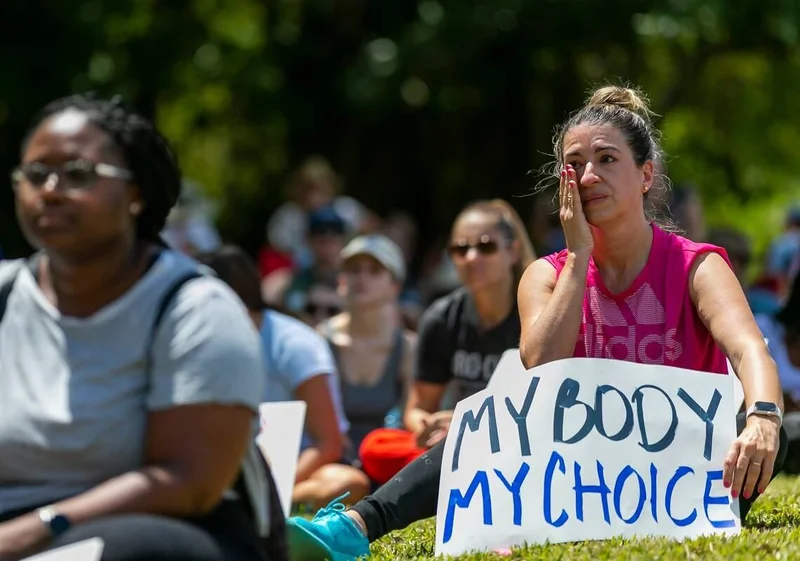
Since Florida banned abortion at six weeks of gestation in May 2024, the number of pregnant women traveling out of state for the procedure has tripled: from 2,800 in 2023 to 10,200 in 2025, according to late-July data from the Guttmacher Institute, a non-profit that advocates for sexual and reproductive health. North Carolina is the closest state where patients can receive care after six weeks of pregnancy; the number of Floridians who have traveled there for care since the bans began has increased more than tenfold.
After the law was reformed in Florida, a wide swath of southeastern U.S. states also tightened abortion restrictions: Georgia and South Carolina at six weeks; Alabama, Mississippi and Tennessee entirely, as well as Arkansas, Louisiana, Oklahoma and Texas. “Florida residents are in a part of the country where abortion care is not available beyond six weeks in any nearby state. When you look at the map, North Carolina is the first state you can geographically reach. We also see people going to Virginia, a bit farther north, and to New York,” explains Kimya Forouzan, senior adviser for state policy at the Guttmacher Institute, in a conversation with EL PAÍS.
In North Carolina, the gestational ban is at 12 weeks, but travel is costly and prohibitive for low-income patients. Wait times for care can be as long as 72 hours, and people seeking care often must make up to two trips or stay for several days.
“Abortion still exists, but access increasingly depends on each patient’s financial situation, time and ability to travel. Latina women face additional barriers: many work jobs where they cannot take time off, and they are more likely to struggle financially to afford a multi-day trip,” says Clara Trullenque, communications manager for Planned Parenthood in Florida.
Planned Parenthood is the largest provider of reproductive health and family-planning services in the United States, with affiliates in 49 of the 50 states. In the state governed by Ron DeSantis they have 17 health centers where, among other services, they provide abortions to women under six weeks of gestation and refer those beyond the state law’s limit to other jurisdictions. But for patients who are immigrants without legal status in the United States, the fear of traveling long distances and being detained by immigration officers en route is another obstacle. “Even when they need medical care, many stay home. And some people continue pregnancies they were not prepared for because they cannot access medical care in time,” Trullenque says.
Since the reversal of Roe v. Wade in June 2022, the provision of abortion services has been affected nationwide and interstate travel has become an increasingly important route to care. In addition to the data collected in Florida, the Guttmacher Institute has recorded that more than 140,000 people traveled out of their state of residence to receive abortion care in the country. Of that group, two thirds (98,000 people) traveled from states with total bans or with six- or 12-week restrictions.
Some of the jurisdictions receiving the largest influx of patients have taken measures to support them, such as approving so-called “shield laws” that protect patients and providers from legal retaliation or creating funds to cover travel costs for low-income patients.
Telemedicine is another alternative that has surged. Last year, 142,000 people obtained abortions by telemedicine in states with total bans or six- or 12-week restrictions. In Texas, where it is illegal to end a pregnancy after the first six weeks or to provide abortions in cases of medical complications as in Florida, more than 42,000 patients accessed the service by telemedicine through providers protected by shield laws. At the same time, according to the Guttmacher Institute, the number of Texas residents who traveled out of state for care fell from nearly 34,000 patients in 2023 to 23,000 in 2025.