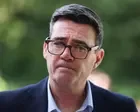
Andy Burnham has said he will review the government’s controversial prisoner early release scheme with the justice secretary.
The scheme, under which thousands of prisoners are to serve shorter sentences after new laws were passed to address a prison overcrowding crisis, is due to begin in September.
Speaking in Bath on Wednesday, the prime minister said: “I’ve spoken to the new justice secretary. We will review the policy together and make further statements in due course.”
Asked about the early release of prisoners, which has again captured headlines amid concerns from the family of police officer Andrew Harper, who died after being dragged behind a car while trying to stop thieves stealing a quad bike. His mother said it felt like an “insult” that two of her son’s killers could be eligible for early release from prison.
Speaking in Bath, Burnham said he felt for the family. “Nobody can deny the pressure on prison places,” he said. “We did not invest in the prison estate when we should as a country, going back a decade or so ago, when it was clear that there was going to be pressure. That has created an unacceptable situation now.”
He said he wanted to assure himself that everything had been looked at before the scheme went ahead. “I can give that assurance that every single part of this I will look into with the justice secretary,” he said. “I can’t say that I can change the policy completely, but I will look at it in detail before we go further forward.”
Killers, rapists and sex offenders will be among more than 5,000 prisoners freed early following a change in the law in January. Under the scheme some serious offenders will be eligible for release halfway through their sentences rather than two-thirds of the way through. Offenders convicted of less serious crimes will qualify for automatic release after serving half their sentences rather than two-thirds, provided they have not seriously breached prison rules.
Unlike emergency measures under which tens of thousands of prisoners were released in the early months of the Labour government as prisons ran out of space, the Sentencing Act includes no exemptions for prisoners convicted of serious crimes, domestic abuse or terrorism.
The scheme has faced fierce opposition from victims’ groups as well as opposition parties and some Labour MPs. This month the victims commissioner, Claire Waxman, and the domestic abuse commissioner, Nicole Jacobs, joined with former safeguarding minister Jess Phillips to make a rare coordinated intervention to warn the government about the scheme, which they say will put abuse victims at risk.
On Wednesday Waxman wrote to Burnham and the new justice secretary, Alex Norris, urging both men to look again at the early release scheme and make it the “No 1 priority in their inbox”.
The plans were spearheaded by the former justice secretary David Lammy, who said that without the move the criminal justice system was at risk for collapse. Lammy, who has been replaced at the Ministry of Justice by Norris, said the government had to press ahead with the scheme because of an impending capacity crisis across the prison state that could leave jails nearly full within six months. The former prisons minister James Timpson has also warned of a “complete breakdown in the criminal justice system”.
skip past newsletter promotion
Free newsletter \| Every weekday
Sign up to First Edition
Our morning email breaks down the key stories of the day, telling you what’s happening and why it matters
after newsletter promotion
Burnham’s comments were welcomed by groups working with victims. Ciara Bergman, CEO of Rape Crisis England \& Wales said: “Obviously there are significant challenges facing our government, including how over-crowding and under-resourcing is going to be managed, but the solutions to these challenges cannot come at survivors’ expense.”
Katie Kempen, Chief Executive at Victim Support, said the review was encouraging. “This review must urgently fix the fact that most victims currently have no way of knowing whether or not an offender could be released early. It is unacceptable that so many victims are being kept in the dark about this – that must change.”
Burnham also said there would be no immediate commitment to increase the income tax personal allowance as a means of easing the cost of living. But the prime minister suggested increasing the £12,570 tax-free personal allowance would be something that the government will look at in the budget this year.
It came as the prime minister reversed a decision to increase the bus fare cap to £3 made by his predecessor Keir Starmer, reinstating a £2 cap on bus fares across England to in a cost of living blitz that has also seen him scrap VAT on energy bills.