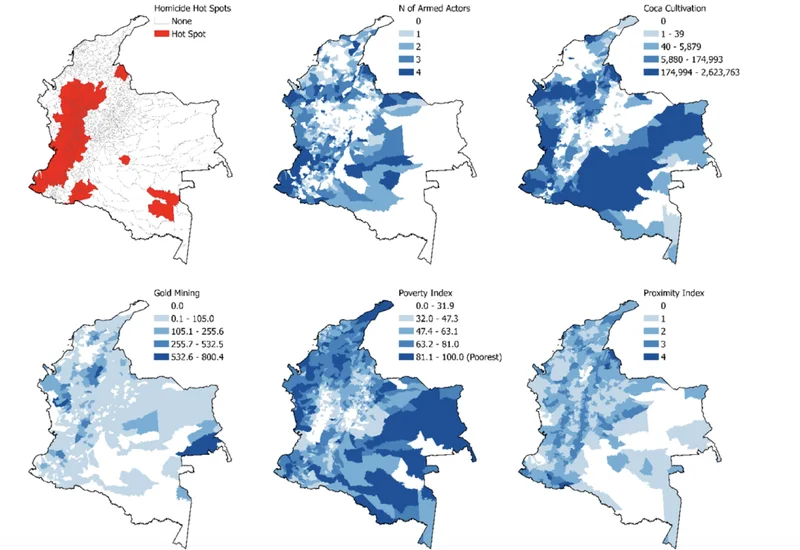
Environmental features and geography may be a better predictor of homicides in Latin America than the prevalence of organized crime gangs.
That’s what we found in a recent study that analyzed homicide patterns across Colombian municipalities between 2010 and 2020.
As researchers in place-based criminology, we were interested in understanding whether the locations where violence occurs matter more than the prevalence of organized crime groups operating within them.
So we compared violence levels against the prevalence or proximity of certain environmental and geographical factors, including coca cultivation, gold mining and transportation corridors, such as major roads, rivers, ports, airports and border crossings.
Using statistical models, we assessed the relative predictive power of these environmental features versus the presence of armed actors, including the now defunct revolutionary group FARC and its dissident factions, the guerrilla group ELN, and various organized crime syndicates.
Our results showed that environmental and geographic features were significant predictors of the local murder rate, independent of whether organized crime groups were present.
In fact, many municipalities with a high armed actor presence in eastern Colombia had relatively low murder rates. Meanwhile, homicide hot spots clustered predominantly in the country’s western corridor, where illicit economic resources and transportation corridors overlap.
Crucially, violence did not stay contained within individual municipalities. A strong spillover effect meant that homicide rates in one municipality were significantly shaped by conditions in a neighboring one – particularly coca production and mining activity in adjacent areas. Environmental features, it turns out, facilitate much of the violence in Colombia.
Why it matters
The implications of these findings cut directly against decades of anti-violence policy across Latin America and beyond. High-profile kingpin strategies – the killing of Colombian drug lord Pablo Escobar, the capture of Mexico’s El Chapo, the arrest or killings of top FARC leaders in the past – are emblematic of a deep-seated belief that cutting off the snake’s head will dismantle criminal organizations and reduce bloodshed.
Our findings, published in the peer-reviewed journal Crime Science, suggest this strategy is misplaced or, at a minimum, incomplete.
If murder rates are driven by the geographic distribution of illicit economic opportunity, then removing individual criminals from those environments does little to change the underlying conditions that make violence profitable and persistent. A new group, or a fragmented remnant of the old one in the case of FARC dissidents, will simply operate in the same place as its predecessor and carry on with that criminal activity.
Our study also reframes how Colombia’s 2016 agreement with the FARC should be understood. Although the accord succeeded in disarming one of the region’s most influential insurgent groups, violence has persisted and in some areas escalated because the broader conditions driving conflict were left largely intact. As the FARC withdrew, rival armed organizations, or fragmented successor groups, moved into the resulting power vacuums and competed for control over coca-producing areas and drug-trafficking routes.
Our findings suggest that for policymakers, reactive strategies that target offenders after violence erupts are not sufficient on their own.
Rather, methods that address the underlying conditions that attract organized crime groups may be more effective. This could include crop substitution programs in coca-growing regions, legal job opportunities for mining communities, and a strengthened security presence along trafficking corridors, as well as in areas where the national government has little to no footprint.
What still isn’t known
At the broadest level, this study looked at where homicides cluster across municipalities – the basic administrative units for which homicide data was available. Some municipalities, however, are quite large, meaning that armed groups may not operate evenly across the entire area, and homicides are not spread uniformly either. Future research could zoom in further, examining whether the same patterns hold at the neighborhood or street level.
Because annual data was not available for all variables, we relied on average homicide rates over the 10-year period, which meant we could not track changes over time. We would like to explore whether shifts in the number and presence of criminal organizations, alongside environmental factors, correspond with annual changes in violence.
Finally, we hope to apply this same framework to other conflict-affected countries in Latin America, particularly Mexico and parts of Central America, to see whether the same environmental factors predict homicide rates across different national contexts. If place-based factors consistently prove just as powerful as offender-focused ones, the argument for prevention strategies that target places and conditions, rather than just criminals, becomes much harder for policymakers to dismiss.
The Research Brief is a short take about interesting academic work.