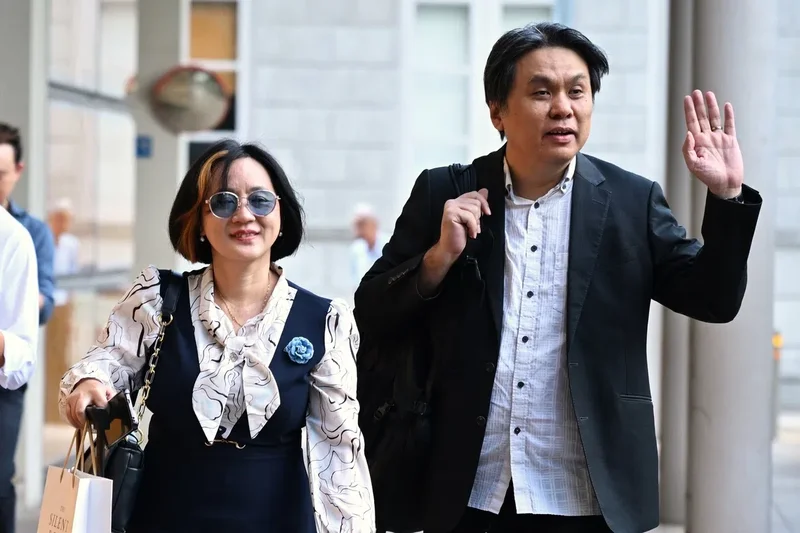
Iris Koh’s husband Raymond Ng declared vexatious litigant, barred from starting lawsuits
AI generated
SINGAPORE - Raymond Ng, the husband of anti-vaccine group founder Iris Koh, was declared a vexatious litigant by a High Court judge on Aug 4.
This means he has been barred from starting any new civil legal proceedings, and cannot continue with his existing lawsuits without first getting permission from the High Court.
In a written judgment, Justice Hoo Sheau Peng said Ng had habitually and persistently and without reasonable ground, instituted vexatious legal proceedings.
Vexatious proceedings include those that are started with the intention of annoying or embarrassing the opposing party, or brought for collateral purposes.
On the other hand, Koh was handed a two-year general civil restraint order, which restrains her from starting any new civil actions or applications without the High Court’s permission.
Unlike her husband, Koh can continue her ongoing civil actions, such as her pending defamation claim against former Nominated MP Calvin Cheng.
The judge said in Koh’s case, the requirements for a vexatious litigant order were not fully met.
The judge added while Koh had instituted vexatious proceedings without reasonable grounds, there was insufficient evidence to establish she had done so habitually.
The judge said a general civil restraint order, which only stops new actions, was appropriate to counter Koh’s “scatter gun” approach to litigation.
Koh is the founder of anti-vaccine group Healing the Divide.
Ng, a management consultant, is the founder of an artificial intelligence platform named “GetEven.AI” and maintains a blog.
The couple has started a host of legal proceedings against various parties.
In 2025, the Attorney-General’s Chambers filed an application for Koh and Ng to be declared as vexatious litigants and sought court orders to restrain them from initiating or continuing any civil proceedings.
Litigation as income source
The AGC estimated that between May 2021 and January 2026, the couple had individually or collectively instituted approximately 37 actions, excluding applications within those actions.
To support its application, which was heard on July 15, the AGC raised four main cases, three brought by the couple, and one by Ng alone.
They included a judicial review application against Health Sciences Authority (HSA), a defamation suit against Calvin Cheng, an action against the National University of Singapore (NUS), and a defamation suit against a man named Wong Peng Kong.
The cases against the HSA and NUS were struck out by the courts, while Ng was awarded $1 in nominal damages against Wong.
Ng’s claim against Cheng was struck out, while the claim by Koh is pending.
Aside from these cases, Ng had also stated his intentions on his blog to sue “thousands” with the help of AI.
Koh had posted a TikTok video, declaring that 2024 would be the year she was going to seek justice for her name and to restore what she had lost.
Ng had also threatened to sue the Singapore Police Force, the Ministry of Health, the Commercial Affairs Department, the Inland Revenue Authority of Singapore and the Monetary Authority of Singapore.
This arose in relation to a Facebook post made by a woman named Geno Ong. Ong, who had been sued by Ng for defamation, committed suicide due to her mounting legal fees as a result of the lawsuits.
The AGC had argued that the number of vexatious legal proceedings instituted sufficed to establish habituality, and pointed to the couple’s conduct out of court to demonstrate their collective efforts to annoy, embarrass and pressure the opposing parties.
The AGC also argued the couple treated litigation as an income source through various lawfare tactics.
The judge found the four cases cited by the AGC were brought without any reasonable grounds.
She added Ng appeared to have started legal proceedings for collateral purposes.
The judge noted that Ng has described potential litigation to be a source of income, that he charges $1,000 for individuals to use his AI platform to sue people, and has publicised a scheme on TikTok where an individual can “sponsor” his lawsuit and get returns.
The judge added that the manner in which Ng issued a letter of demand was a veiled attempt at extracting a settlement and not to resolve a genuine dispute.
Ng admitted he uses the same template when issuing letters of demand. In the letter, he demands damages of $50,000 but says he is willing to accept $5,000 to settle the claim.