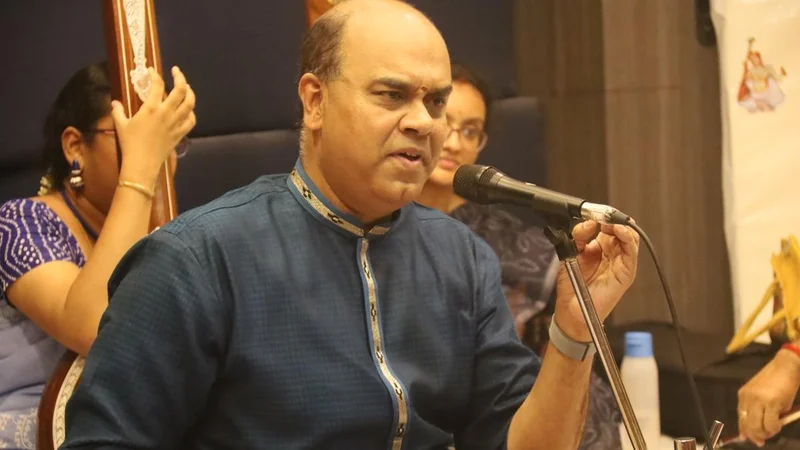
What does a musician do when the repertoire well before him has run nearly dry? That was the question facing Delhi P. Sunderrajan as he stepped up to deliver the 13th and final concert of the monthly series ‘Ekaika Raga Kritis of Tyagaraja’, curated and launched by violin maestro A. Kanyakumari last June. Over the preceding 12 editions at the Arkay Convention Center, the series had systematically exhausted about a hundred kritis — compositions that are solitary in their ragas — leaving Sunderrajan with very little to choose from. This meant repetition was almost inevitable.
Yet the violinist-turned-vocalist and guru of repute transformed this constraint into an opportunity. Accompanied by M.A. Sundareswaran (violin), Tiruvarur Vaidyanathan (mridangam) and K.V. Gopalakrishnan (kanjira), Sunderrajan presented a vocal recital that was less about novelty of selection than about the depth of its interpretation. The focus was rightly on the kritis, and the fare was an enchanting mix of the familiar and the rare. Nine compositions were presented, with manodharma kept to the essentials.
‘Padavi ni sadbhaktiyu’ in Salagabhairavi — a kriti that critiques hollow piety while championing genuine devotion — provided a brisk start. A short swara segment capped it. Sunderrajan’s sublime artistry came to the fore in his alapana of Bhushavali, a shadava-sampurna raga (nishada-varja in the ascent) derived from Vachaspathi. He maintained the raga’s identity throughout, with characteristic phrases flowing with elegance. Sundareswaran’s response on the violin was sweet and silken. The vocalist’s rendition of ‘Tanamidane’, a composition in which Tyagaraja owns up to his faults rather than complaining to Rama, made one wonder why it is not heard more often in concerts. Deftly presented kalpanaswaras added value.
The Vasanthabhairavi kriti ‘Nee dayarada’ (in Rupakam) showcased the beauty of sangatis — with familiar ones in the one-phrase pallavi, and a few intriguing variations rendered in the charanam. Sunderrajan then moved on to Swarabhushani, a rare shadava-shadava raga with an asymmetric scale (omits ‘ri’ in the ascent and ‘ga’ in the descent) derived from Kharaharapriya, and rendered ‘Varadaraja ninnu kori’, also set in Rupaka tala. The kriti paints a vivid portrait of the iconic Garuda Seva festival, comparing the Lord’s radiance on the moving Garuda mount to the bright moon shining among the stars.
Subhapantuvarali ushered in a reflective mood. Sunderrajan’s exploration of the raga, particularly in the mandhra sthayi, was marked by measured and meditative phrases. Long, loopy ones towards the end served as a perfect foil. ‘Ennalu urake’ is a typically expressive kriti whose dominant sentiment is one of mock indignation and loving confrontation, born from a deep sense of intimate devotion. Tyagaraja takes on the role of a lawyer presenting a case, questioning the Lord’s apparent unconcern and indifference by reminding him of his own divine track record. The niraval at ‘Satatamu tyagaraju nammaga leda?’ — the rhetorical question “Didn’t Tyagaraja forever keep faith in you?” — sustained the emotional arc beautifully. The ensuing swara passages sparkled with seamless team sync, the top-octave forays rising above the rest.
‘Manavyala kincha ratade’ in Nalinakanti and ‘Evvare Ramayya’ in Gangeyabhushani followed, with contrasting musical contours. A short delineation of raga Andolika — whose literal meaning is ‘palanquin’ or ‘swing’ — led into the kriti ‘Raga sudha rasa’, which proved true to the raga’s name. Like a palanquin bearing a sovereign, Andolika lifted the kriti’s theology — sacrifice, union, enjoyment — carrying Tyagaraja’s ecstatic vision of Omkara in a single melodic procession. Synergy was the reigning element in another burst of engaging swara exchanges. Vaidyanathan’s energy and experience were an asset, and his tani avartanam in two-kalai Adi tala alongside his percussion partner Gopalakrishnan was crisp and lively.
‘Kamalaptakula’ in Brindavana Saranga was the concluding composition. On the day, ‘Pavamana’ served as the mangalam not just for the concert, but for the series itself.
Published - August 04, 2026 06:22 pm IST