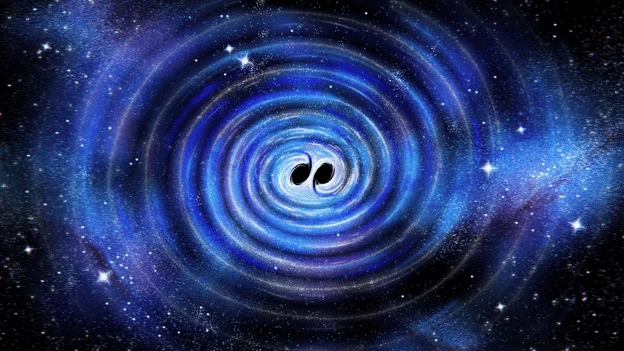
Usually, when physicists want to model the merger of two black holes, they use supercomputers. Now, however, physicists in the US have found a possible shortcut. In a study published in Physical Review Letters, they show that, of the final states permitted by energy and angular momentum, the remnant of a non-spinning black hole merger ends up in a state quite close to one that maximizes the system’s entropy – a surprising and puzzling result that reinforces the deep connection between thermodynamics and black holes.
“Our group has long believed that black hole thermodynamics could provide a new perspective on binary black hole mergers,” says team member Monica Rincon-Ramirez, a postdoctoral researcher at Pennsylvania State University. “While black hole thermodynamics is well established for equilibrium systems, much less is understood in the highly dynamical regime of mergers.”
**Merging black holes **
Black hole mergers occur when two black holes that orbit each other spiral inward with increasing speed, losing both energy and angular momentum by emitting gravitational waves until they eventually converge in a violent clash. After the moment of merger, the remnant oscillates vigorously, “ringing down” into a quiescent, rotating object known as a Kerr black hole that can be described in terms of just two quantities: mass and spin.
Meanwhile, the gravitational waves – ripples in the fabric of spacetime – from this energetic collision propagate through space virtually uninterrupted. These gravitational waves encode information about their source, and when we detect them on Earth (millions of light-years away from their origin), we can use them to predict the remnant’s size and spin. However, doing this requires solving complex equations from Einstein’s general theory of relativity using computationally expensive numerical simulations.
Connecting black holes and thermodynamics
Thermodynamics is the branch of physics concerned with the relationships between energy, heat, work and temperature. For ordinary matter, thermodynamics can describe how energy flows from one system to another in simple terms, even for complex systems with numerous particles and degrees of freedom. For example, rather than meticulously tracking each individual particle, concepts such as entropy – a measure of a system’s disorder – can be used to describe the final state of the entire system.
Physicists have long known that black holes obey laws that closely parallel the laws of thermodynamics, with the event horizon and surface gravity of black holes being analogous to entropy and temperature, respectively. Building on this established connection, Rincon-Ramirez and colleagues at the University of Mississippi, the University of California, Berkeley, and Northwestern University as well as Penn State investigated whether black hole thermodynamics could go beyond describing the properties of isolated, stationary black holes and provide, in addition, a principle for determining the final state of a merger.
The maximum-entropy conjecture
After accounting for the energy and angular momentum carried away by gravitational waves, the researchers tracked the evolving mass and angular momentum of a binary, mapped these values to those of hypothetical Kerr black holes, and calculated the corresponding entropy. They found that the Kerr entropy reaches a maximum at a mass and spin strikingly close to the final mass and spin predicted by numerical relativity simulations. Indeed, the two methods agreed with each other to within a few percent. “The Kerr entropy turned out to be remarkably meaningful for the binary system as a whole,” Rincon-Ramirez says.
Interpreting and presenting these results proved to be a challenge, however. “What we found was completely unexpected,” says Rincon-Ramirez. After deliberating among themselves as to why the final black hole’s parameters should lie so close to those of the maximum-entropy black hole, they ultimately chose to extend the conversation to the scientific community. By presenting their puzzling results and a broad conjecture, which they term the “maximum entropy conjecture for black hole mergers”, they hope to sharpen their findings through rigorous testing and eventually place them on a firm mathematical foundation within general relativity.
The unsung theory: why thermodynamics is as important as quantum mechanics and general relativity
In the meantime, the researchers plan to extend their conjecture to more general binary black hole systems. By studying systems such as highly spinning and eccentric binaries, they hope to gain further understanding of the role of thermodynamic quantities in general relativity. “Ultimately, we hope this work will contribute to a more complete thermodynamic framework for highly dynamical spacetimes,” Rincon-Ramirez says.