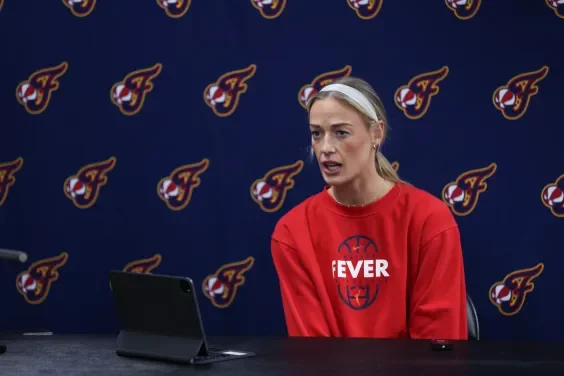
A lot of people in and around the WNBA are talking about trans women. In the aftermath of Indiana Fever role player Sophie Cunningham's negative comments about trans people playing sports in an ESPN profile, transphobic right-wing grifters and small groups of protesters have made a show of themselves at her games. In response, Storm co-owner Celeste Keaton got suspended by the league for telling off a couple of Cunningham boosters, while coaches like Cheryl Reeve and Natalie Nakase have given statements in support of trans women and girls participating in sports. Still others in the league, like Caitlin Clark, Fire coach Alex Sarama, and Fever coach Stephanie White have delivered more mealy-mouthed quotes about this controversy that Fox News describes as a "culture war" and ESPN describes as "the disunited United States that shadows the WNBA."
If you came across these headlines as a non-sports fan, it would probably be fair for you to assume that there's a trans woman playing in the WNBA, or at least one at a high level in college who might be drafted soon. Google's autocomplete suggestions, which offer phrases like "trans wnba star" or "wnba player who looks like a man," imply that some number of curious people are trying to put a proper name to all this chatter. But there's no such trans basketball player. Not unlike that period in the 2000s when male athletes would get asked if they'd be comfortable with an imaginary gay teammate, these quotes, both for and against, are all about trans women and girls as a concept, as opposed to an actual woman who could potentially speak for herself.
So, why is anyone talking about this? Let's go back to the most memorable presidential campaign ad of 2024, the one I remember seeing all over the MLB playoffs that year: "Kamala is for they/them, not you." Following Trump's win, a number of people upset by the result blamed trans people—as a concept—for the Democratic Party's defeat, while Republicans went full steam ahead with the idea that they could win by publicizing that their opponents weren't sufficiently anti-trans. It's no secret that they see women's sports as the key wedge issue that they can use to their advantage, selling people who might otherwise recoil at their policies on the idea that a handful of athletic trans girls and an even smaller number of athletic trans women with comparable hormone levels to cis women represent some existential threat to womanhood—and that the only way forward would be mandatory sex testing for any girl who might want to play soccer or volleyball with her friends.
In the earlier stage of this campaign, University of Pennsylvania swimmer Lia Thomas was the big bad boogeywoman demonized for her success in the Ivy League on the men's and then the women's team. Thomas was so hated by the right-wing grievance machine that merely tying for fifth with her in a race was enough to launch the career of right-wing influencer Riley Gaines, whose endless complaining about trans women landed her a New York Times profile last year. Additionally, after Trump took office again, he made Penn walk through a whole humiliation ritual as revenge for Thomas's existence.
Thomas hasn't swum competitively since 2022, but nobody has taken her place. Because of exclusionary policy changes, the overall rarity of trans athletes, and likely no small amount of intimidation, there hasn't been any trans athlete on Thomas's level in the last four years. (Keep in mind that this level was "very very good college swimmer.") This presents a problem for the right. If your winning issue is trans women in sports, and you're struggling to uncover trans women in any league that anybody has ever heard of, then how do you keep trans athletes at the top of people's minds?
Answer: You invent them. The Olympic boxer Imane Khelif, who is certainly not a trans woman, nevertheless got smeared as a man in 2024 because of a questionable sex test controversy. NWSL star Barbra Banda, also not trans, went through a similiar wringer when J.K. Rowling learned who she was. All of the words devoted to Cunningham over the past several days represent an apotheosis of this manufactured outrage, where the debate doesn't even involve a fake trans woman, just the vague concept of one's participation in sports.
This rhetoric is ideal for listeners who believe trans women are an issue that they're supposed to care about, but don't actually have any real-world experience with them. The hypothetical trans girl who's supposedly causing all this trouble in the WNBA is the perfect tool for the conservative movement. She can't fight back, she can't disprove anyone's assumptions, and she can't garner sympathy when she's the target of hate. The perfect trans girl is the one who only exists in the imagination of the loudest cis people. Her monstrousness, the need to "protect young girls in a locker room" from her, gives them permission to enact policies that in reality only harm the anonymous girls, cis and trans, who want to play sports without the invasive scrutiny of gender-obsessed adults.
On a long enough timeline, barring universal anti-trans policies like the one that's currently shut the door on playing in the NCAA, a trans woman from somewhere in the world will make it onto a WNBA court, finally putting a real person where all we previously had was empty discussion. If that future world looks anything like our own, this woman will suffer through a living nightmare of right-wing abuse, and that looming threat alone should be enough to make the league act now. But for WNBA employees and players who take pride in the longstanding connection between progressivism and women's sports, this Cunningham debacle isn't just about the hypothetical concept of a future trans athlete. On any given day in the WNBA, a real, live trans woman is going to be attending a game. How do they want it to feel when she gets there?