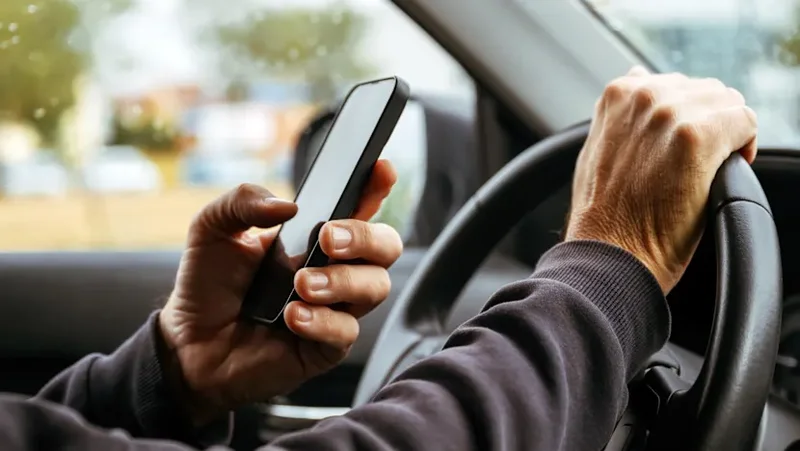
MPs raise concerns over mounted devices, private-hire drivers as law passed to criminalise holding phones while driving
One Member of Parliament noted the growing range of digital distractions in the form of wearable devices and large infotainment systems in vehicles.
SINGAPORE: Members of Parliament on Tuesday (Aug 4) sought clarifications on the use of mounted devices while driving and the impact on private-hire drivers as a law was passed to criminalise holding mobile phones while driving.
A total of 26 MPs from both sides of the House and one Nominated MP spoke during a debate that lasted over five hours at the second reading of the Road Traffic (Miscellaneous Amendments) Bill.
The changes to the law make it an offence for motorists to hold their mobile phones while driving, even if they are not using the device.
Previously, an offender needed to be using it in hand for communicative functions such as calling and texting while the vehicle was in motion, for it to constitute an offence.
The requirement that the driver must operate a function of the device could only be enforced by a police officer who observed the driver using the device while driving, Second Minister for Home Affairs Sim Ann said during her opening speech.
"This is challenging to enforce practically," she said.
"More importantly, there should be no need to prove that the driver was operating the device. Unlike other everyday objects, a mobile communication device is ordinarily held to communicate or access information.
"These are activities which typically require the driver’s visual and cognitive attention and divert their attention away from driving.
"Where the device is handheld, the risk of distraction is further compounded because the driver must hold and support the device, reducing the driver’s ability to maintain proper control of the vehicle."
The new law makes it clear that it is not an offence if the device is secured in a mount and a driver touches it while driving.
But drivers who get distracted or compromise control over their vehicle while using a mounted device may still be liable for offences such as careless or dangerous driving.
The law also allows the traffic police to enforce the offence using cameras, as well as photos or videos submitted by members of the public. This will increase the detection of such offences, the Ministry of Home Affairs (MHA) said previously.
Besides stricter rules on holding a mobile phone while driving, the law now imposes harsher penalties for dangerous driving causing grievous hurt and lowers the drink-driving limits.
MOUNTED DEVICES
MPs who spoke on Tuesday had questions on the use of mounted devices while driving and about evidence submitted by the public that can be used for enforcement.
MP Mariam Jaafar (PAP-Sembawang) asked what checks would be in place for footage submitted by members of the public, while MP David Hoe (PAP-Jurong East-Bukit Batok) asked if the traffic police would publish guidance on the minimum information required and the quality of the evidence submitted.
He asked if a photo or a video showing a driver holding a device with a vehicle registration number would suffice and whether the police would consider checking other available camera footage if the recording submitted is not clear enough to corroborate the report.
Many MPs highlighted that mounted devices could still distract drivers.
MP Dennis Tan (WP-Hougang) told the House not to underestimate the growing range of digital distractions confronting motorists, giving examples of mounted phones, wearable devices, large infotainment systems and digital dashboards among others.
He also asked if multiple mounted devices contributed significantly to driver distraction.
"While stronger penalties are necessary, enforcement alone cannot fully address the problem if the design of modern vehicle cockpits is itself becoming a source of distraction.
"If we focus solely on penalising distracted driving after it occurs, without examining whether certain vehicle designs contribute to driver distraction in the first place, we may be addressing the symptoms rather than the cause," said Mr Tan.
He asked if the ministry would work with the Land Transport Authority (LTA) to consider standards governing pre-installed infotainment systems and if the government would look at whether there was a need for certain complex touchscreen interactions or app-based functions to be automatically restricted while a vehicle was in motion.
Singapore’s regulatory frameworks must keep pace with the changing nature of digital distraction confronting drivers, which no longer arises only from handheld phones. This includes wearable technology such as smartwatches and the design of modern vehicle cockpits itself. Making this point in parliament on Tuesday (Aug 4), MP Dennis Tan asked if Singapore will consider imposing standards governing increasingly screen-dependent cockpit design, vehicle mobile application control functions and preinstalled infotainment systems. He also urged a proactive study into the effects of using multiple mounted devices, which he said is a practical reality for many private-hire drivers.
MP He Ting Ru (WP-Sengkang) raised similar concerns about in-vehicle displays, asking what rules apply when acts such as typing, scrolling through social media, watching videos or taking video calls are carried out through vehicle systems.
MP Poh Li San (PAP-Sembawang West) was also concerned that the changes might legitimise the "blatant misuse of mounted devices" while MP Lee Hui Ying (PAP-Nee Soon) cited Queensland in Australia as an example of a jurisdiction that has limited the use of mounted mobile phones for certain licence types.
She also asked about accidents where mobile phone usage was the primary factor.
A number of speakers also addressed the impact the new law may have on private-hire drivers who depend on their mobile phones for their livelihood and navigation.
Labour MP Wan Rizal (PAP-Jalan Besar) asked if the ministry would consider a campaign to ensure platform workers are kept up to date.
Ms Lee, who is one of the advisers to the National Taxi Association, asked if the ministry would consider working directly with taxi companies, ride-hailing platform operators to accelerate the adoption of hands-free navigation and voice assistant tools.
MP Charlene Chen (PAP-Tampines) said the government could work with platform operators to minimise the need for interaction while vehicles are moving.
"This could include simpler displays, voice-guided directions, suppressing non-essential notifications, and sufficiently long response windows, so drivers can wait until it is safe before responding to job offers. Drivers should not be penalised for putting their safety first," she added.
        Listen:


  ## "NO EXCEPTION"
In addressing the concerns raised by members, Ms Sim said: "The Bill makes it clear that if the vehicle is in motion, holding a mobile communication device is prohibited. There is no exception."
Even if the device has fallen from its mount, the driver should stop the vehicle safely before retrieving the device, she added.
"It is dangerous to assume that it is safe to pick up the device while the vehicle is moving, even if just for a second. What we are aiming for is a collective change in driver mindset and habits to minimise distractions while on the road."
On increased distractions for drivers when using mounted devices and in-car entertainment systems, Ms Sim said the ministry did not criminalise the use of a mounted device while a vehicle is in motion as there are legitimate reasons for operating them, such as using navigation applications.
Still, there are existing provisions that target the use of mounted screens in moving vehicles under certain circumstances.
Depending on the facts of the case, if a driver were to use a mounted device – whether single or multiple – and becomes distracted to the point that it affects his or her driving behaviour, the driver may be liable for the offence of careless or dangerous driving.
She added that the Road Traffic (Motor Vehicles, Construction and Use) Rules already make it an offence to install any visual displays in a manner that poses a safety hazard or causes distraction.
"We will monitor the road traffic situation and we do not preclude making changes to our approach to mounted devices or screens should the need arise."
In parliament on Tuesday (Aug 4), Second Minister for Home Affairs Sim Ann responded to clarifications sought by Members on the Road Traffic (Miscellaneous Amendments) Bill. The bill was then passed in the House.
Replying to Ms Lee's question on accidents that resulted from handphone driving, Ms Sim noted there are significant evidential difficulties in proving whether handphone driving contributed to the accidents reported to the traffic police.
"For one, drivers would not proactively confess that they were in fact using a mobile communication device at the time of the accident," she said.
"There is also often no objective video evidence available to establish that a driver was on their mobile communication device at the time of the accident.
"But that does not mean that handphone driving is not dangerous or not prevalent."
Mobile phone driving violations are on an upward trend, she said, with a 40 per cent increase from 3,014 cases in 2024 to 4,214 in 2025.
"We must move decisively against this undesirable driving behaviour and not wait until more accidents or fatalities have been caused," she said.