European Union interior ministers emerged from a video conference on Tuesday with an agreement to beef up external security, the group said in a statement.
"There was a common understanding of the need to continue relentlessly fighting migrant smuggling networks, to reinforce returns, to strengthen EU borders, to build deep partnerships with third countries, and to improve foresight," they wrote in a press release.
Ministers also "pointed out that communication during moments of crisis could further be reinforced through timely coordination and should be more coherent, especially to counter malicious external actors engaged in foreign information manipulation and interference."
The group agreed to provide emergency aid to Spain to help boost border security.
What happened in Ceuta?
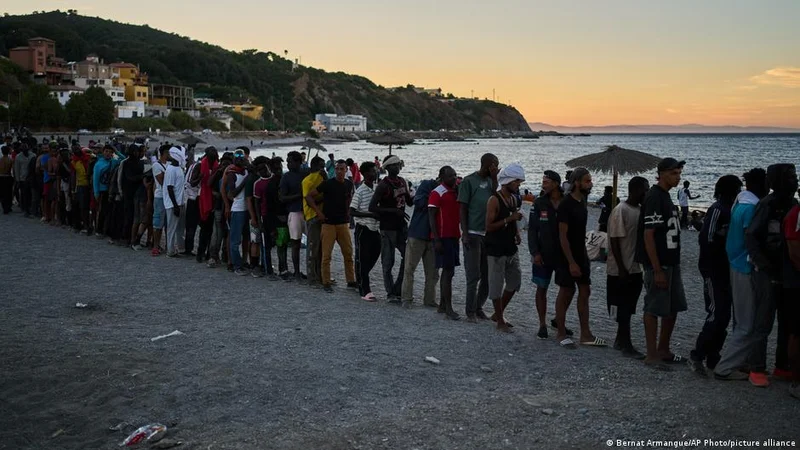
The meeting had been called to address concerns about security inside the Schengen free movement area after some 60,000 people rushed the border gates in the Spanish exclave of Ceuta.
Hundreds among the group were minors, European NGOs have said.
The incident prompted a series of blistering critiques from center-right and right-wing leaders of EU member states against left-leaning Spanish Prime Minister Pedro Sanchez. Countries such as Italy and Finland called for an immediate suspension of Spain's membership in the Schengen agreement.
However, officials and law enforcement from across the EU have said that the breakdown of border controls was due to misinformation given to asylum seekers waiting on the border. Authorities also expressed suspicions that human trafficking gangs purposely misled the would-be migrants.
Spain's Ceuta exclave is located on the African continent, bordered by Morocco on one side and the sea on the other. It is subject to stricter-than-usual Schengen entry and exit procedures, as well as identity checks for passengers crossing over to the Spanish mainland.
Spain confirmed on Tuesday that some 60,000 people have returned to Morocco since the weekend, leaving 2,500 still in Ceuta.
What did EU interior ministers say?
"It is clear that in no way was the Schengen area compromised in this crisis," Spanish Interior Minister Fernando Grande-Marlaska said after the talks with his counterparts in other EU nations.
His sentiment was echoed by French Interior Minister Laurent Nunez: "We all agreed the Schengen area was not really the problem."
European Commissioner for Internal Affairs and Migration Magnus Brunner said that there was "full solidarity with Spain around the table" at the meeting. He added that increased border security provided by the EU's Frontex agency was already active in Ceuta and "ready to do more."
He called the meeting a "useful opportunity" to confirm that no one had moved from Ceuta to the mainland.
"These past few days were a test of our European resilience, a test of the security of our external borders," Brunner told. "Europe, I think, has definitely passed this test."
Edited by: Darko Janjevic
Don't let the algorithm hide the news. If you rely on our team for trusted reporting, please take a moment to select us as your Preferred Source on Google by clicking here and hitting the "star" or "preferred" button, so you'll always see our verified news first.