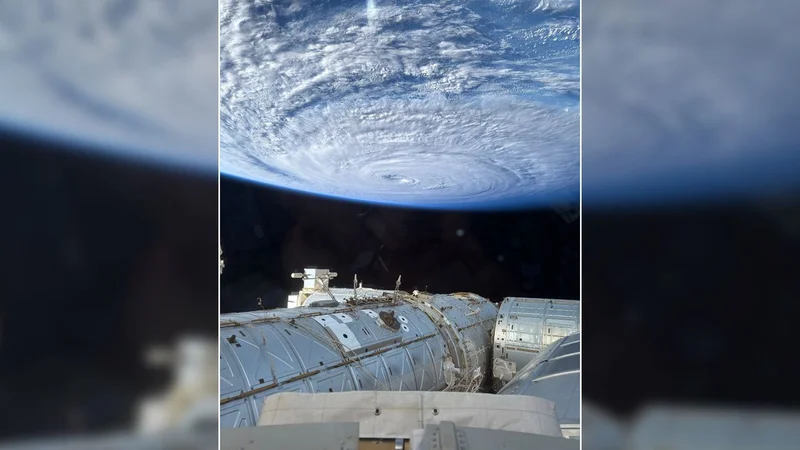
NASA astronaut Anil Menon captured an incredible photograph of a swirling typhoon in the Pacific Ocean from the International Space Station on Aug. 2, 2026.
What is it?
According to his post on X sharing the image, Menon used an iPhone to capture the photo from the space station's cupola, a domed structure built by the European Space Agency that features six circumferential windows and central nadir viewing window.
The photograph shows a massive swirling typhoon in the Pacific Ocean. While Menon doesn't mention the storm or its location by name, it appears to be Super Typhoon Dolphin, the fifth tropical cyclone to reach category 5 in 2026. It has since been downgraded to a category 3 storm, and is expected to weaken to a category 1 or 2 as it continues to move westward towards Japan's Okinawa island.
Why is it incredible?
Aside from being a reminder of how powerful some storms on Earth can be, Menon's photograph shows just how far astronaut photography has come.
Even equipped with only a phone camera, astronauts can capture breathtaking photos to share with the world. On NASA's recent Artemis II mission around the moon and back, the four crewmembers beamed back incredible images captured with iPhones. They even sometimes used them as "mirrors" while shaving.
Menon's photo, like other space station photography, also drives home just how mind-boggling of an engineering feat the International Space Station (ISS) truly is.
There are currently seven people aboard the football-field-sized orbital laboratory, circling Earth every 90 minutes at a speed of 17,500 miles per hour (28,000 kilometers/hour) at an average altitude of around 250 miles (400 km).
Since 2000, the ISS has hosted international crews and has been the site of countless groundbreaking scientific experiments made possible by its microgravity environment. But the station is reaching the end of its life; NASA plans to retire it and crash it in into the Pacific Ocean around 2030.
Brett is curious about emerging aerospace technologies, alternative launch concepts, military space developments and uncrewed aircraft systems. Brett's work has appeared on Scientific American, The War Zone, Popular Science, the History Channel, Science Discovery and more. Brett has degrees from Clemson University and the University of North Carolina at Charlotte. In his free time, Brett enjoys skywatching throughout the dark skies of the Appalachian mountains.