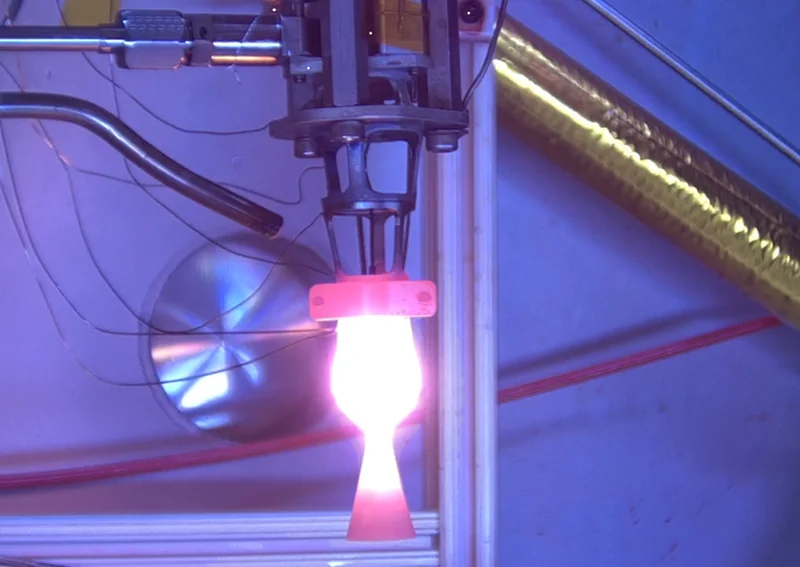
SAN FRANCISCO – Rubicon Space Systems completed hot-fire testing of its Velox 5-newton ASCENT monopropellant thruster, paving the way for on-orbit operations in 2027.
“The program demonstrated performance beyond our design objectives,” Rubicon Director Daniel Cavender told SpaceNews. “We are now transitioning the thruster into flight production.”
The Velox thruster, fueled with ASCENT, a hydrazine replacement, was tested in Rubicon’s vacuum altitude test chamber in Huntsville, Alabama.
“We rigorously hot-fire tested the Velox 5N thruster for weeks,” Cavender said. “We tested across the entire range of feed pressures – from 25% above nominal down to 25% of nominal. We mapped the full range of duty cycles from 1% to 100%. We know where the thruster’s performance margins are, where its behavior begins to change and what to expect as it accumulates life.”
With the testing campaign completed, Rubicon moves Velox into production for three undisclosed customers. Delivery to the first customer is scheduled for early 2027 for a flight in late 2027. Additional flights are slated for 2028.
Through hot fire testing, Rubicon qualified the thruster for nearly 14 kilograms of propellant throughput.
“From what’s been publicly reported, no other manufacturer has demonstrated this much throughput in a 5-newton class or 1-newton class ASCENT monopropellant thruster,” Cavender said. “Every additional kilogram of propellant that makes it through a thruster is more mission capability and more mission flexibility.”
ASCENT is nearly 50% more dense than hydrazine, “so it’s got an advantage there,” Cavender said. Rubicon testing demonstrated 255 seconds of specific impulse from the thruster, “which is nearly 10% higher than any hydrazine thruster.”
The combination of high throughput and high performance will enable “mission capability beyond what you could do with current state-of-the-art hydrazine,” said Cavender, who worked on ASCENT missions in previous roles at NASA.
ASCENT stands for Advanced Spacecraft Energetic Non-Toxic Propellant. ASCENT was developed by the U.S. Air Force Research Laboratory in the 1990s.
Rubicon also won a NASA contract in 2025 to develop a 110-newton ASCENT thruster prototype. And the company delivered the propulsion system for a NASA’s Green Propulsion Dual Mode technology demonstration mission scheduled to launch later this year.
Rubicon, founded in 2022, is a division of Plasma Processes.