We feel your pain: PM sets election battle lines with One Nation, pledges cost of living relief
Save
You have reached your maximum number of saved items.
Remove items from your saved list to add more.
AAA
Prime Minister Anthony Albanese will set up his bid for a third term with a promise of further expensive cost of living measures to address financial stress fuelling One Nation’s ascension as he expands a program to pay health workers as they study.
However, Labor ministers are downplaying the prospect of a tax on gas exports before a fight at its national conference on the popular proposal, signifying tension in Labor ranks over how aggressively Albanese is pursuing populist causes.
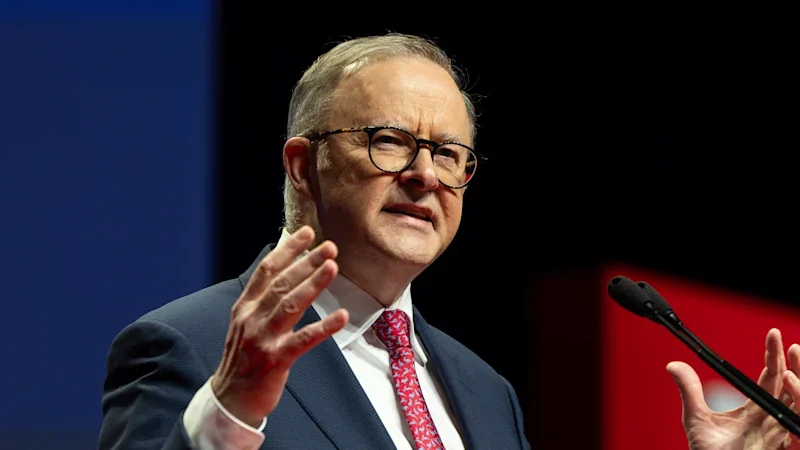
Prime Minister Anthony Albanese addresses the national Labor conference in 2023.Alex Ellinghausen
In a speech to Labor faithful on Thursday that Albanese will use to frame the election’s battle lines, the prime minister will invoke 135 years of Labor tradition on practical responses to boost workers’ living standards rather than “raging against a system … without a plan to fix it”.
Albanese will say that “people have been given every reason to feel like the economy is simply not working for them” as he seeks to boost the government’s political fortunes and meet pessimistic voters where they are.
“That goes deeper than sentiment – it’s a reality people are up against,” he will say, according to an advance copy of his speech, noting he was riding “rough seas” after a series of economic shocks and an oil crisis sparked by the Middle East war.
“It’s how we prove that the status quo is not set in stone. How we demonstrate to Australians that their hard work will pay off, that their effort is worth it. That faults in the system can be fixed [and] that Labor is delivering the real change Australians deserve.”
His emphasis on helping voters pay their bills, and stating this was a fundamental contrast with his opponents, suggests that Labor will test the fiscal boundaries and focus on cost of living relief in its next two pre-election budgets after spending political capital on revenue-raising tax concession changes this year.
Albanese does not mention One Nation by name but his exhortations to reject populist politics underline the upended political dynamic two years out from the next election. Just over a year after his historic win, Albanese’s party has dropped 6.5 percentage points on first-preference vote, according to Poll Bludger’s average of major polls, and is only narrowly ahead of Pauline Hanson’s party, with the Coalition languishing in third.
Albanese will take a veiled swipe at Hanson’s recent controversies on race relations by suggesting the surging populist leader was “blaming people who cannot defend themselves” and championing a form of politics that “doesn’t build anything”.
In the face of criticism from Opposition Leader Angus Taylor about an expanding and unproductive care sector, Albanese will on Thursday announce Labor is extending financial support to health students while they undertake training as part of their degrees. Labor did not provide the cost of the policy.
This will offer a weekly stipend to thousands of students in physio and occupational therapy, clinical psychology, pharmacy and podiatry, speech pathology, audiology, radiography, rehab therapies and paramedics.
The government first announced in its 2024 budget that it would give weekly payments to students undertaking practical placements for their teaching, nursing, midwifery and social work qualifications – one of its cost of living pitches to young Australians before the 2025 election. The indexed subsidy is almost $340 a week.
But allied health groups and young students in health professions wanted the prac payments extended to them. The issue has been taken up in parliament by independents Helen Haines and David Pocock.
Photo: Matt Golding
Parliamentary Budget Office modelling commissioned by Haines found that extending the payments to health and medical students – including psychologists, paramedics and physiotherapists – would cost $290.4 million through to the 2028-29 financial year, on top of $505.3 million budgeted for the current scheme over the same period.
Albanese said the program had changed the lives of students who were struggling to make ends meet during university, moving in with their parents or juggling part-time work with their placements to pay rent.
Causing headaches for Albanese has been a campaign from MPs including Labor’s Ed Husic, unions, the left-wing Australia Institute think tank, and online content creators to levy gas firms with a 25 per cent export tax.
The issue caught on in the public discourse right at the same time as Albanese was trying to secure fuel from Asian neighbours at the start of the US and Israel’s war with Iran. Many Asian nations that supply fuel rely on Australia’s gas exports, so Albanese scuppered the idea.
However, a section of the party’s draft platform states that Labor will ensure Australians “receive a fairer return from their natural resources”, opening the door to a tax later this term. Treasurer Jim Chalmers and others in the government have been open to a fresh revenue grab on resources firms.
The renewed fighting in the Middle East means that the issue of fuel scarcity may again come to the fore, adding pressure on Albanese to downplay a new tax as he did on the weekend. Ministers have also tried to quash talk of a tax.
“The position of the government has been that we haven’t supported a gas tax,” Environment Minister Murray Watt said on Nine’s Today program on Wednesday.
Save
You have reached your maximum number of saved items.
Remove items from your saved list to add more.
Paul Sakkal is Chief Political Correspondent. He previously covered Victorian politics and won a Walkley award and the 2025 Press Gallery Journalist of the Year. Contact him securely on Signal @paulsakkal.14.Connect via X or email.
Natassia Chrysanthos is Federal Political Correspondent. She has previously reported on immigration, health, social issues and the NDIS from Parliament House in Canberra.Connect via X or email.