Our Changing World: High powered magnets, and making steel with hydrogen
High powered magnets, and making steel with hydrogen
New Zealand researchers are developing a new way to make steel that could dramatically reduce carbon emissions while making use of the country's distinctive black ironsands.
At the Paihau Robinson Research Institute at Victoria University of Wellington, Professor Chris Bumby and his team have spent close to a decade investigating how hydrogen could replace coal in one of the most carbon-intensive industrial processes in the world.
"Steel is also responsible for about seven and a half percent of the total world's CO2 emissions," says Chris. "And in New Zealand it's a very significant amount of our total industrial emissions is coming from the Glenbrook steel plant."
Traditionally, steel production relies on the carbon in coal to remove oxygen from iron ore.
Coked coal, iron oxide and some limestone is heated in a blast furnace, the oxygen gets stripped from the ore, and the iron melts, separating out into pig-iron and slag (leftover material). The process has been used for centuries, but it produces large quantities of carbon dioxide as a by-product.
In New Zealand, the process is more challenging.
New Zealand's black sands
"We have a somewhat unusual iron ore. We use iron sand," says Chris.
The iron-rich black sands found along parts of the North Island's West Coast provide one of the raw ingredients for New Zealand steelmaking.
However, they also contain titanium dioxide (TiO2), which prevents them from being processed in conventional blast furnaces, Chris explains "What happens is that if you try and just melt that in a blast furnace that TiO2 has a very high melting point well above two thousand degrees C, and that doesn't flow through your blast furnace. So it just solidifies your entire blast furnace as one big ceramic terracotta ornament."
Instead, New Zealand steelmaking relies on a bespoke method developed in the 1960s, which involves a two-step process to make iron.
In the first stage the iron oxide in the black sands is 'reduced' by using heat and coal to strip oxygen away, producing what's called direct reduced iron.
The Robinson Research Institute team have targeted this step, using hydrogen rather than carbon (the coal) to do this chemical stripping of oxygen. Instead of producing a carbon dioxide byproduct, this reaction makes water. If a source of 'green' hydrogen could be used, this would dramatically reduce the emissions footprint of the process.
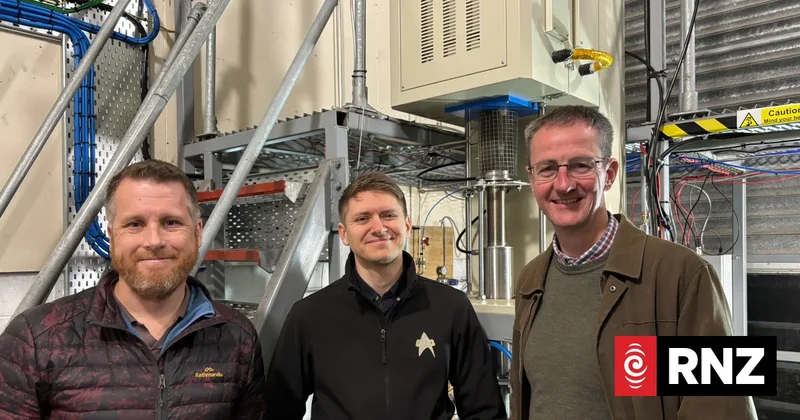
To test the concept, the researchers have built a series of increasingly larger reactors. What began as gram-scale experiments has grown to laboratory pilot reactors capable of producing around 10 kilograms of direct reduced iron per hour.
The before and after looks very similar to the naked eye.
"It's a little bit disappointing in that we're putting black sand in and we're getting black sand out," senior research engineer Ben Rumsey says. "But I can tell you a lot has changed."
Scaling up the reactors has allowed the team to produce more direct reduced iron, which they can then melt and test the chemistry of. Because they are using hydrogen instead of carbon, their resulting iron product will be different to traditional pig iron, and will need to be treated differently in the subsequent steps of steel-making.
Not just reducing carbon emissions
As they worked through this process a key discovery has been that the hydrogen reaction is dramatically faster than the traditional coal-based process.
In the Glenbrook steel mill it can take about 10 hours to convert the iron sand to direct reduced iron.
"We can achieve that same reaction in about two and a half minutes using hydrogen", says Professor Chris Bumby.
That increase in speed could offer significant commercial advantages, allowing more material to be processed in a much smaller footprint.
As a result, the research has begun the move beyond the laboratory.
A new company, CullBeck Limited, has been established to commercialise the technology and is working towards building a larger demonstration facility next to the Glenbrook Steel Mill.
While New Zealand's ironsands prompted the research, the technology could have applications elsewhere. Similar titanomagnetite sand deposits occur in other parts of the world, particularly around the 'Pacific Ring of Fire'.