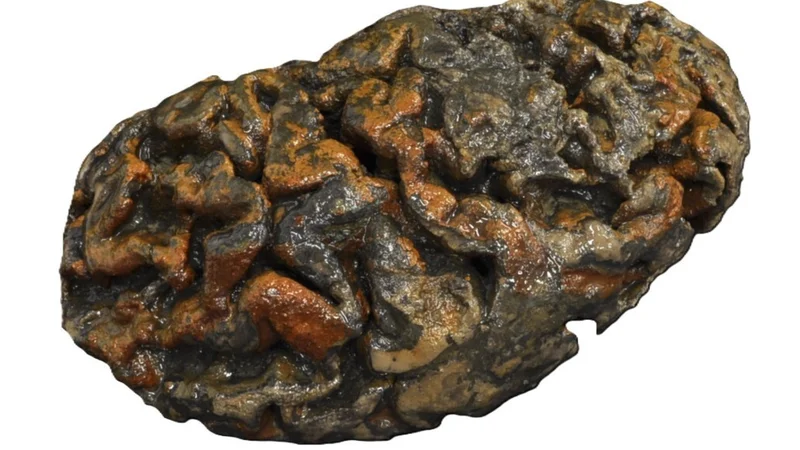
The brain preservation paradox — the discovery of well-preserved human brains among otherwise skeletal remains — has puzzled archaeologists and pathologists alike for decades. Now, new research finally provides a scientific explanation for this longstanding mystery.
"We found that brain preservation isn't a rare anomaly, it's a novel chemical pathway," first study author Alexandra Seviour, a doctoral researcher of paleobiology at the University of Oxford, told Live Science in an email about the new work, published June 19 in the Journal of Proteome Research. "Under the right conditions, preservation actually arises from decay itself: the same reactions that degrade tissue can also weld the breakdown products together into something far tougher."
Despite being one of the first tissues to begin decomposing after death, human brains are surprisingly prolific in archaeology: more than 4,400 preserved brains have been discovered among human remains spanning the last 12,000 years, according to earlier work published by Seviour.
Mummification, freezing, and even saponification (where body fat turns into a greasy substance called grave wax) can all preserve soft tissues, sometimes for millennia. Usually, these processes conserve the structures of multiple body parts, including the internal organs and skin. But bizarrely, around one-third of the archaeological brains recovered don't fit this model, and a shrunken mass of protein is the only surviving tissue left among a cluster of bones.
The bulk of these unexplained brains were found in waterlogged, oxygen-poor (hypoxic) ground — anything from riverbeds and lake shores, to flooded caves and sunken shipwrecks. "Water, being nature's solvent, is typically associated with decomposition, not preservation, " Seviour said. "So the surprise is really the selectivity." In other words: Why is it only the brain which survives under these conditions?
Burying mice
Seviour's team hypothesized that this specific burial environment, combined with the brain's unique structure and chemistry, divert the normal decay pathway away from total breakdown — instead stabilizing the brain's proteins via a different chemical sequence. To test this theory, they buried mouse carcasses in four different water and oxygen conditions and evaluated their decay pathways over a period of six months.
"At 24 hours, 72 hours, one week, six weeks, three months, and six months, we dissected the brains and analysed them using high-resolution mass spectrometry to see exactly which proteins were still present and in what state," Seviour explained. "We were looking for which specific peptides survived and which vanished, and what chemical marks were left on the survivors."
Get the world’s most fascinating discoveries delivered straight to your inbox.
Overall, their analysis yielded more than 1.26 million protein decay trajectories, enabling the team to draw patterns about how and when the chemistry diverged under the different conditions. Early analysis showed that the initial steps of decay were fairly similar, but that after a few weeks, oxygen levels became the controlling factor, with more oxygen leading to faster and more widespread decay. Conversely, wet, low-oxygen conditions favored the formation of toughened protein structures, which resisted further decomposition and preserved the remaining brain tissue.
The solution comes down to free radicals — extremely reactive particles with a single, unpaired electron. Abundant oxygen initiates a chain-like free radical chemical sequence in the brain proteins, which quickly degrades the entire protein structure, Seviour said. However, in hypoxic conditions, there is simply not sufficient oxygen for this same cascade to occur; instead, intermediates in the sequence form crosslinks with other neighboring parts of the brain protein, creating tough and insoluble aggregates that resist decay.
Brain tissue is particularly well-adapted to this localized and self-limiting pathway, Seviour added: it's rich in metals that promote free-radical chemistry, packed with membranes where radicals can accumulate, and contains many "redox-active" amino acids that can absorb free radicals to form crosslinks. The physical barrier of the skull also likely plays a part, restricting the exchange of fluid and oxygen compared with the rest of the body, the researchers said.
Related stories
Richard Evershed, an organic geochemist at the University of Bristol who was not part of the study, was impressed by the team's comprehensive analysis. Evershed believes it would be fascinating to expand this to other proteins found in the archaeological record.
"Comparing more tissues — other organs and muscles — would be really useful to get an idea whether what was happening in the brain was special compared to what was happening elsewhere, and also to resolve questions regarding proteins preserved in other environments in archaeology such as pots or dental calculus," Evershed told Live Science.
But the implications of the work extend beyond archaeology. "For medicine, the more unexpected finding is that the molecular fingerprint of these decay-resistant peptides closely resembles the fingerprint seen in neurodegenerative diseases like Alzheimer's," Seviour said. One interesting future direction will therefore be to explore how far this similarity extends and whether preserved brains could ultimately help scientists understand the progression of these devastating diseases.
Morton-Hayward, A., Flannery, S., Berry, P., Vendrell, I., Johansen, A., Hansen, M., & Fischer, R. (2026). Molecular solution to the paradox of ancient brain preservation. Journal of Proteome Research. https://doi.org/10.1021/acs.jproteome.6c00200
See how much you know about the most complex organ in the human body with our brain quiz!
Victoria Atkinson is a freelance science journalist, specializing in chemistry and its interface with the natural and human-made worlds. Currently based in York (UK), she formerly worked as a science content developer at the University of Oxford, and later as a member of the Chemistry World editorial team. Since becoming a freelancer, Victoria has expanded her focus to explore topics from across the sciences and has also worked with Chemistry Review, Neon Squid Publishing and the Open University, amongst others. She has a DPhil in organic chemistry from the University of Oxford.