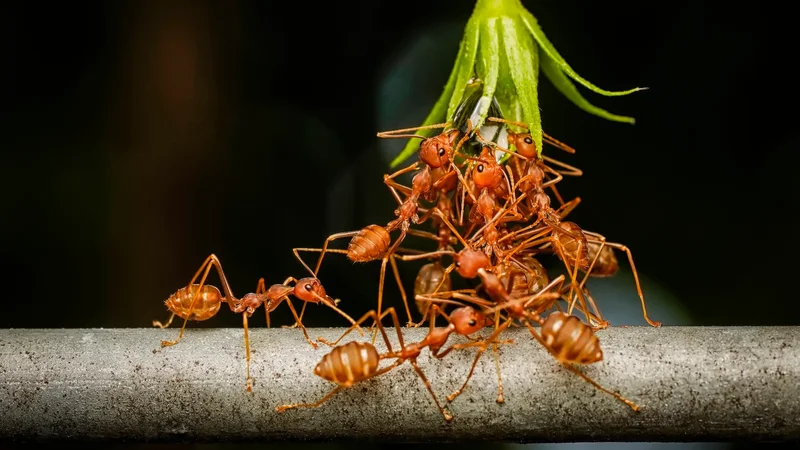
Collaborative projects can often succumb to the “too many cooks” problem. Task an excessive number of people with achieving a specific goal, and it may not take long until the situation turns chaotic. While recently observing ants working together to haul heavy, asymmetrical food into their colony, Weizmann Institute of Science behavioral ecologist Ofer Feinerman wondered if the same rule applies to ant colonies. His lab’s results, published in the Journal of the Royal Society Interface, suggest adding more ants into the mix may actually allow them to solve far more complex challenges than they achieve in smaller groups.
To find an answer, the team 3D-printed tiny props designed with precise shapes and weights. Storing the objects in cat food overnight made them appetizing to longhorn crazy ants (Paratrechina longicornis), which were placed inside laser-cut mazes of varying sizes and difficulties. In each case, the team made sure that the objects’ weight scaled consistently across the number of ants in each experiment. This allowed them to measure coordination and cooperation instead of simply making the tasks more physically draining. All researchers had to do was leave the bait-laden labyrinths near their ant nests, then film the results.
Nearly every group size successfully navigated the easier mazes, guiding smaller objects through more straightforward paths. This changed as maze routes became more difficult in tandem with heavier load weights. In those cases, larger ant numbers became far more efficient than teams with fewer members. This remained true even in situations requiring the ants to factor in gravity to their maneuvers.
Meanwhile, Feinerman’s team ran computer simulations to see if machine learning programs could handle the same challenges by factoring in physical theories and forces. The programs then produced potential explanations about why larger ant colonies solved harder situations more efficiently.
“The simulations showed that simple puzzles can be solved by simple gravity-based models,” Feinerman recently said in a statement. “If one were to take the maze, with the load inside, tilt it and shake the whole thing, the load would eventually fall out.”
This wasn’t the case for the more difficult mazes, though. In order for their machine learning programs to efficiently solve those scenarios, the team needed to introduce ‘ant-like’ properties that have to do with the ants’ distributed nature,” explained Feinerman. These aspects can include gravity not functioning as the center of mass or acting on different points on an object every few seconds.
Although their findings underscore how ant colonies likely scale their ingenuity and collective intelligence depending on their size, researchers cautioned against viewing it as a true “hive mind” of cognition. The same can be said for machine learning and artificial intelligence.
“They are just random and unknowing,” said Feinerman of his team’s programs, noting that the models still require outside tweaking from their designers depending on each maze. “The ants do not require such tuning and appear to use the same rules to solve all mazes without any outside information,” he added.