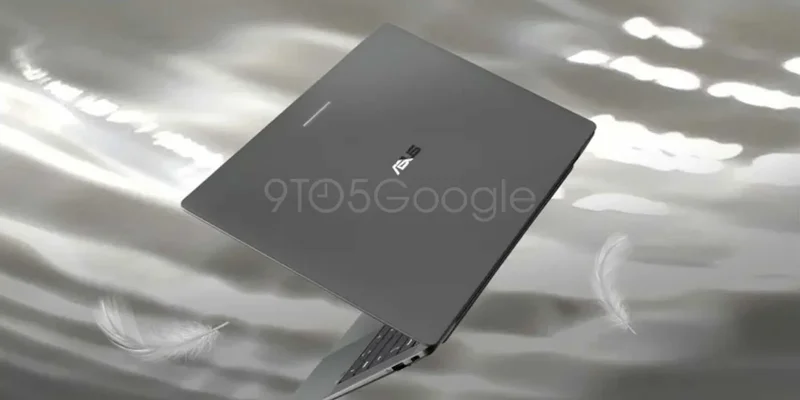
Another Googlebook has surfaced online just a day after images of a separate PC maker’s version made an appearance. This is the Asus Googlebook CX9406.
We know of the existence of Google’s Googlebook line, though there’s an air of mystery still enveloping it. Recent leaks have shown off versions from Lenovo, which appears to be planning on two models.
More images of the larger 15-inch model have since surfaced, but nothing from some of the other manufacturers Google has tasked with developing hardware for the new laptop line – until now, at least.
9to5Google has obtained images of a Googlebook from Asus, named the CX9406. The images appeared via the iF Design website – no longer appearing on the website – listing the Asus Googlebook not as the new series, but as a Chromebook. It’s clearly not a Chromebook.
The listing identifies “Aluminium OS” as the operating system at the helm, which immediately disqualifies it as a Chromebook. Google hasn’t officially given the underlying Googlebook OS a name, though early reports identify it as Aluminum OS. It’s possible the Gemini-powered laptop operating system will go by something different.
There’s more that identifies the laptop as a Googlebook in the latest leaked images. A “Glowbar” can be seen over the Asus logo. The LED strip is expected to work in a similar way to the Pixel 11’s HiLight indicator by lighting up for certain notifications.
The Google “G” can also be seen where the start menu button would sit on a Windows machine. That same launcher icon that appears over the caps lock key on Lenovo’s Googlebook shows up on this model, though there’s still little clue as to what it does. As for back row keys, it’s nearly impossible to identify each button. They’re likely very similar to what comes on Lenovo’s version.
Ports are hard to identify, too. The curved edges of the bottom half don’t help, either. It looks like one side has a USB-C port and an HDMI port, while the other has one USB-C and two USB-A ports. Asus’s Googlebook also has a 3.5mm audio jack.
The colorway is nice, too. While Lenovo’s versions are lighter, Asus’s model is more on the carbon or dark gray side. The Glowbar should contrast nicely.
The article gives a few details about the Googlebook’s hardware, like the “Ultra-Ceramic Light Alloy” used for the chassis. It goes on to mention that one of its components or the entire device is 34% lighter and 13% stronger. It’s unclear because the article seems to devolve into gibberish right before that statistic is outlined.
Here’s what the article says, word for word:
The ASUS Chromebook CX9406 is crafted for advanced digital professionals, merging Rational Hormony with the next-generation Google Aluminium OS to redefine lightness and intelligence. Using an innovative Ultra-Ceramic Light Alloy, it achieves an ultra-light body under one kilogram while the Super Liq-Crea Tech awe4erfgt/enhances durability-34% lighter and 13% stronger, balancing mobility and strength. With its slim profile, superb practicality, and comprehensive business support, it delivers a flagship-level user experience.
Beyond that, little else is identified with specs. There’s no mention of CPU or storage capacity. We’d suggest taking the listing’s text with a grain of salt. It looks unfinished and could be wrong in more ways than one. The images, though, seem to hold much more weight.
With Lenovo and now Asus, there’s no telling which laptop maker will show off their Googlebook next. Google has officially listed the latter two alongside Acer, Dell, and HP as manufacturing partners. What is clear, though, is that the first wave of Googlebooks is quickly nearing launch.
Thanks, Yitzy!