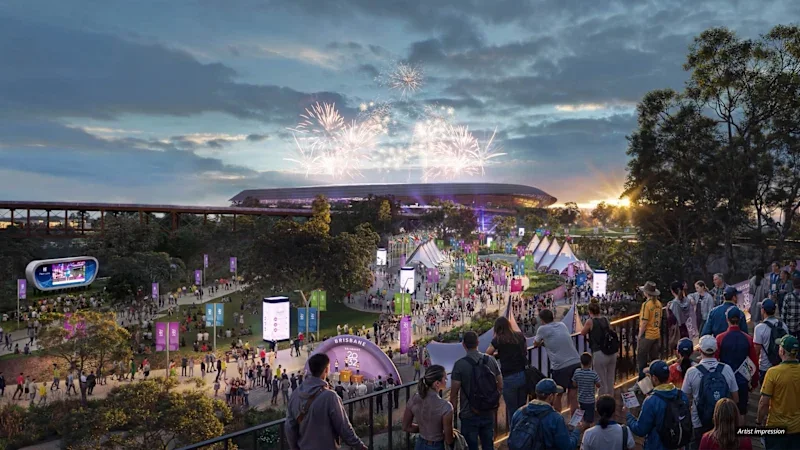
The Brisbane 2032 Olympic and Paralympic Games will not begin at the stadium gates – they will begin at the airport, at train stations, along city streets, and in sprawling fan zones spread across Queensland.
The industry term for all this is “overlay” and it could become one of the largest moving parts of Brisbane’s Olympic planning.
The term crops up regularly in planning documents and media briefings, usually without much explanation.
But Brisbane-based architect and Populous senior principal James Pearce says overlay will ultimately shape much of the experience for athletes, spectators and residents during the Brisbane Games.
“One of the ways to look at it, which some people enjoy and helps to set the context, is if you tipped the stadium upside down and shook it, overlay is everything that falls out,” Pearce said.
In practical terms, overlay is the temporary infrastructure added to existing venues and public spaces to turn them into Olympic-ready facilities.
It can include security screening zones, broadcast compounds, hospitality areas, merchandise outlets, transport facilities, live sites, temporary grandstands, and crowd-management infrastructure.
Imagine, for example, a row of television studios lined up at South Bank, giving Games anchors a stunning backdrop of Brisbane to broadcast back to their home countries.
Pearce, whose firm has worked on every summer and winter Olympic Games since Atlanta 1996, said overlay allowed cities to avoid building permanent facilities that would be oversized once the Olympic circus left town.
“The overlay is that nice way to be able to bring all that extra potential to host those major once-in-a-generation opportunities, while allowing the venue to continue operating afterwards in a more appropriate mode,” he said.
Sydney’s Olympic Stadium was an obvious example. The temporary seating installed for the 2000 Games enabled crowds of up to 115,000, before the stands were removed after the event.** **
For Brisbane 2032, the concept would extend far beyond venues.
Pearce said modern Olympics increasingly spilt into the fabric of a city itself, a trend accelerated in Paris, where landmarks became sporting backdrops for the 2024 Games and the broader urban environment became part of the spectacle.
“The city became the backdrop, it became the venue,” he said.
That could mean everything from airport welcome experiences and transport hubs to fan zones, live sites, and temporary event spaces across Brisbane and south-east Queensland.
While billions of dollars were being spent on permanent infrastructure, much of what visitors would actually experience in 2032 could be temporary, and a major driver would be security.
Olympic venues required airport-style screening zones, expanded secure perimeters, and carefully managed crowd flows. Pearce pointed to London 2012, where bridges around the Olympic Stadium were temporarily widened to cope with Games crowds and security requirements.
Pearce said good overlay should feel less like an inconvenience and more like part of the event itself.
“If there may be an extra level of security screening, or there might be an extra longer walk or process, you design that as part of the experience,” he said.
“So you feel like you’re at the event, and you celebrate that as much.”
Pearce said technology would play a growing role. Real-time travel information, crowd forecasting and queue management systems could help spectators’ navigation, while branding, entertainment and activation zones would create a festival atmosphere.
Pearce said Brisbane’s greatest opportunity was using overlay to showcase the city and the wider state. Unlike London or Paris, he said, Brisbane was still relatively unfamiliar to many international visitors, so the Games offered a rare chance to shape global perceptions.
“You put those images on television and it sticks with you,” he said.
“It’s finding those moments. What is it that we can celebrate? We’ve got amazing natural beauty. We’ve got amazing spaces and gathering spaces that we can celebrate.”
That could mean expanded live sites at locations such as the Riverstage and South Bank, riverside venues, and gathering spaces across the region. The goal, Pearce said, was not simply to move people through the city, but to create lasting memories.
While stadium design attracted headlines, overlay planning has been quietly under way for years and would continue well into the lead-up to the Games.
Some installations would only take weeks to erect. Others, including entirely temporary sporting venues, could require months of construction, and months more to remove.
And if Brisbane got it right, Pearce said it could be a blueprint for future Olympic host cities seeking to avoid a massive permanent building spree.
“I think what’s going to be wonderful is Brisbane can be the springboard for a lot of other cities to step in and go, ‘Hold on, if Brisbane can do this, and do a fantastic job of it, why wouldn’t we carry on and do that?’” he said.