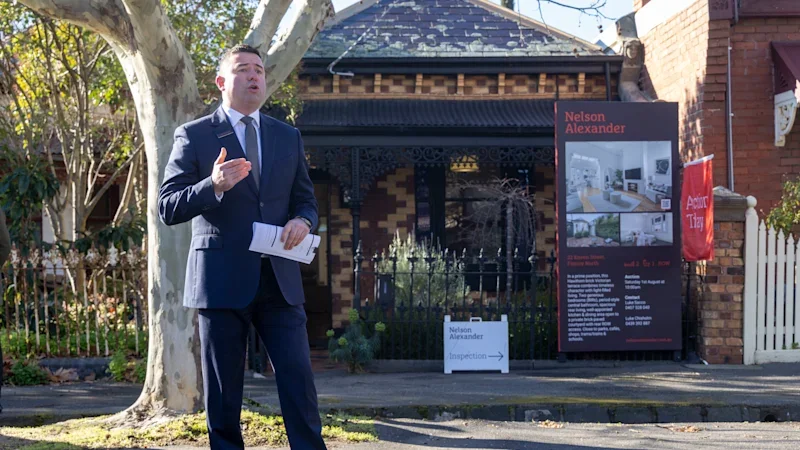
Potential home buyers are dropping out of auctions and not turning up to open for inspections, nervous about falling property prices and an uncertain economy.
The number of average active bidders per auction has plunged below two, leaving many listings with only one serious buyer or none at all, after the metric hovered around three for much of last year, Ray White figures show. This is lower than for most of the past four years.
The number of potential buyers at open homes has also fallen to about two on average, compared with three to four in previous stronger markets, as buyers hesitate to overpay or make decisions while interest rates stay high, prices drop and the tax treatment of investment properties changes.
But the data shows buyers have evaporated just as conditions have swung to a buyer’s market.
“The buyers have way better conditions, and they can buy at a discount and they can have their terms,” buyer’s advocate and Property Investment Professionals of Australia chair Cate Bakos said.
“They’re so scaredy-cat. They sit back and wait, and they moan when it turns into a seller’s market ... It’s such a herd mentality.”
Auction clearance rates have spent weeks largely below the 60 per cent level that is considered a balanced market between buyers and sellers. Some buyers are hesitant to buy now when they expect to be able to get a lower price later in the year, as economists forecast further property price falls.
On Tuesday, NAB downgraded its forecasts and now expects dwelling prices to decline 5 per cent across Australia’s capital cities this year, more than double its earlier forecast of 2 per cent.
“That includes peak-to-trough declines of around 10 per cent in Melbourne and Sydney,” the bank said in a note.
Ray White chief economist Nerida Conisbee said fewer people were looking to transact, which flows through to the numbers of people bidding at auction.
“People are still bidding; it hasn’t shut down completely,” she said. “It’s just reflecting the much slower market conditions and far less buyer activity.”
She said two bidders was the minimum for the market price of a property to be uncovered because if there was only one bidder, they were not bidding against anyone else. An auction became much more competitive with three or four parties, she said.
Buyers were also not turning up to open hopes as they felt “very uncertain”, she said.
“There’s a fear that prices will continue to fall,” she said. “We don’t typically see a lot of activity when prices fall. When prices start to recover, that’s when everyone piles in.
“They probably won’t jump back in until the market gets hot again … Everyone likes buying in an up market; they don’t like buying in a down market.”
On the ground, Bakos said that often she had been buying properties after auction that had passed in to her with no competition, or she might be competing against one other party.
Some potential buyers were turning up to auctions with a “wait-and-see-what-happens approach”, she said.
“If you’re serious about buying, waiting and seeing is not going to help you get a home,” she said.
“It’s sentiment. People are thinking they will wait for the bell to ring, they’ll wait for the market to bottom out.”
She thought some buyers were waiting until interest rates came down, perhaps next year, while others needed to sell first before they could buy and didn’t want to sell in a down market, and others were less active in the winter.
At quiet auctions, she said, “social proof” could be a factor. Attendees may think there is something wrong with a property if nobody else bids, even when nothing is wrong with it – especially for entry-level properties because first time buyers can be nervous.
“It’s really hard in a climate like this to rely on social proof,” Bakos said. “Sometimes a buyer will not have competition, which they should see as a good thing because it means they will pay less.”
PRD chief economist Dr Diaswati Mardiasmo said potential home buyers were cautious about how much they were spending and how much value they were getting, as well as making cautious decisions about their financing, prompting some buyers to wait.
She thought that the unconditional nature of an auction, which has no cooling-off period, could also make some buyers nervous amid an uncertain environment.
“When people see that there isn’t anyone bidding, it just confirms the market is a little bit slow,” she said.
“[They think] ‘That means we have time, that means we can relax a bit, that means we can not get it at a high market rate.’”