In Manicoré, when a pregnant woman goes into labor in a riverside community or an elderly person needs urgent medical care, no one waits for the wail of an ambulance siren. In this municipality in the Brazilian state of Amazonas — located 2,400 kilometers (1,490 miles) northwest of Rio de Janeiro — rivers are the roads. For that reason, many communities are accessible only by water and medical care usually arrives from the river.
Moving slowly along the Madeira River, the floating primary care unit, Nossa Senhora das Dores, carries doctors, nurses, dentists, vaccines, medicines, and laboratory equipment. It is a floating health center that embodies one of the biggest challenges facing Brazil’s public health system: guaranteeing the right to health where geography seems to make it impossible.
The unit was designed to serve about 230 riverside communities and nearly 28,000 inhabitants spread along the Madeira and Manicoré rivers. On board there are medical and dental consultation rooms, a pharmacy, a laboratory, a vaccination room, and spaces where the health team lives for several days while navigating the vast municipality.
Each expedition brings the public health system to populations that would otherwise have to travel for hours, or even days, to see a doctor.
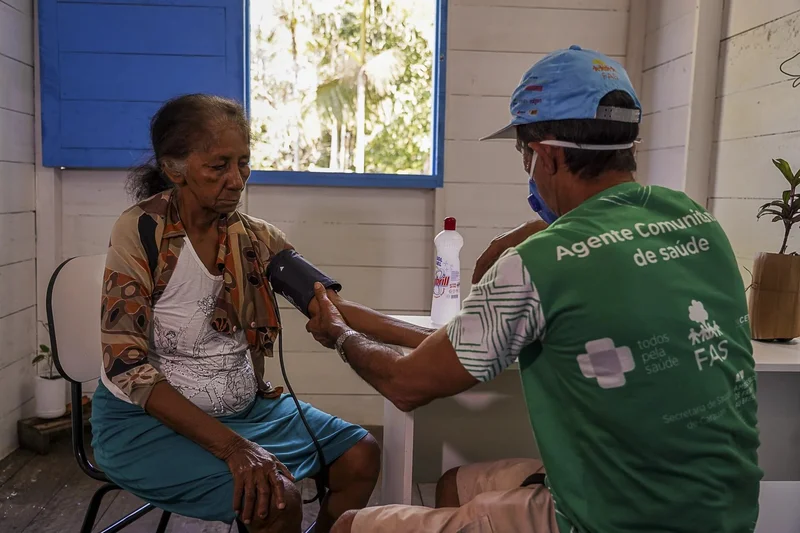
But the boat is only the visible part of a broader strategy. In Manicoré and in dozens of municipalities across the state of Amazonas, healthcare is built by adapting to the territory. Community health workers visit isolated communities to identify pregnancies, monitor patients with chronic illnesses, promote vaccination campaigns and detect malaria or tuberculosis early.
They know families by name and understand that, in a region where the river sets the rhythm of daily life, prevention is as important as medical treatment.
Years ago, the unit’s first expeditions revealed that many residents had never been examined by a doctor. Some had lived for years with high blood pressure or diabetes without a diagnosis. For many mothers, the arrival of the boat also means the opportunity to complete their children’s vaccination schedules without leaving the community.
The Manicoré experience illustrates a much larger challenge. The state of Amazonas, Brazil’s largest, covers more than 1.5 million square kilometers — an area similar in size to France, Spain, Germany and Italy combined. Its 62 municipalities have different realities but share one characteristic: in much of the state, rivers are the main means of communication. Bringing healthcare to those territories requires more than building hospitals. It forces a reinvention of service organization, adapted logistics, and solutions tailored to each community’s particularities.
That capacity for innovation appears in multiple initiatives developed by Amazon municipalities, such as strategies to expand coverage of human papillomavirus (HPV) vaccination or to incorporate digital tools.
These initiatives were born locally, driven by health professionals who know first-hand the challenges of working in riverside communities, rural areas, extractive reserves, and Indigenous territories.
Far from being improvised fixes, these experiences reflect a public health approach based on continuous adaptation. The territory is not an obstacle to be overcome but the starting point for designing policies able to respond to diverse realities. Thus, innovation arises not only from new technologies but also from new ways of organizing work, bringing services closer, and building trust with communities.
All these experiences were recently compiled in the book Amazonas, Aqui tem SUS (Amazonas, here is your SUS), referring to the country’s Unified Health System (SUS). This publication was produced by researchers from the century-old Oswaldo Cruz Foundation (Fiocruz, the largest health science and technology institution in Latin America), the Council of Municipal Health Secretariats of the state of Amazonas, and municipal health managers.
More than a study on public policy, the publication gathers dozens of first-hand accounts written by the people who carry out these initiatives daily: doctors, nurses, community health workers and officials who turn everyday problems into concrete solutions. In that sense, it serves as a collective record of health innovation in the state of Amazonas. You can read it here in Portuguese.
At a time when debates about public health systems tend to focus on budgets, infrastructure, or technology, the Amazon experience invites us to look at another indicator: the capacity to be present — with vaccines, with medicines and with prenatal care. And with a team of professionals willing to sail for days to guarantee a basic right.
The image of a floating health unit moving through the waters of the Madeira toward an isolated community captures better than any statistic the meaning of SUS: a public policy that, despite enormous challenges, seeks to ensure that geographic distance does not become a sentence for those who live in the world’s largest tropical forest.
Faced with the geographic and social challenges the Amazon imposes — where poverty, isolation and structural difficulties condition access to basic rights — SUS appears as a sustained state presence, with all its limitations, through nurses, doctors and community health workers who travel for days to care for a dispersed population often living in precarious conditions.
That presence is neither homogeneous nor perfect. The context in which it is realized reveals tensions and shortages. But there is a network of care operating, sustained by public policies and by the commitment of those who implement them.
In that sense, SUS also emerges as an instrument of territorial integration. In regions where other state services arrive intermittently, health becomes one of the main links between the state and the population.
Margareth Cristina De Almeida Gomes holds a bachelor's degree in Nursing, a master's degree, and a Ph.D. in Public Health.
Sign up for our weekly newsletter to get more English-language news coverage from EL PAÍS USA Edition