“Get the camera out of here or else I’m going to cut his throat.”
It was a summer morning in 1985 when a distraught father leaned out of a third-floor apartment window in Vancouver, holding a knife in one hand and dangling his two-year-old son upside down by the ankles with the other. Spooked, he yelled to the police about a news photographer encroaching on the street below.
The lensman was Ralph Bower, with The Vancouver Sun. When the cops advanced to move him back, the photojournalist retreated. He heard someone shout his name: A Global TV cameraman in a news van was trying to get his attention.
“He flipped the door open and I jumped in,” Mr. Bower recalled during a 2020 photojournalism event at West Vancouver Memorial Library. As the urban drama continued above, he snapped pictures from the van with his new long lens. The police eventually rescued the toddler and arrested the father, who was involved in custody battle.
“It was a sad story,” Mr. Bower said, “but a good ending.”
The Sun’s competitor in the city, The Province, also had a photographer on the scene. It was Mr. Bower’s photo, however, that earned a National Newspaper Award.
“Both photographers got the shot at the same time, but Ralph had the right angle,” said John Denniston, a former photo editor with The Province. “He was one of those guys who was in the right place at the right time, consistently.”
Mr. Bower, for more than 40 years an affable and enthusiastic photojournalist who modestly described himself as an “old button-pusher,” died on July 21 at Lions Gate Hospital in North Vancouver, the municipality in which he was born, raised and stayed. He was 92 and had suffered from dementia.
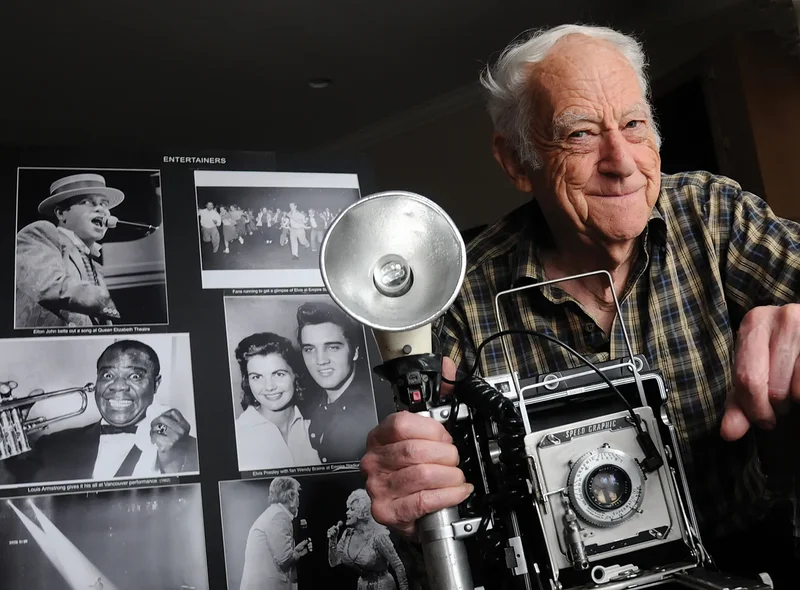
When he began shooting for The Vancouver Sun in the mid-1950s, he used a Graflex Speed Graphic, the iconic large-format press camera. In 1996, The Sun purchased six digital cameras at $20,000 apiece − an end of one era and the beginning of another. Mr. Bower retired one year later.
Collegial and quick to chuckle, he was a true character (back when newsrooms still had them). The photographer had an easygoing manner that put his subjects at ease and earned him access to the world’s most famous people.
In 1957, an attractive young woman told a disbelieving Mr. Bower she could get them both backstage into Elvis Presley’s dressing room before his concert at Empire Stadium. She claimed to have met the King’s bodyguard, and that he would allow her to be photographed with the singer. Sure enough, Mr. Bower and the woman – beauty pageant winner Wendy Braine – were allowed in the dressing room.
“I went in with my Speed Graphic,” the photographer said six years ago. “Elvis walked up to me and he said, ‘Glad to meet you, sir.’ I said, ‘Don’t call me sir. I’m only a year older than you.’”
The remark broke the ice; the woman was photographed with her Love Me Tender idol.
In 1972, Muhammad Ali arrived at Vancouver International Airport for a fight with Canadian heavyweight champion George Chuvalo at Pacific Coliseum. Mr. Bower told Mr. Ali that his editor was holding a page open for a photo of the superstar boxer and asked if he could help him out. Without a word, Mr. Ali pulled a fire axe from a wall. He said he was going to cut trees in a city park to get in shape for the fight. Mr. Bower snapped away.
“I didn’t make that picture, he did,” the photographer would later say of Mr. Ali.
Mr. Bower loved shooting sports. He is believed to have invented the first “net cam” used in a National Hockey League game, on Dec. 12, 1971. Sitting behind the Vancouver Canucks goal during a game against the Boston Bruins, he manipulated the small camera with a doorbell device attached to a wire under the ice. A photograph of Vancouver goalie Dunc Wilson sprawled on the ice with his mask caked with snow appeared in the next day’s newspaper.
During his career and into retirement, he was a regular at Hastings Racecourse. His love of the thoroughbreds and the horse track community earned him the nickname “Railbird.”
“He was not a big better,” said Doug Bower, his son. “He really liked the atmosphere and adrenaline of it, and capturing it photographically too.”
In the 1970s and 80s, Mr. Bower was among a crack staff of Vancouver Sun photographers that included Glenn Baglo, George Diack, Deni Eagland, Brian Kent, Ken Oakes and others. Photo editor Earl Smith had considerable editorial control and believed in pictures first, stories second.
In her 2016 book Vancouver in the Seventies: Photos from a Decade that Changed the City, former Sun librarian Kate Bird wrote that the newspaper’s photographers “captured the changing city through more than 4,500 assignments each year, covering news, politics, business and industry, sports, food and fashion, and a host of local events, all on deadline.”
Over the decades, Mr. Bower documented Vancouver: Frank Sinatra performing at the PNE Forum in 1957; the collapse of the Second Narrows Bridge in 1958; North Vancouver sprinter Harry Jerome equalling the world record of 9.2 seconds in the 100-yard dash at Empire Stadium in 1962; B.C. Premier W.A.C. Bennett checking out actress Mamie Van Doren at a movie premiere in 1963; members of the Kitsilano neighbourhood rallying to demand a traffic light at the site of a fatal pedestrian accident in 1973; crying baby brothers with a Santa Claus at the Vancouver Association of Twins and Triplets Christmas party in 1975; the aftermath of a deadly riot at British Columbia Penitentiary in 1976; the victory parade for the Vancouver Whitecaps soccer team in 1979.
“The body of work he captured is phenomenal,” said Mike Wakefield, a former photojournalist with The North Shore News.
A photo of a shirtless Canuck hunk Pavel Bure having his body fat measured during training camp in 1994 was so popular the newspaper printed extra copies to meet the demand. Mr. Bower said when he gave Mr. Bure a print, the Russian all-star remarked, “Oh, I didn’t know you were working for Playboy now.”
Canuck general manager Pat Quinn was upset with Mr. Bower for taking the topless photo but did not stay mad for long. The photographer was likeable.
“Ralph left his mark not only on the industry,” Mr. Wakefield said, “but anybody who crossed his path.”
Ralph Henry Bower was born on June 16, 1934, in North Vancouver. His father was ferry operator Herbert Bower; homemaker Gertrude Brower was his mother. He was one of five children.
He graduated from North Vancouver High School, where he met his wife, the former Joan Clark. They would have celebrated their 70th wedding anniversary on Aug. 4.
Mr. Bower started his career as a copy messenger in The Sun newsroom in 1955 but was soon promoted: first to the darkroom, then as a photographer.
One of his specialties was his work with animals. He claimed to have kept a prop varmint in the trunk of his car that he used for annual Groundhog Day photos. Other furry and feathery highlights included shots of a goose attacking a police horse in Stanley Park and a water-skiing squirrel.
Mr. Bower has a passion for automobiles. He had a 1931 Ford Model A and, for a time, drove a green Ford Thunderbird on assignment. Former Sun reporter Wyng Chow said the photographer was a lead-footed driver who had a small black-and-white television on the floor of the passenger side, hooked up to the cigarette lighter.
“In the late 1970s, we were driving back to the city from the Fraser Valley, where we were covering the first goat dairy farm,” Mr. Chow recalled. “He turned on the TV, and he was speeding of course. Suddenly broadcaster Danny Gallivan said, ‘He shoots, he scores!’ Ralph is craning his neck to see the replay and he’s not watching the road. He could have gotten us killed.”
His last assignment, in 1997, was a Canucks game.
“He never lost his sense of enthusiasm for the job,” Mr. Denniston said. “He was childlike when he got the picture, he was so happy. If he could have, Ralph would have stayed at The Sun forever.”
He leaves his wife, Joan Bower; son, Doug Bower; daughter, Kelly; five grandchildren and three great-grandchildren.
You can find more obituaries from The Globe and Mail here.
To submit a memory about someone we have recently profiled on the Obituaries page, e-mail us at obit@globeandmail.com.