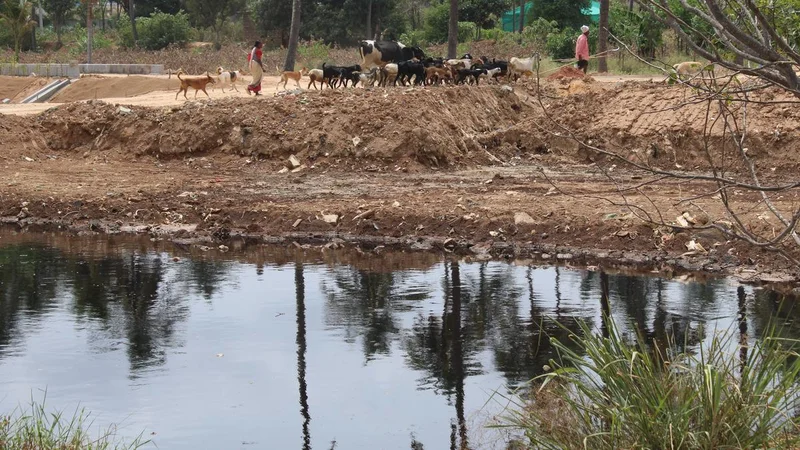
Leachate from Mittaganahalli landfill entering Srinivasapura Lake, Sathanur, in the northeastern outskirts of Bengaluru.
\| Photo Credit: Chetan B.C.
Mittaganahalli landfill is once again at the centre of a controversy over the discharge of leachate into Srinivasapura Lake, located approximately 800 metres away from the landfill.
Srinivasapura Lake, also called Baiyappanahalli Lake, is located on the northeastern outskirts of the city and spans 23.36 acres, of which about 13.2 acres is open water. The waterbody had eroded bunds, rampant growth of invasive species, and poor water quality. In June 2024, a non-governmental organisation took up rehabilitation and conservation works using CSR funds, which are currently ongoing.
However, the restoration has now encountered a new challenge, as leachate from the landfill has been flowing into the water body through an inlet for the past week. This is not the first time leachate has entered the water body, as the problem had occurred in 2025 and it was fixed.
Originating from higher elevations
The lake has two inlets. When The Hindu visited the waterbody, it was observed that leachate was flowing through the southern inlet, where a septic tank is currently under construction. When the flow of leachate was traced, its origin was found to be near the Mittaganahalli landfill, about 800 metres away.
The landfill is located at a higher elevation than the lake, and the leachate flows through a natural waterway before entering drain lines created for a nearby private layout. It then joins a natural drain, ultimately ending at the lake inlet.
The continuous flow over the past week has also disrupted the rehabilitation works, with a portion of the lake filled with leachate, which has now entered the open water area.
Kaatappa, a resident of Srinivasapura, said the waterbody has become highly contaminated, leading to the deaths of cows, two sheep, and a dog in the past. “We are no longer allowing our cattle to drink water from the lake and are instead relying on smaller tanks near our houses,” he said.
Nagaraju, whose agricultural land lies about 200 metres from the landfill, said that even borewell water has become contaminated. He added that his recent attempt to dig a borewell also proved futile, as the contamination had spread widely.
Quarry to landfill
The Mittaganahalli landfill began operations over six years ago and is one of the three quarries that were converted into landfills for Bengaluru’s daily waste. It is managed by Bengaluru Solid Waste Management Limited (BSWML). However, the site has witnessed multiple problems, including leachate, methane emissions, and frequent fires. Although the other issues are now largely under control, the leachate problem has persisted and is now affecting the lake.
Karee Gowda, Chief Executive Officer (CEO) of BSWML, told The Hindu that the landfill has accumulated about 287 crore litres of leachate that needs to be treated.
“Work is underway to build a treatment plant at an estimated cost of ₹475 crore. It will be operational within two months. But an immediate solution to the problem is unlikely,” he said. The treatment plant will have the capacity to treat about 20 lakh litres of leachate per day,” he added.
Rich ecosystem
According to a report, the lake ecosystem supports 145 plant species, 35 species of butterflies, and 35 macro-invertebrate families. In addition, 116 bird species, including kingfishers, drongos, and bee-eaters, have been recorded around the lake.
Published - July 22, 2026 06:17 pm IST