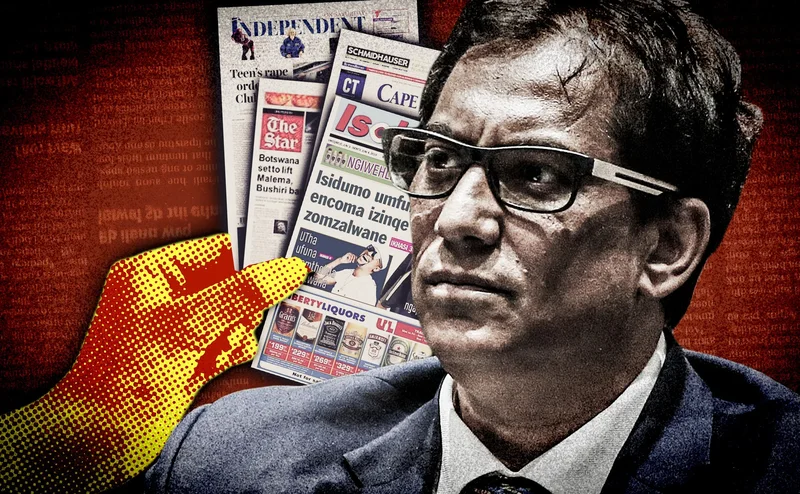
National Media Group (NMG) __described itself __in its launch statement last week as a âdynamic new forceâ in South African media.
It said the company had âapplied for and receivedâ licences from Sagarmatha Technologies to publish the former Independent Media titles Cape Times, Cape Argus, The Star, Pretoria News, Daily News, The Mercury, Isolezwe, Sunday Tribune, Business Report and seven others.
This was âan exciting new chapter in South African mediaâ, NMG proclaimed â and it was treated as such.
News24 quoted Reggy Moalusi, the executive director of the SA National Editorsâ Forum (Sanef), as responding to the development by saying that Sanef welcomed âany addition of more voices and diversity in the media sectorâ.
Speaking anonymously to Daily Maverick, Independent Media journalists said executives repeatedly insisted the company and NMG are entirely separate entities. That claim raises eyebrows, however, given that NMGâs new CEO is former Independent Media managing editor Melanie Peters, and every Independent Media journalist has reportedly been transferred to NMG.
Yet, despite all the talk of NMG as a fresh new media player distinct from Independent Media, Daily Maverickâs digging into corporate records told a different story.
NMG did not respond to Daily Maverickâs questions, while the Iqbal Survé-controlled Sekunjalo Group directed us __to a statement __it issued on Tuesday without answering direct questions.
**A not-so-new company **
Company records show that although NMG was unveiled to the public on 31 July 2026, it was first registered in August 2019 under the generic name K2019436141 (South Africa).
It became National Media Group only on 14 April 2026, 19 days after the Supreme Court of Appeal ruled against Independent Media Consortium in its R485-million debt battle with Sactwu (Southern African Clothing and Textile Workersâ Union) Investments, stemming from a loan the union gave to Independent in 2013.
Until July 2026, NMGâs sole listed director was Lizaan Nel, who is also the company secretary of Sagarmatha Technologies, Independent Media and Independent Newspapers.
The overlap became particularly stark in April.
Three days after the company was renamed NMG, records show that Nel joined the board of Independent Media Consortium, the company fighting Sactwuâs claim.
For the next 10 days, she served simultaneously as a director of the supposedly new publisher and the old debtor company. She then left the consortium board but remained NMGâs sole listed director until July.
Nelâs records in this regard indicate a direct governance bridge between the two structures during the period in which NMG was being prepared for its new role.
NMGâs registered business address is on the second floor of Silo 5 at the V&A Waterfront, the address Sekunjalo publicly identifies as the Survé Family Office.
NMGâs exact ownership structure remains undisclosed.
But in its Tuesday statement, Sekunjalo stated that it had a financial stake in NMG.
The group said it would continue investing in media âwith other investors, like we have done with National Media Group, IOL and other media interestsâ.
Sekunjalo did not disclose what form its NMG investment took, how much it invested or who the other investors are.
In late May, however, IOL trumpeted the fact that it had secured a R200-million investment from âshareholdersâ, which would establish it as âone of South Africaâs largest and most influential digital publishersâ.
It would recruit âat least 200â additional editorial staff to its ranks, it said â and the good news kept coming.
In June, Sekunjalo CEO__ Lucien Jacobs announced__ that IOL had secured further âsubstantial funding from European and American partnersâ, subsequently specified by IOL CEO Viasen Soobramoney as totalling an additional R220-million.
IOL also claimed that within a week, it had received 3,000 applications for âIOLâs recent recruitment driveâ.
âThe same old peopleâ
Independent staffers have been left with their heads spinning. At the end of May, they say they were informed about the R200-million shareholder investment and told it would be used to create 200 new media jobs and a new flagship newspaper title, The National.
Many staffers were excited, particularly about the possible injection of much-needed new editorial faces.
The first they heard about NMG was when they, together with the general public, read its launch statement on 31 July, they say. That was also when they learnt that The National would also be an NMG product.
That same day, Independent journalists were locked out of their Independent email inboxes and given new email addresses ending with â@__national.co.za__â.
Independent Media staff, according to insiders, were simply assigned new roles at NMG.
âWeâre still sitting with the same old people and the same editors. Everyone has just been assigned, reshuffled. Theyâve just crossed the floor,â one told Daily Maverick.
Despite the enthusiastic invitation to external media practitioners and the resulting 3,000 applications, staff say only a handful of external applicants have been hired.
Staffers also report that they have still not been told who the European and US investors are and have yet to receive new contracts â leading to a work environment described as stressful and confusing.
Journalists, meanwhile, have been complaining about the difficulties they face from the sudden loss of access not only to their Independent email inboxes, including source contacts and membership of vital mailing lists, but also to their Google documents.
Where is Iqbal Survé?
The figure most closely associated with Sekunjaloâs media empire, Iqbal Survé, announced in April 2026 that he was stepping down as chairman of the Sekunjalo Group.
Jacobs is now the Sekunjalo Group CEO, while the company says a âyounger and new generation of leadershipâ has taken charge of investment decisions.
Survé has resigned from the boards of Independent Media, the principal Independent Media Consortium company and Sagarmatha Technologies.
But he has not disappeared from the structure.
CIPC records list him as an active director of Sekunjalo Investment Group, Independent On-Line, Independent Online SA and two related Independent Media Consortium companies.
The records also complicate the impression of a clean break with the old order, revealing that Survé remains embedded in the wider corporate machinery.
What happens to the debt?
The relationship between Sekunjalo, IOL, Independent Media and NMG matters because the old structure carries substantial debts.
The Sactwu case arose from a R150-million loan advanced to Sekunjalo Independent Media in 2013. In March, the Supreme Court of Appeal ruled that the company could not rely on a purported subordination agreement to avoid repayment and ordered it to pay R458.6-million plus interest.
On 3 August, the Constitutional Court refused Independent Media Consortium and Sekunjalo Investment Holdings leave to appeal and ordered the applicants to pay costs jointly and severally.
On Tuesday, Sactwu Investments moved to turn Sekunjaloâs own defence into grounds for liquidation.
It filed an urgent high court application to have Independent Media Consortium (IMC) â formerly Sekunjalo Independent Media â provisionally wound up, alleging that the company is commercially insolvent, has no cash to pay the R300-million judgment debt and owns little beyond its 55% stake in Independent Media.
The application cites Sekunjalo CEO Jacobsâ own descriptions of IMC as a vehicle that âeffectively has no assetsâ and has âno realistic prospects of satisfying the claimâ. The matter is due to be heard on 19 August.
Sekunjalo said earlier on Tuesday that it was itself considering liquidating IMC and its subsidiaries. Hours later, Sactwu filed its own application to have IMC liquidated.
The Public Investment Corporation (PIC), meanwhile, is also on the hunt.
The PIC remains a 25% shareholder in Independent Media and is pursuing separate claims reported at approximately R392.6-million against Independent Media and more than R709-million against Sekunjalo Independent Media.
The obvious question that arises is whether the newspaper business has effectively been given a fresh corporate home, while the debts, litigation and outside shareholders remain behind in the old one. DM