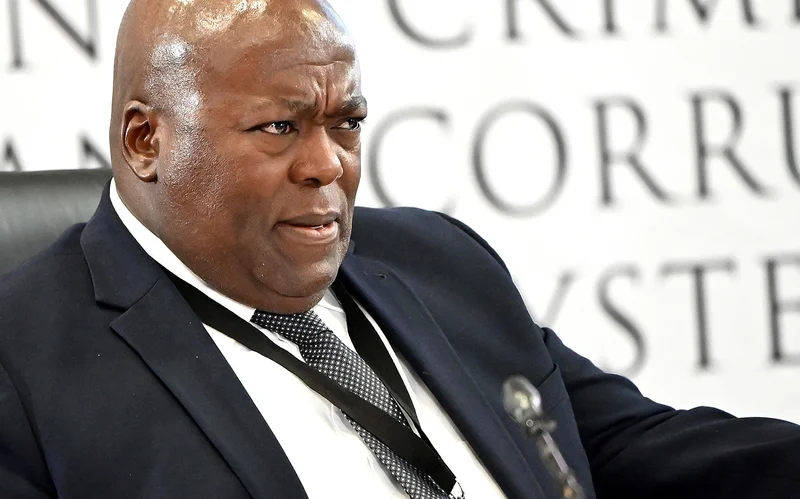
Senior Investigating Directorate Against Corruption (Idac) prosecutor advocate Peter Serunye, a Deputy Director of Public Prosecutions (DDPP), told the Madlanga Commission that the arrest of then Crime Intelligence head Lieutenant General Dumisani Khumalo and six others was premature, arguing that they were brought before court before the investigation had been completed and before critical evidence had been gathered.
Testifying on Tuesday, Serunyeâs evidence focused on the prosecution of Khumalo and his six co-accused in relation to the appointment of Brigadier Dineo Mokwele.
His testimony laid bare what he described as a series of fundamental flaws in Idacâs investigation, from incomplete investigations and legally defective charges to unanswered questions about evidence, jurisdiction and the handling of the prosecution.
Serunye revealed that the State entrusted the Crime Intelligence officersâ bail hearing to a junior prosecutor.
According to Serunye, there was no senior prosecutor, DPP or chief investigator overseeing the first appearance, prompting him to intervene after becoming concerned about the handling of a case of such magnitude.
Collectively, his evidence suggests the case may have been rushed to court before investigators had established the elements of corruption, raising fresh questions about how and why the prosecution had been initiated.
Khumalo and his colleagues appeared in court in June 2025, facing fraud and corruption charges linked to Mokweleâs appointment as the head of Crime Intelligenceâs Technical Support Services unit. Investigators alleged she lacked the required qualifications and that her appointment formed part of a scheme to âcaptureâ the division.
However, the Madlanga Commission has heard evidence that Mokwele was qualified for the post and that the investigation underpinning the arrests was riddled with procedural, legal and evidential shortcomings.
The National Prosecuting Authority (NPA) has since withdrawn all fraud and corruption charges against Khumalo and his co-accused, effectively conceding that the prosecution could not proceed.
The arrests assumed wider significance because they are widely believed to have been the catalyst for KwaZulu-Natal Police Commissioner Lieutenant General Nhlanhla Mkhwanaziâs explosive July 2025 media briefing, in which he alleged that criminal syndicates had infiltrated law enforcement, the criminal justice system and politics.
Idac repeatedly defended its case against the Crime Intelligence leaders, but last month, former Idac head Andrea Johnson made stunning admissions about flaws in the case, leading her to vacate her post with immediate effect.
Johnson was grilled over how she dealt with complaints from politician Fadiel Adams that ultimately sparked the arrests, and suggestions were made that she took âintrusive stepsâ with no proper basis.
Courtroom chaos on arrest day
On Tuesday, Serunye recounted how he first learnt of the arrests of Lieutenant General Khumalo and six others in June 2025, not through official channels, but by overhearing colleagues discussing the matter as he arrived at the office.
Having had no prior involvement in the case, he asked who was handling the prosecution and was told it was advocate Joy Hlatshwayo, a junior state advocate who reported to him. She was assisted only by investigating officer Brian Padayachee, with no senior prosecutors on the case.
That immediately raised alarm bells for Serunye. Concerned that the matter had not been properly staffed, he and fellow DDPP advocate Sibusiso Tshikovhi received permission from Johnson to attend court and assist.
What unfolded in the Pretoria Magistratesâ Court, Serunye testified, exposed how poorly prepared the prosecution was.
Before proceedings could even begin, the J15 administrative form, to which the charge sheet was attached, had not been completed. Advocate Jacyntha Witbooi obtained the forms, while Serunye took the docket, completed the outstanding administrative details and read the names of the accused into the court record.
Although Hlatshwayo informed the court that the State would not oppose bail, she struggled to answer several questions from the magistrate, repeatedly consulting Serunye and investigating officer Brian Padayachee.
The difficulties escalated when she requested a bail condition prohibiting the accused from contacting State witnesses. The magistrate asked for a list of those witnesses so they could be identified and warned, but appeared dissatisfied when none could be produced. He then invited Serunye to address the court directly.
Before doing so, Serunye asked Padayachee whether an investigating officerâs bail affidavit or statement had been prepared to support the Stateâs position.
It had not. One of the most significant moments for Serunye came when the magistrate remarked that he was not persuaded that the State had a strong case, a consideration that influenced his decision to grant bail.
The magistrate also observed that the matter did not resemble a conventional fraud or corruption prosecution, an assessment Serunye said foreshadowed the concerns he would later raise after reviewing the docket in detail.
Arrests came before the evidence
Serunye told the Madlanga Commission that while Mokweleâs appointment may have appeared suspicious, suspicion alone could not justify corruption charges or arrests.
He said investigators had proceeded on allegations rather than evidence and that the work needed to establish corruption should have been completed before, not after, the June 2025 arrests.
According to Serunye, the corruption case âdid not make senseâ. The State had failed to explain what benefit Mokwele, then a private-sector employee, could have offered the senior SAPS generals in return for her appointment.
âIt was not apparent what she could offer the generals in return, nor what unlawful act she was to perform. To contend that she would at some future time act corruptly to their benefit would be speculation,â he said.
He also rejected investigatorsâ later explanations, including allegations involving Mokweleâs father and claims that her appointment formed part of an attempt to âcaptureâ Crime Intelligence, saying none of those allegations appeared in the docket.
Serunye concluded that the corruption charges were legally defective under the Prevention and Combating of Corrupt Activities Act, adding that investigators should first have established a corrupt motive through bank records, cellphone data and other corroborating evidence.
Denied access to complaint by Adams
The Section 27 referral submitted by MP Fadiel Adams, alleging irregularities in Mokweleâs appointment to SAPS Crime Intelligence, was the complaint that triggered Idacâs investigation.
Yet Serunye told the Madlanga Commission that after taking over the prosecution on 8 August 2025, he repeatedly requested the document, but was never given a copy.
Serunye said the referral was the foundation of the case, making it essential to his assessment. At a meeting on 1 September 2025, former Idac head Johnson questioned why he would not simply accept the investigatorsâ assurance that the referral existed, and urged him to proceed with the prosecution.
Days later, chief investigator Dylan Perumal briefly showed Serunye what he said was the Section 27 referral, but did not allow him to inspect it. Even from that limited glimpse, Serunye said he noticed what appeared to be an irregularity in the commissioning of the document.
The incident reinforced his view that the prosecution had been launched before the investigation was complete. He maintained that key steps â including verifying Mokweleâs qualifications, analysing financial and cellphone records, and assessing the recruitment process â should have been completed before, not after, the arrests.
On Wednesday, Idac prosecutor advocate Drushantha Ramsamy is expected to continue her testimony. DM