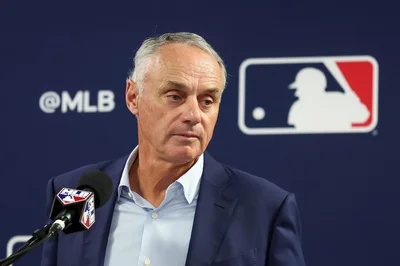
Rob Manfred and the owners are pushing for a salary cap in Major League Baseball for the first time since 1994. (Photo by Mike Carlson/MLB Photos via Getty Images)
MLB Photos via Getty Images
Major League Baseball is pushing for a salary cap for the first time since the 1994-95 strike. The league’s proposal and its reasoning are in deep contrast to how the MLB Players Association sees the landscape. Fundamentally, the sides are so far apart that what constitutes economic disparity and competitive balance is seen through an entirely different lens. As the sides dig in heading into the final months before a potential lockout, here’s the data and the viewpoints from both sides.
The Battle Over Economic Imbalance
MLB’s Luxury Tax system, or as it is officially called the Competitive Balance Tax (CBT) started in 1997, and the sides have muscled back and forth on its effects since then. Initially put in place during Bud Selig’s tenure, the argument then, as it is now, was free-spending high-revenue clubs have an economic advantage when it comes to free agent signings and long-term extensions. In the nearly 20 years since being in place, numerous adjustments around the tax penalties for those that exceed the Luxury Tax threshold, how that plays out when clubs break it in consecutive years, and surcharges that kick in when clubs exceed far beyond the threshold have been put in place.
The league now says that that system is broken, not just during the life of the current five-year labor deal, but over multiple collective bargaining agreements. Under the system player payroll disparity has increased between the top and the bottom clubs. The league claims that the distance between the top and bottom spending clubs is now 7x. But, even using last year’s Luxury Tax payrolls, the distance is closer to 5x (Dodgers $417,341,608 compared to Marlins $86,926,975 comes to 4.8x), which was up from 2024 (4.2x) and down from 2023 (5.1x). Regardless of the adjustment, the distance is considerable. Under the league’s hard cap proposal, they claim the distance moves to just 1.4x from bottom to top.
The MLBPA has been quick to note that there is key context missing from the gap and what would comprise what is considered within the league’s proposed cap system.
To start, clubs at the bottom are highly subsidized.
Hundreds of millions of dollars are collected in Luxury Tax penalties each year.
Last year saw a record $402,637,907 collected from a record-tying nine clubs (Yankees, Red Sox, Dodgers, Padres, Mets, Phillies, Blue Jays, Rangers, Astros). However, not all of those proceeds go to small market clubs.
Based upon the current CBA, the first $3.5 million of proceeds collected for each year is used to defray the clubs’ funding obligations arising from the Major League Baseball Players Benefit Plan Agreements. That brings the total $399,137,907.
From there, 50% with interest goes to “fund contributions to the Players’ individual retirement accounts, as provided in the Major League Baseball Players Benefit Plan Agreements.” The other 50% with interest goes into what the league calls the “Supplemental Commissioner’s Discretionary Fund” which Rob Manfred, in consultation with the MLBPA, uses as revenue sharing. For 2025, that total was nearly $200 million ($199,568,953).
Since 2003, a total of $1,617,318,148 in Luxury Tax penalties have been collected, and with it, an incredible sum in revenue sharing has been provided to the small market clubs to incentivize them to spend on player payroll.
So, yes, there is payroll disparity, but from the union’s perspective, the gap should not be nearly what it is. The refrain from MLBPA interim Executive Director Bruce Meyer, and the players is that many of the clubs simply aren’t trying to win. Indeed, the public does not see the financials of the league, but it is known that some of the most profitable clubs in Major League Baseball are ones with low payrolls.
Based upon the MLBPA’s proposal to the league, they would seek a new "Competitive Integrity Tax" applying to clubs that fail to meet minimum payroll benchmarks. The union has not defined what that system would look like, but would likely see elements similar to the top with the Luxury Tax in terms of some form of penalties for those that slide past a threshold.
Additionally, while details have not been provided, the MLBPA is proposing that clubs will be able to keep more of the stadium-related revenues they generate. They claim “tens of millions in extra revenue sharing will go to low-income clubs that qualify for the playoffs or have a winning record,” and are seeking to “significantly increase sharing of local media revenues from high to low revenue teams.”
The MLBPA’s proposal would see increased revenue sharing that initially guarantees every small market club “a minimum of $240 million in revenue every season, subject to the requirement that funds be used to compete on the field.” In other words, without the contingent of the proposed “Competitive Integrity Tax” at the bottom, no mechanism would be in place to ensure clubs are using the revenue-sharing correctly.
The league’s hard cap proposal would force clubs at the bottom to spend and limit at the top, closing the gap.
Under their proposal for 2027, the cap would be $245.3 million, with the floor set at $171.2 million and the league proposing a 50/50 split in baseball-related revenues (would not include revenues from ancillary development by the clubs around ballparks). But what is considered in payrolls for the league’s proposal affects what the actual payroll to the players would be.
The league is using Luxury Tax payrolls, which, according to the Associated Press for 2025, are:
Figures are for 40-man rosters and include the average annual values of contracts and $17,209,029 per club for benefits and extended benefits, which include items such as health and pension benefits; club medical costs; insurance; workman’s compensation, payroll, unemployment and Social Security taxes; spring training allowances; meal and tip money; All-Star game expenses; travel and moving expenses; postseason pay; and college scholarships. Also included is $1,666,667 per team for the pre-arbitration bonus pool.
That means that player benefits and the pre-arb bonus pool are skimmed off the floor and the cap. That would adjust the cap $226,424,304 and the floor to $152,324,304.
Those numbers would drop further given all amateur signing bonuses would also be factored in. According to MLB.com, Major League Baseball clubs spent a record total of $392,533,711 in signing bonuses for drafted players in 2025, breaking the previous record of $374,345,077.
The players made gains for players with lower service time in the latest labor deal, but the league wants to take the cap system and use that to redistribute money further to those players. Based on their most recent proposal, the minimum salary would increase by 28% from $780,000 in 2026 to $1 million in 2027 for players with at least 2 years of service. Any player with zero or 1+ years of service would receive $1 million if they receive a full year of service ($900,000 minimum salary plus automatic $100,000 service bonus from the Pre-Arbitration Bonus Pool). The league is touting the increase from $780k to $1 million as “the largest year-over-year increase in the minimum salary in baseball history by nearly $100,000.”
It’s unclear what the minimum salary would be if the league’s push for a salary cap falls short. It would unlikely be the increase in MLB’s proposal under the cap system. Under the current labor deal that runs 2022-2026, the minimum salary only grew $20,000 in each year. So, it’s possible that unless there are gains by the MLBPA, the minimum salary under the status quo would be $800,000 for 2027.
Competitive Balance And The Eye Of The Beholder
Commissioner Rob Manfred and league officials have said that a driver for seeking a cap system is to give the league increased competitive balance. According to the league, and polling from the likes of The Athletic, fans want to see increased competitive balance.
The league points to the other sports leagues as saying caps drive increased competition, but that needs to be taken with the understanding that baseball’s design is fundamentally different than the NBA, NHL, and NFL where skill players can control outcomes for all or most of a game in a “flow” dynamic whereas baseball sees the defense control the ball, batters are only at the plate roughly every inning and a half, and starting pitchers are likely every fourth day.
But even under baseball’s own system, the league and MLBPA frame the state of competitive balance and how it is tied to payroll economics differently.
"The biggest issue baseball fans want solved to strengthen the game is fixing the payroll disparity that leaves too many fans without hope of their team competing for a World Series title,” said Glen Caplin, Major League Baseball Special Assistant, Baseball Operations as part of a statement with the latest league proposal. “Every other major U.S. sport has tackled this problem, and every year more small market teams in those leagues have a chance to win. The salary cap and floor proposal levels the playing field, allowing us greater flexibility to address longstanding player priorities while sharing baseball revenue with the players 50/50.”
Payroll is but one factor in overall performance, albeit it can be significant at later stages (more on that shortly). As Travis Scott has detailed at MLB Trade Rumors, payroll accounts for about one-third of success while the rest includes things like doing a good job with amateur signings (where small markets currently have significant structural advantages in the CBA that the union notes MLB proposals completely remove), development in the minors and in the pros, talent identification and acquisition in trades and free agency. That's how teams with low payrolls can lead the majors (Brewers in 2025) or the league (Orioles in 2023) in wins, make the World Series (Diamondbacks, Rays, Guardians) or win it without huge payrolls (Braves, Astros, Royals).
Neither the league nor the MLBPA can deny that payroll ranking plays a factor in making the playoffs. Since the expansion of the Wild Card with the current labor deal, a total of 12 teams make the postseason. Every small-market team has made the playoffs at least twice from 2015-2025 (including 2020), and only the big-market Angels have failed to make it during that time.
In the last four years, seven teams have failed to make the playoffs: four big-market teams (Giants, Angels, Nationals, White Sox) and only three small-market teams (Pirates, Rockies, A’s), which means that 81% of small-market teams have made the playoffs while only 71% of big-market teams have seen the postseason.
Drilling down deeper, using Final Payrolls – player payrolls that do not include benefits that are seen in the Luxury Tax payrolls – the dispersal of payrolls by thirds for the 2025 season breaks out as follows:
- Top 1/3 - L.A. Dodgers, N.Y. Yankees, Philadelphia, Toronto, San Diego, Chicago Cubs
- Middle 1/3 – Boston, Seattle, Detroit
- Bottom 1/3 - Milwaukee, Cincinnati, Cleveland
Based upon last season, the top third has as many teams in the playoffs as the middle and bottom thirds combined.
That has ebbed and flowed in recent years:
- 2024 saw five teams in the upper third, two teams in the middle third, and five teams in the lower third.
- 2023 saw five teams in the upper third, four teams in the middle third, and three teams in the lower third.
- 2022 saw eight teams in the upper third, one team in the middle third, and three teams in the lower third.
But the key issue with competitive balance and clubs at the bottom comes into play based on MLB’s playoff format.
In the Wild Card (best of 3) or Division Series (best of 5), there is enough randomness for rosters built on smaller payrolls to succeed. Once it gets into the League Championship Series and World Series, where it’s the best of 7, payrolls can make a difference, although not 100% of the time (Guardians at #23 and Diamondbacks at #19 made the World Series in consecutive years).
Below breaks down payroll for the LCS and World Series from 2022-2025 by rank, team, payroll (winners in bold):
2025
Payrolls for the 2025 LCS and World Series
Maury Brown
2024
Payrolls for the 2024 LCS and World Series.
Maury Brown
2023
Payrolls for the 2023 LCS and World Series
Maury Brown
2022
Payrolls for the 2022 LCS and World Series.
Maury Brown
But overall, the case for small market teams winning it all is more difficult if they are not applying their revenue sharing properly and developing well. The margins for low-revenue clubs to absorb mistakes are far lower.
Case in point: while the Diamondbacks and Guardians have made the World Series recently, only the Kansas City Royals in 2015 are a small-market team to win the World Series.
The league continues to use Luxury Tax payrolls, which include player benefits, as the barometer, but they show that for four consecutive years, and seven of the last eight years, the World Series winner was a top-10 payroll.
Luxury Tax payroll rank 2025-2016 based on CBT payrolls.
Major League Baseball
Large-market, big-revenue clubs haven’t exactly “bought” a World Series Championship. Over the last three years (2023-2025), the Dodgers aren't first in CBT payrolls. The Mets are, and they are 18th in wins over that span and rank 27th for the 2026 season as of publication. Over those same three years, three of the five worst teams are in big markets (Nationals, White Sox, Angels).
The Brewers are currently 20th in payroll and rank 2nd in wins.
Additionally, from 2015-2021 (2020 excluded due to shortened season), small-market clubs made up 35% of playoff teams. Over the last four years, they have been 48% of playoff teams, including six of 12 last year, a sign the MLBPA believes small markets are improving.
Is There A Compelling Argument For A Cap?
League officials are quick to point out that rule changes they’ve made have put the league in a positive direction with attendance and television shows, and that they are smart enough to see the need for a hard cap system. League officials admit that a cap system isn’t going to ensure all clubs are going to see additional postseason success, and point to poorly run organizations in other sports such as the New York Jets.
And depending on how you slice the data, MLB is either in great shape for competitive parity or falling behind. MLB has more different World Series champions (16) than the NBA, NHL, and NFL from 1998-2025. Major League Baseball has pointed out that from 2015-2025, just one small market has won the World Series (the aforementioned Royals), while the NBA and NFL have had four, and the NHL has seen a total of seven.
MLB’s proposed hard cap system doesn’t require a percentage of the cap to be spent, like it is in the NBA. Therefore, it’s very possible that clubs at the bottom will spend just above the floor and the top will continue to dominate at the top. The mid-revenue clubs may see increased opportunity, but the bottom could stay at the bottom. Baseball, more than any other, requires balanced roster construction so how clubs choose to balance stars and rank-and-file in the proposed cap system would require intelligent design.
Finally, there’s this…
The league’s proposal says nothing about phasing it in. While they talk about what the 2027 Luxury Tax payrolls plus amateur signings floor and ceiling would be, contracts are contracts. Under no system would Shohei Ohtani, Vladimir Guerrero Jr., Juan Soto, Kyle Tucker, or anyone else with high-dollar multi-year contracts see their contracts voided. So, even if the cap were somehow forced on the players, it would be many years before any competitive balance possibilities that the league is touting would come to fruition.
What would hit immediately under a cap is increased franchise values, incredible increases in overall control of the players, and eventually, soaring profits.
Regardless of whether a cap is put in place, there does need to be a clear change. Clubs at the bottom are not all using revenue sharing to increase competitiveness; clubs at the very top are in windows where they are blowing past the Luxury Tax thresholds, and while there is absolutely zero excuse for any team to not make the playoffs, the ability to reach and win the World Series leans into clubs with payroll resources in the upper third of the league. What Rob Manfred, with the league, and Bruce Meyer, with the players, need to do is get creative and figure it out. Right now the sides see the issues in entirely different lights through different lenses and are speaking completely different languages. With each day, a lockout at 12:59 pm E.T. on December 1st seems all the more certain. And, from there, it will take the approaching 2027 season as a point of urgency before real action happens. Get ready for a long winter.