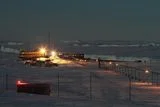
The people wintering at Concordia Research Station spend four months without sunlight and live beyond the reach of aircraft. Once winter sets in, no plane can reach the Antarctic base, and the nearest other people are about 370 miles (600 kilometres) away at Vostok Station, according to the European Space Agency.
Outside the station, temperatures fell to negative 119.4 degrees Fahrenheit (negative 84.1 degrees Celsius) on July 18, 2026. Concordia recorded the temperature twice, at 6:25 a.m. and 6:34 a.m. local time. It was the lowest temperature recorded anywhere on Earth since 2012, according to Live Science.
Concordia’s Weather Station Measures Antarctica’s Interior
Concordia sits at Dome C on the East Antarctic Plateau, about 10,600 feet (3,230 meters) above sea level. According to the Antarctic Meteo-Climatological Observatory, its automatic weather station was installed in January 2005.
Rather than a single thermometer, the Vaisala Milos 520 is the system at the center of Concordia’s automatic weather station. Instruments mounted on a 10-foot (three-meter) mast measure temperature, relative humidity, atmospheric pressure, wind speed, and wind direction.
Official metadata from Italy’s National Antarctic Research Program shows that the station collects observations throughout the year at one-minute and hourly intervals. It then transmits the measurements through the Argos satellite system. The data contribute to a weather record extending back to 2005 and support meteorological research and forecasting models.
According to the observatory’s station records, Concordia’s official minimum remains minus 120.5 degrees Fahrenheit (minus 84.7 degrees Celsius), recorded on Aug. 13, 2010.
The world record is even colder. The World Meteorological Organization recognizes minus 128.6 degrees Fahrenheit (minus 89.2 degrees Celsius), measured at Vostok Station on July 21, 1983, as the lowest temperature recorded through verified ground observations.
Read More: Blood Falls in Antarctica May Harbor Ancient Microbes, Preserving Traces of a Lost Ocean
Why Dome C Becomes So Cold
A 2022 study published in the Journal of Geophysical Research: Atmospheres examined how clouds and blowing snow affect the surface and lower atmosphere at Dome C.
The snow-covered surface at Dome C steadily releases heat into the sky. Clouds act somewhat like a blanket, keeping some of that warmth near the ground. When the sky is clear, more heat can escape, and temperatures near the ice can fall even lower.
The researchers also found that during fall and winter, the coldest air often sits directly above the ice, beneath a layer of warmer air. Meteorologists call this a temperature inversion. Wind and blowing snow can stir the two layers together, reducing the temperature difference between them.
The research examined Dome C’s more general atmospheric patterns rather than the specific conditions responsible for the July 18 reading.
Life Inside Antarctica’s White Mars
Up to 16 people can spend a year at Concordia, according to the European Space Agency. The station supports research in glaciology, seismology and astronomy, along with studies of how people handle prolonged isolation.
According to ESA, Concordia’s elevation, remoteness and months without a normal day-night cycle resemble some of the challenges astronauts could encounter during extended missions. The station is often nicknamed “White Mars.”
Each year, ESA sponsors a doctor to live with the winter crew and monitor how the experience affects their sleep, mental health, ability to work together, and physical condition. The findings could help agencies prepare astronauts for future missions to the Moon and Mars.
Concordia’s July reading did not break the station’s 2010 record, but it came within 1.1 degrees Fahrenheit (0.6 degrees Celsius), according to the Antarctic Meteo-Climatological Observatory. At the station, researchers can study how the high Antarctic Plateau produces such extreme cold and how a small crew adjusts to living there for months at a time.
Read More: Tourism in Antarctica Is Growing — Along With Its Carbon Footprint and Potential Long-Term Risks
Article Sources
Our writers at Discovermagazine.com use peer-reviewed studies and high-quality sources for our articles, and our editors review for scientific accuracy and editorial standards. Review the sources used below for this article:
- This article references information from Live Science: Antarctica just experienced minus 119 F, Earth's coldest temperature since 2012 — here's why
- This article references information from the ESA: Concordia: Earth’s most remote laboratory
- This article references information from the Antarctic Meteo-Climatological Observatory: Concordia
- This article references information from the Italian Antarctic Data Center: Metereological data - AWS CONCORDIA - Antarctic Meteoclimatic Observatory in Concordia
- This article references information from a study published in JGR Atmospheres: Impact of Clouds and Blowing Snow on Surface and Atmospheric Boundary Layer Properties Over Dome C, Antarctica
- This article references information from The World Meteorological Organization: WMO concludes evaluation of possible new record Antarctic temperature