Las Vegas, United States, August 4th, 2026/CyberNewswire/--
"Our vision is an intelligent, agentic platform constantly evaluating whether a threat is actually a risk in your environment, so your team gets a faster, sharper response and spends its time on the risk that matters. The intelligence to hunt threats, prioritize exposures, and build detections all starts from the same data, so it shouldn't take three tools to make it work. And when a working exploit lands in hours, a queue ranked by a severity score that doesn't know who's attacking you is wasting your best analysts on work that should be automated," said Jonathan Cran, founder and CEO of Mallory.
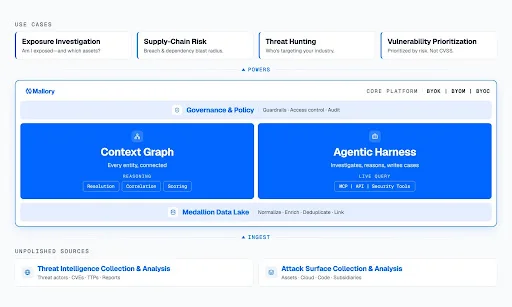
The context graph, reasoning layer, and policy layer are fully separable, so Mallory fits any security team's stack, not just one built around it. Teams that just want a contextual data source can plug Mallory's threat and context data straight into the workflows they already run. Teams ready to go further can adopt Mallory's agentic harness out of the box, handing routine exposure remediation to agents at scale, all within the policy guardrails they define and control.
Mallory's consumption model is a deliberate break from usage-based AI pricing. It meters on coverage and outcomes rather than token usage, and supports bring-your-own-key (BYOK), so teams run on their own model infrastructure or Mallory's. Teams pay for software and the outcomes it produces, not for how much a workload happens to consume.
AI-assisted attackers have collapsed the cost and time of finding exploitable flaws, and security teams are drowning in intel they cannot act on fast enough. Point tools force teams to choose between prioritizing exposures, hunting for threats, or building detections, when the real problem is upstream: knowing what to look for, where to look for it, and being fast and cost-effective enough to act on it. Mallory's architecture is built to close that gap once, at the layer underneath all three problems, rather than solving each one separately.
- The context graph pulls in attack surface and security configuration information, then unifies it with external threat intel and vulnerability information using the same underlying pipelines. Every new CVE or adversary technique is correlated against an organization's actual exposure within minutes, not days.
- The intelligent reasoning layer sits on top, determining whether a given signal reaches the environment, where it lands, and how much it matters given real adversary activity, not a static severity score alone.
- The policy and governance layer sits above that, letting teams set exactly how much autonomy the reasoning agents get: auditing code repositories against current adversary techniques, watching supply chain dependencies, evaluating CI/CD configurations, or routing a prioritized case straight into the ticketing tool the team already uses.
Mallory Founder, Jonathan Cran, writes about its origin in the blog: Adversary Timelines Have Collapsed: Defenders Must Rethink Proactive Security with Agents
About Mallory:
Contact
Head of Marketing
Alexa Rzasa
Mallory
alexa.rzasa@mallory.ai
This story was published as a press release by Cybernewswire under HackerNoon’s Business Blogging
Disclaimer:
This article is for informational purposes only and does not constitute investment advice. Cryptocurrencies are speculative, complex, and involve high risks. This can mean high prices volatility and potential loss of your initial investment. You should consider your financial situation, investment purposes, and consult with a financial advisor before making any investment decisions. The HackerNoon editorial team has only verified the story for grammatical accuracy and does not endorse or guarantee the accuracy, reliability, or completeness of the information stated in this article. #DYOR