Fry said the earthquake appeared to have occurred in an unusual part of the Earth’s crust and did not fit the pattern of the two main types of earthquakes usually seen in the region.
He said it did not appear to be a typical subduction earthquake, where the Australian Plate is forced beneath the Pacific Plate, nor did it appear to be a shallow earthquake on one of the crustal faults commonly found in Southland.
Instead, Fry said the earthquake may have been similar to a 1989 shake that was interpreted as a tear within the subducting Australian Plate.
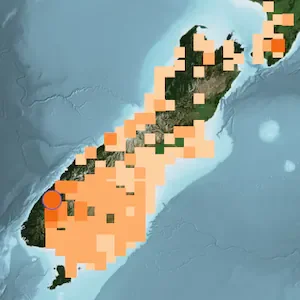
The magnitude 5.9 quake struck near Te Anau. Photo / GeoNet
Fry said that process could redistribute stresses within the Earth, potentially affecting the likelihood of earthquakes on nearby faults.
“The good thing is the Alpine Fault is quite a distance away from where this earthquake happened, probably at least a couple 100kms, so the influence of this earthquake on the Alpine fault is relatively minor,” he said.
“We know that the Alpine Fault is a very dangerous fault, a very active fault, so we always need to be prepared for an Alpine Fault earthquake.”
The Alpine Fault is capable of producing a magnitude 8 or greater earthquake and is considered one of New Zealand’s most significant natural hazards.
He said earthquakes in Fiordland could theoretically transfer stress to the Alpine Fault, but the effect was likely to be small.
Fry said aftershocks from the magnitude 5.9 earthquake could continue for weeks or months, but that the average gap between aftershocks would gradually increase as the sequence settled.
“There’ll be longer and longer until it goes back to what we would consider background activity or just the normal state of earthquakes in New Zealand.”
Fry said there was a small chance a larger earthquake could follow.
The Alpine Fault is marked out on satellite images by the western edge of the Southern Alps snowline. Image / Nasa
Looking at global earthquake sequences of a similar magnitude, he estimated there was around a 3% to 8% chance of one or more magnitude 6 or larger earthquakes occurring within the following month.
While the earthquake had not changed the way scientists viewed the Alpine Fault, Fry said researchers would continue monitoring the aftershock sequence.
“The one thing that might change is we will, for this aftershock sequence, keep a close eye on the migration of it to see if we start to see activity anywhere around the greater Southland region,” he said.
“That’ll give us an understanding about if something did start to happen because of this earthquake.”
He said scientists would be watching whether activity moved towards neighbouring faults, similar to how seismic activity was monitored after the 2010 Darfield earthquake.
Fry praised people in Milford Sound who self-evacuated after feeling the earthquake.
“The accounts that I’ve heard suggested that they responded appropriately. That was absolutely the right thing to do.”
He said the earthquake was a reminder for communities across the South Island to remain prepared.
“I would like people to think about the fact that they live in an active tectonic region, and we need to use events like this to make sure we keep prepared for bigger, more damaging earthquakes in the future.”
For people living near the Alpine Fault, Fry said preparation remained the key message.
“Make sure you have all of your grab bags, your procedures well in hand or in head, and you’re ready to act on any future earthquakes that happen.
“As always, listen to your civil defence groups for information about how to respond.”
Ben Tomsett is a journalist based in Dunedin. He joined the Herald in 2023.