*Correction: This story has been updated to correct names and clarify comments.
When I was 25, I thought I was losing my hearing. I could hear clearly in normal situations, but I struggled at parties and networking events where many people would be speaking at the same time.
After countless times standing in a circle with people laughing at a clearly very funny joke that I could not even hear, I took myself to get a hearing test.
There I was, prepared to be told that I need to live with a hearing aid for the rest of my life. But instead, I was told that my hearing was perfectly fine.
The good news was that I didn't need to worry about what colour I wanted for my hearing aid, the bad news was I continued to feel alone at parties.
But it turns out that it's not just me. Scientists have long studied people's ability to focus on a targeted speech in noisy environments, a phenomenon known as the cocktail party effect.
In research, cocktail party means a noisy setting where there could be a large quantity of people speaking at the same time, and there could be other environmental noises such as clinking of the glass, traffic and buzz from machines.
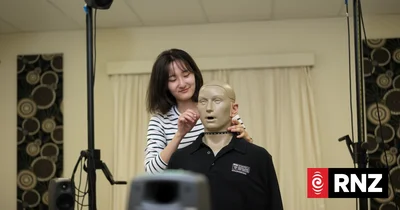
Clara Zhang, PhD candidate at the University of Auckland's Acoustics and Vibration Research Centre, has been looking into listening in noise.
"My research is on improving the perception of non-native speakers in noise. Cocktail party is a very typical noisy environment, and non-native listeners are typically more disadvantaged when they're listening in noise."
Zhang said the effect was first defined and named in the 1950s, and affects both native and non-native listeners.
She said noisy environments made it harder to isolate the speech from the background noise, even if it's being made by the person right in front of you.
Pouria Bahmani Kolour (right) organises language exchange events around Auckland.
Pouria Bahmani Kolour / Supplied
It's easier for native listeners as their ears are sharper at distinguishing the sounds. But for non-native listeners like me who grew up speaking a different language, everything muddles into one big pot of boiling noise.
In the 2023 census, 24 percent of those living in New Zealand said they spoke a second language other than English or te reo Māori.
Pouria Bahmani Kolour, who organises language exchange events around Auckland, is also familiar with the problem.
"Many people, many immigrants have the same common problem. Some people actually get very frustrated. They blame themselves for not studying enough, not trying hard. Some people don't actually care, they just let it slide."
He said their events were set up afterhours in a quiet cafe, and hopefully prepared participants for noisier events in the future.
"We are trying to make a calm environment for the people who participate to be able to actually hear each other and speak."
Bahmani Kolour's native language is Farsi and he's a strong believer in "practice makes perfect".
He said his listening had improved significantly since attending four language exchanges a week.
Zhang said while practicing the language helped, asking for help was also important.
"I think studies have shown that non-native listeners, even if you have a lot of experience and you are very proficient, you still can't quite reach the native behaviour, so I think maybe you want to ask the speaker to come a bit closer to you or ask them to speak slower."
She said organisers could also mitigate the effect, by choosing a venue with better acoustic settings, for example, using a larger space that allow groups to scatter.
Audiologist Angela Loucks Alexander said some treatment and training may also help.
Specialising in Auditory Processing Disorder, Loucks Alexander, said some native-listeners who were not experiencing hearing loss may also find themselves unable to hear clearly.
Audiologist Angela Loucks Alexander says trainings used to help those with Auditory Processing Disorder can also help non-native listeners in noisy settings.
Angela Loucks Alexander / Supplied
"Auditory Processing Disorder is a hearing problem that has less to do with the ears and more to do with the brain, it's difficulties in understanding what you hear. People can go in and have a test done and find out that their hearing sensitivity is within normal limits, but they may have a hard time understanding what they hear."
She said five to 15 percent of the population had the disorder, which affects both children and adults, and could present more in some groups than others.
Loucks Alexander said while non-native listeners may not be suffering from the disorder, they could still benefit from the training that was used in the treatments.
"So auditory processing can be improved because the brain is plastic, and we can actually train the brain in how to hear better in noise. I just want people to know who have these difficulties that there is hope."
She said the number of professionals who could help with the disorder had been growing, and she had set up a map to help those to find the right help.
Currently, most treatments required private funding, but Loucks Alexander hoped that with more research and awareness, this could change.
"When they can't hear and understand, they don't feel heard and understood, and I think this is a huge problem here in New Zealand."
I'm not sure whether I will seek treatment yet.
But speaking with the experts does make me feel... heard.
And don't mind me if I ask you to repeat your joke, I'd love to know what I'm laughing about.