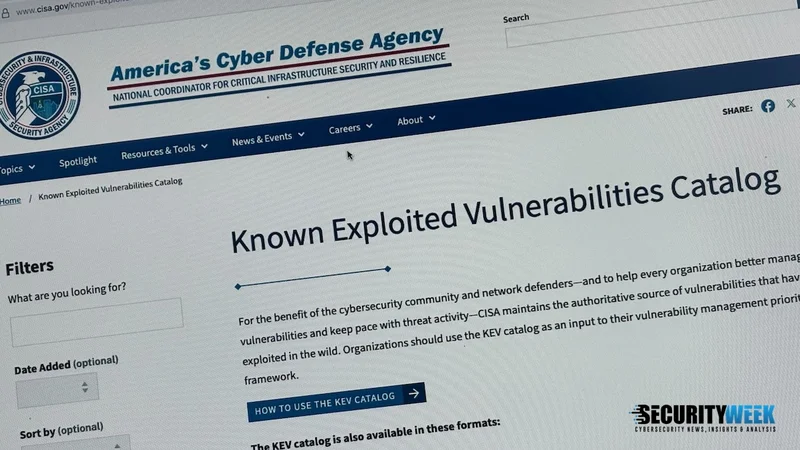
The US Cybersecurity and Infrastructure Security Agency (CISA) on Tuesday warned that threat actors have been exploiting three vulnerabilities in IBM Langflow OSS, N-able N-central, and Apache Tomcat.
Tracked as CVE-2026-9198 (CVSS score of 9.8), the Langflow OSS bug allows unauthenticated attackers to chain two API endpoints for remote code execution.
It was disclosed on July 17, when IBM rolled out patches for it, in Langflow OSS version 1.10.1, warning that all default deployments are affected.
“The vulnerability combined two distinct issues: an unauthenticated endpoint that issued superuser bearer tokens to any network caller, and a code validation endpoint that executed arbitrary Python code. An attacker could chain these vulnerabilities by first obtaining a superuser token from the auto-login endpoint, then using that token to submit malicious code to the validation endpoint,” IBM warned.
Proof-of-concept (PoC) code targeting the security defect was published roughly a week after the public disclosure, and CISA added the CVE to its Known Exploited Vulnerabilities (KEV) catalog on August 4.
The N-able N-central bug flagged as exploited is tracked as CVE-2026-18556 (CVSS score of 7.4) and described as an authentication bypass.
According to N-able, threat actors exploited the issue as a zero-day to gain administrative access and connect to systems managed through the remote monitoring and management (RMM) platform.
The initial fix for CVE-2026-18556 was incomplete, and threat actors bypassed it. As the exploitation activity intensified at the end of July, N-able rolled out a hotfix, issuing CVE-2026-18577 for the patch bypass. Both CVE-2026-18556 and CVE-2026-18577 are now in CISA’s KEV list.
Tracked as CVE-2026-34486 (CVSS score of 7.5), the third vulnerability added to the KEV catalog on Tuesday is an EncryptInterceptor bypass in Apache Tomcat that was patched in April.
The flaw was introduced in March, with the patch for CVE-2026-29146, a padding oracle issue in EncryptInterceptor, an optional channel interceptor that encrypts messages transmitted between nodes in Tomcat clusters.
“The fix moved one line of code. That line turned the encryption layer from fail-closed to fail-open, and opened a direct path to unauthenticated remote code execution on every cluster member,” StrigaAI, which identified the bug, explains.
On deployments with EncryptInterceptor configured, only messages encrypted using a shared key should be decrypted and passed to the deserialization layer. Due to the bypass, however, upon failed decryption, the attacker-controlled code was forwarded up the interceptor chain unmodified.
Last week, SOCRadar warned that CVE-2026-34486 had been exploited by a Chinese threat actor in attacks involving the Snowlight malware family, while Palo Alto Networks observed the vulnerability being exploited by Chinese hackers in an AI-enabled autonomous hacking campaign.
In line with BOD 26-04 requirements, CISA is urging federal agencies to patch all three vulnerabilities by August 7.
Related: TP-Link Omada ZTP Vulnerabilities Chain Into Full Network Takeover
Related: Decades-Old BMC Vulnerability Exposes Thousands of Data Centers to Attacks
Related: Recent SonicWall Vulnerabilities Exploited in Ransomware Attacks