Overview
Qwen3.6-27B-Fable-Fusion-711-Uncensored-Heretic-NM-DAU-MTP is a 27-billion-parameter fine-tuned language model built by DavidAU that exceeds ARC-C benchmark scores of 700 in both 8-bit and 4-bit quantization—the first open-source model of this size to accomplish this across both precision levels. The model is a multi-stage fine-tune and merge combining work from multiple collaborators (Nightmedia for merging, TeichAI for the Polaris dataset, armand0e for Fable traces, and trohrbaugh for decensoring via Heretic v1.2.0). It supports a 256k context window, includes activated vision capabilities (requiring a separate mmproj file), and runs as GGUF quantizations in standard AI applications. The decensored version uses the Arbitrary-Rank Ablation (ARA) method, reducing refusals from 99/100 to 4/100 with a KL divergence of 0.0469. Training was conducted on consumer hardware using Unsloth, with the core mission being to improve instruction following and problem-solving without modifying the underlying Qwen 3.6 base model architecture.
Best use cases
Complex reasoning and coding tasks requiring high instruction fidelity. This model excels when given explicit, detailed prompts that demand multi-step problem-solving. The fine-tuning emphasis on instruction following makes it particularly effective for tasks like debugging legacy code, architecting software systems, generating structured data formats, or solving mathematical proofs—scenarios where Claude Opus traces were incorporated during training. Unlike models optimized purely for conversational response, this one maintains coherence across complex technical specifications and logical constraints.
Writing and narrative generation with atmospheric depth. Despite not being designed primarily for creativity, the model demonstrates strong performance on fiction writing, worldbuilding, character development, and scene composition. The integration of Fable-5 traces provides narrative structure; the provided example shows generation of psychologically layered character backstories and visceral scene construction that avoids clichéd phrasing. This is useful for authors, screenwriters, and game narrative designers who need an AI writing partner that can sustain consistent voice and thematic depth across extended passages.
Decensored content generation without refusal patterns. The Heretic decensoring allows the model to generate adult content, horror, satirical dark humor, and mature themes without the default safety filters. Unlike models where content is merely made possible through jailbreak prompts, this version requires only direct instruction rather than elaborate workarounds. This is valuable for mature-audience creative projects, horror fiction, research into model behavior, and applications where content policies need to be set by the user rather than the model developer.
Long-context document analysis and multi-turn dialogue. The 256k context window enables processing of entire books, codebases, research papers, or extended conversation histories without losing earlier context. Multi-token prediction (MTP) variants can accelerate token generation in multi-turn conversations as the token window fills, making it practical for ongoing consultation tasks, document summarization with reference maintenance, and interactive coding sessions where context accumulation would otherwise degrade performance.
Vision-based reasoning with text analysis. With vision activated and the mmproj file downloaded, the model can process images alongside text queries. This enables tasks like analyzing screenshots for UI/UX feedback, extracting structured data from documents or charts, answering questions about image content while cross-referencing text documents, or providing technical analysis of diagrams alongside textual explanation.
Limitations
Decensoring requires explicit direction for some content. While the model no longer refuses harmful requests, generating x-rated content or certain swearing patterns may require you to specify slang terms and content level explicitly. This is a behavioral difference from models trained (rather than fine-tuned) on uncensored data—you cannot rely on inference alone to produce the full "expected" content level without directional hints.
MTP variants have strict configuration requirements. Multi-Token Prediction GGUF versions degrade significantly with temperature above 1.0 or repetition penalty above 1.0. Token acceptance rates below 50% (meaning the model predicts only 1 token instead of 2) indicate that regular GGUF quants would actually run faster for that use case. Performance is best with temperature ≤1.0 and repetition penalty = 1.0 (off). This creates friction when users expect MTP to always accelerate inference—it requires manual switching based on measured performance.
Speed varies substantially by quantization and hardware. On a Q4_K_S (4-bit) quant with an RTX 5090 on Windows 11 in LMStudio, regular GGUFs achieve ~75 tokens/second while MTP variants exceed 90 t/s at 60% token acceptance. These numbers shift based on GPU type, AI application, operating system (Linux/Mac generally faster), and total token window size. No universal inference speed can be guaranteed—testing is mandatory before production deployment.
Hardware requirements depend on quantization choice. While specific VRAM figures are not provided in the README, a 27B model in 8-bit format requires approximately 54 GB of VRAM without quantization; 4-bit variants reduce this substantially but exact figures must be determined per quantization type. The "LOW" variant quants (IQ4_XS and Q6_K) reduce footprint further for hardware-constrained environments.
Vision capability requires manual file management. Using vision requires downloading a separate mmproj file and placing it in the same folder as the GGUF before inference. The model includes only one compatible mmproj file; this is an additional manual step not required for text-only inference.
Benchmark improvements are modest in some categories. While this model exceeds Qwen 3.6 27B in 6 of 7 benchmarks and matches it on the 7th, the improvements vary by metric: ARC-C improvements are significant (71.1 vs 64.7 in instruct mode), but BOOLQ shows minimal gains (91.0 vs 91.0), and OBKQA improvements are moderate (51.4 vs 45.0). Some benchmarks show marginal returns that may not justify the additional fine-tuning complexity for certain applications.
Apache 2.0 license applies. The model uses an Apache 2.0 license, which permits commercial use but requires license attribution and does not provide liability protection. Commercial deployments must include license text and acknowledge the original model sources.
How it compares
Qwen3.6-27B-Fable-Fusion-711-Uncensored-Heretic-NM-DAU-NEO-MAX-MTP-GGUF is the GGUF-quantized version of this same model with NEO IMATRIX optimization and both regular and MTP variants already prepared. Choose this model (source) when you need the original model files for further fine-tuning, merging, or custom quantization; choose the NEO-MAX-MTP-GGUF version when you want production-ready quantizations with 2-4% accuracy improvement over standard GGUFs and the option to switch between regular and MTP variants without re-downloading.
Qwen3.5-9B-The-Defiant-Fable-Uncensored-Heretic-NEO-IMATRIX-MAX-MTP-GGUF is a smaller 9B model that exceeds all 7 benchmarks for Qwen 3.5 9B and 3.5 27B, scoring 640+ on ARC-C in both 4-bit and 8-bit. Use this model when running on hardware with 12-16 GB VRAM (vs ~24+ GB for the 27B), willing to accept slightly lower absolute capability for substantially faster inference and lower memory footprint. The 9B does not achieve the 700+ ARC-C ceiling, but it delivers remarkable performance-per-parameter and supports both instruction following improvements and decensoring.
Qwen3.6-27B-Heretic-Uncensored-FINETUNE-NEO-CODE-Di-IMatrix-MAX-GGUF is an alternative 27B fine-tune with NEO-CODE-Di-IMatrix quantizations (reporting 94% of full precision performance in IQ4_XS quants, 98.38% in Q8). Choose Fable-Fusion-711 when prioritizing raw intelligence benchmarks and ARC-C scores; choose the CODE variant when you need the most accurate quantizations with proven preservation of base model performance across diverse benchmarks and when your use case demands maximum fidelity even at smaller quantization levels.
Qwen3.5-9B-Claude-4.6-OS-Auto-Variable-Heretic-Uncensored-Thinking-MAX-NEOCODE-Imatrix-GGUF is a 9B model fine-tuned on four Claude datasets for enhanced reasoning across multiple reasoning frameworks. Choose Fable-Fusion-711 when you need the highest absolute benchmark scores and 256k context; choose the Claude-4.6-OS variant if you prioritize reasoning diversity and have limited VRAM, accepting lower raw benchmark scores in exchange for smaller parameter count and theoretical reasoning breadth.
Qwen3.6-27B-NEO-CODE-Di-IMatrix-MAX-GGUF is a non-decensored, quantization-focused version of Qwen 3.6 27B with benchmarked Di-IMatrix quants from IQ2_M to Q8. Choose Fable-Fusion-711 when you require decensored behavior and maximum instruction-following optimization; choose the NEO-CODE variant when working in environments with content policies requiring safety alignment and when you need maximum transparency in quantization quality metrics (5 metrics provided per quant level).
Technical specifications
Architecture and Parameters: 27-billion-parameter transformer-based language model with no modifications to the underlying Qwen 3.6 architecture. Multi-stage fine-tune combining multiple datasets and training passes.
Context and Vision: 256,000-token context window. Vision capabilities activated but require separate mmproj file for image input processing.
Quantization Options: NEO IMATRIX quantizations (improving accuracy 2-4% over standard GGUF and enhancing long-context performance). Output tensor modified to full 16-bit precision for all quants (10-20% of output). Variants include:
-
Q4_K_S (4-bit)
-
IQ4_XS (4-bit, memory-optimized "LOW" variant available)
-
Q6_K (6-bit, "LOW" and "AMD/VULCAN" variants available)
-
Q8_0 (8-bit)
-
mxfp8 and mxfp4 (mixed precision)
MTP (Multi-Token Prediction) variants available with MTP tensors set to Q8_0 precision. AMD/VULCAN variants address CPU offload issues for AMD GPU users with output tensor in f16 instead of bf16.
Training Data: Light Fable traces, light Claude Opus (reasoning/thinking components), F451 (in-house dataset), Polaris dataset (non-reasoning GPT5 data). No full training step count or dataset size disclosed.
Decensoring Method: Heretic v1.2.0+ with Arbitrary-Rank Ablation (ARA) method. Reduces refusals from 99/100 to 4/100 with KL divergence of 0.0469 compared to base model.
Framework and Format: GGUF quantizations run in all standard AI applications (LMStudio, Ollama, llama.cpp, and compatible inference engines). Source model can be fine-tuned using Unsloth.
Inference Speed: On Q4_K_S quant with RTX 5090 (Windows 11, LMStudio): regular GGUFs ~75 tokens/second; MTP GGUFs at 60% token acceptance exceed 90 tokens/second. Speed varies by GPU, application, OS, and context window state. Linux/Mac typically faster than Windows.
Benchmark Performance (Instruct mode, NEO MAX MTP variants):
| Metric | This Model (mxfp8) | Qwen 3.6 27B | Qwen 3.6 35B-A3B | Qwen 3.5 27B |
|--------|-------------------|-------------|------------------|------------|
| ARC-C | 0.711 | 0.647 | 0.581 | 0.557 |
| ARC-E | 0.879 | 0.803 | 0.757 | 0.711 |
| BOOLQ | 0.910 | 0.910 | 0.892 | 0.868 |
| HSWAG | 0.790 | 0.773 | 0.751 | 0.533 |
| OBKQA | 0.514 | 0.450 | 0.428 | 0.452 |
| PIQA | 0.823 | 0.806 | 0.803 | 0.706 |
| WINOGRANDE | 0.763 | 0.742 | 0.688 | 0.695 |
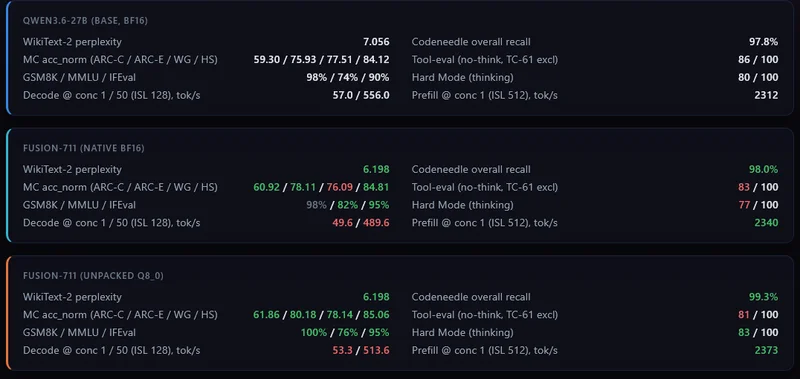
Third-party testing (IRONLLM Labs) at full precision (16-bit) and Q8_0 confirms Fusion-711 surpasses Qwen 3.6 27B; Q8_0 variant achieves higher IQ at 2x the speed of full-precision base model.
BF16 (full precision) expected to score 2-5 points higher than mxfp8 metrics across most benchmarks.
Model inputs and outputs
Inputs
-
Text prompts:Arbitrary length (up to 256k tokens), UTF-8 encoded text
-
Images (vision mode):Requires separate mmproj file; image format and resolution constraints not specified in README
-
Conversation history:Full multi-turn chat context within 256k window
-
System instructions:Compatible with thinking mode and instruct mode directives
Outputs
-
Text generation:Variable-length token sequences; generation behavior controlled via temperature, top_p, top_k, min_p, presence_penalty, repetition_penalty
-
Vision outputs:Text descriptions/analyses of image content (when vision mmproj loaded)
-
Reasoning traces:Extended reasoning output in thinking mode (temperature 0.6-1.0)
-
Structured formats:JSON, code, markdown, and plain text (not specialized but capable)
Getting started
To use the GGUF quantizations in LLaMA.cpp or llama-cli:
```
Download a quantization (e.g., Q4_K_S)
huggingface-cli download DavidAU/Qwen3.6-27B-Fable-Fusion-711-Uncensored-Heretic-NM-DAU-NEO-MAX-MTP-GGUF Qwen3.6-27B-Fable-Fusion-711-Q4_K_S.gguf
For vision, also download mmproj
huggingface-cli download DavidAU/Qwen3.6-27B-Fable-Fusion-711-Uncensored-Heretic-NM-DAU-NEO-MAX-MTP-GGUF Qwen3.6-27B-mmproj.gguf
Run inference (text only)
./llama-cli -m Qwen3.6-27B-Fable-Fusion-711-Q4_K_S.gguf -p "Solve this coding problem:" -n 512 --temperature 0.7 --top-p 0.80
```
For Python with llama-cpp-python:
from llama_cpp import Llama
model = Llama(
    model_path="Qwen3.6-27B-Fable-Fusion-711-Q4_K_S.gguf",
    n_ctx=8192,  # start with 8-16k context
    n_gpu_layers=-1,  # offload to GPU
)
response = model(
    prompt="Explain quantum entanglement:",
    max_tokens=512,
    temperature=0.7,
    top_p=0.80,
    top_k=20,
)
print(response["choices"][0]["text"])
For thinking mode (reasoning) on a complex problem:
response = model(
    prompt="<|im_start|>system\nYou are a helpful assistant.<|im_end|>\n<|im_start|>user\nProve P != NP<|im_end|>\n<|im_start|>assistant\n<|im_start|>thinking\n",
    max_tokens=2048,
    temperature=0.6,  # lower for precise reasoning
    top_p=0.95,
    top_k=20,
)
For MTP variants, keep temperature ≤1.0 and repetition_penalty at 1.0:
response = model(
    prompt="Write a story about:",
    max_tokens=512,
    temperature=1.0,  # not above 1.0 for MTP
    repetition_penalty=1.0,  # keep at 1.0 for MTP
)
Frequently asked questions
Q: Can I use this model commercially?
A: Yes, under Apache 2.0 license. You must include the license text and acknowledge the original sources (Qwen base model, Heretic, and all collaborators). No liability protection is provided; you assume responsibility for model outputs.
Q: How much VRAM do I need to run this model?
A: Exact requirements depend on quantization. A 27B model in 8-bit requires approximately 54 GB VRAM without quantization. Q4_K_S quants are ~1/4 this size (~13-14 GB), Q6_K ~1/2 size (~27 GB). "LOW" variant quants further reduce memory. Test with your hardware before production use.
Q: Should I use regular or MTP GGUF variants?
A: Download both and test on your hardware. MTP variants can exceed 90 t/s at 60% token acceptance on Q4_K_S, but only if token acceptance stays above 50%. If your use case shows below 50% acceptance, regular GGUFs run faster. For creative tasks or temperatures above 1.0, use regular variants. For multi-turn conversation where context accumulates, MTP may accelerate as window fills.
Q: How does this model perform compared to Qwen 3.6 27B on coding?
A: Exact code generation quality is not quantified in the README, but the 64-point ARC-C improvement (71.1 vs 64.7) and enhanced instruction-following suggest stronger coding problem-solving. Third-party IRONLLM testing confirms superior performance. For web development specifically, suggested temperature is 0.6 (precise mode). Test on your own codebase to validate fit.
Q: What happens if I use MTP with high temperature or high repetition penalty?
A: Performance degrades significantly. MTP tensors are optimized for temperature ≤1.0 and repetition_penalty=1.0 (off). Higher values reduce token acceptance rates below the ~60% target, actually making inference slower than regular GGUFs. Stick to suggested settings or switch to regular quants for creative generation.
Q: Can I fine-tune this model further?
A: Yes. The source model can be fine-tuned using Unsloth (the framework used to create it). Quantized GGUF versions are for inference only; download the base model files from the source repo to prepare additional fine-tunes. The README explicitly states this repo contains "SOURCE code for merging, creating quants and using this as a BASE MODEL for further tuning."
Q: What content can this model generate that the base Qwen 3.6 refuses?
A: The Heretic decensoring reduced refusals from 99/100 to 4/100. The model generates x-rated content, horror, dark satire, and mature themes without default safety filters. However, some content types (particularly specific slang or explicit language) may require you to specify the desired content level explicitly rather than relying on inference alone.
Q: Is this model still maintained?
A: The README does not specify ongoing maintenance status. The model was built as a collaboration between DavidAU, Nightmedia, TeichAI, armand0e, and trohrbaugh. Check the Hugging Face repo commit history and release dates to assess recency. Related research on fine-tuning methodologies can be reviewed via papers on low-rank fine-tuning.