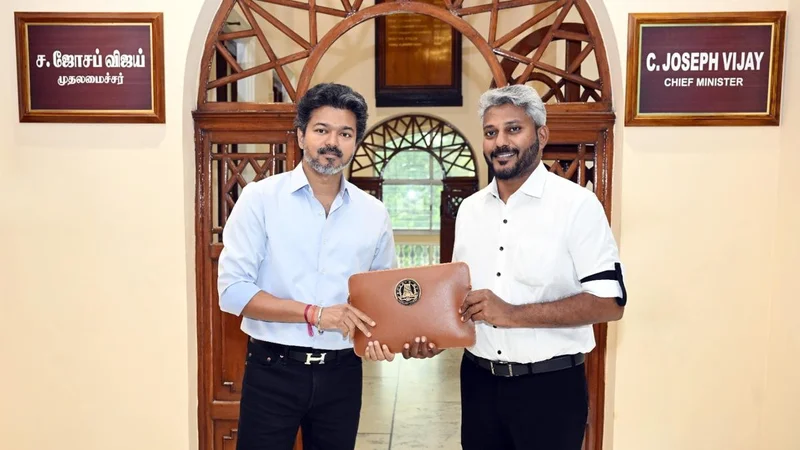
Tamil Nadu Finance Minister N. Marie Wilson on Wednesday (August 5, 2026) said the fiscal position of the State remains under strain and the new government inherited a treasury burdened with debt, inadequate income, and systemic leakages.
Presenting the Revised Budget 2026-27 in the Legislative Assembly, he said the repair process had begun but would require at least two years to bring the financial administration back on the track of fiscal prudence.
He said under the leadership of Chief Minister C. Joseph Vijay, the government aims to build fiscally prudent governance capable of delivering balanced and inclusive economic growth.
“Unlike the previous government, which focussed only on short-term political gains with the belief that they should make best use of their five-year term, our government believes that we need to look forward to at least 15 years of sustained growth through consistent policies and providing clean and efficient governance,” the Finance Minister contended.
“The State has been borrowing without reference to what its revenues can sustain. While there is nothing wrong with borrowing to invest in human and physical capital that act as drivers of economic and social growth, this needs to be accompanied by corresponding efforts to mobilise resources that could cover such borrowings. The previous government failed to recognise this simple fact,” the Minister said.
“The previous government allowed revenue-earning departments to bleed uncontrollably, while permitting a substantial share of public money in works to be siphoned off by unscrupulous middlemen,” he charged.
Since the formation of the present government, he said, continuous efforts have been made to plug leakages on both the revenue and expenditure sides, enabling the State government to generate at least ₹1,500 crore on the revenue side so far. It also expects to create substantial fiscal space on the expenditure side through savings in the procurement of goods and services.
Welfare schemes
The Finance Minister reiterated that welfare schemes such as scholarships, free education for students, subsidies to entrepreneurs to start businesses and manufacturing units, PDS subsidies and free housing for the poor are not largesse but investments in human and social capital that drive consumption and long-term economic growth.
The State government would continue most of the welfare schemes that have been in existence for the past three decades and planned to expand them further. However, it believes a calibrated balance between investments in welfare schemes and investments in physical capital and infrastructure is necessary. Such measures require adequate resources and fiscal space, and without sustained efforts in this regard, welfare schemes cannot be continued.
Apart from the Revenue Augmentation Committee, he said the State government will also constitute a similar high-level Expenditure Reforms Committee to advise the State government on rationalising expenditure by enhancing the productivity of the service delivery apparatus, reviewing all welfare schemes by evaluating their impact on target beneficiaries, and ensuring all those who genuinely require State intervention receive the intended benefits.
The Minister clarified the committee’s scope would not be limited to reducing expenditure but would include rationalising it, including expanding welfare schemes that have long-term positive benefits for society and the State.
Published - August 05, 2026 05:03 pm IST