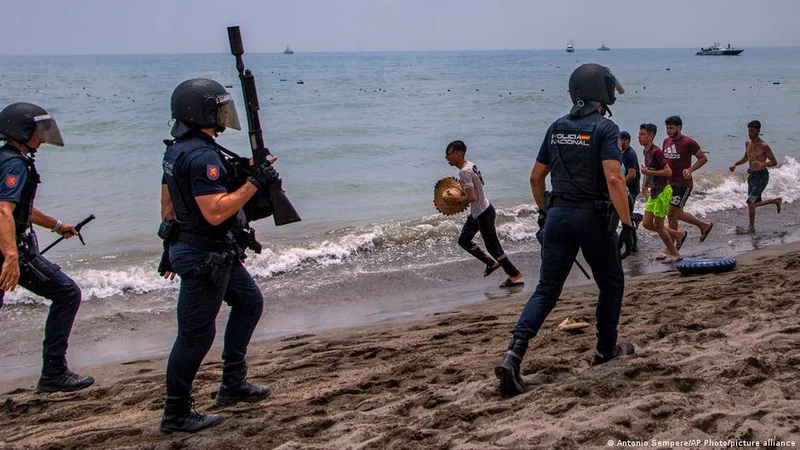
Misleading social media posts appear to have contributed to a sudden surge in migrant crossings into Spain's North African exclave of Ceuta. Tens of thousands of people attempted to cross from Morocco in late July. According to authorities, dozens drowned or were killed in crowd-related incidents during the crossings, which triggered a major humanitarian crisis.
European, Spanish and Moroccan authorities blamed the sudden surge in crossings on incorrect information circulating on social media and human traffickers. A recent Spanish Supreme Court ruling on migrant returns became the focus of many of the misleading claims.
The decision was issued several weeks earlier. It ruled that migrants who arrive by sea cannot be subject to the same fast-track deportation procedure applied to people intercepted while crossing physical border infrastructure, such as fences and other official barriers.
Posts on social media claimed that the ruling effectively prevented Spanish authorities from returning migrants who reached Spanish territory by sea, implying that they would be allowed to remain in the country.
The ruling was widely misrepresented online. DW Fact check examined how the claims spread and what the court actually decided.
What was circulating on social media?
Claim: "The Spanish Supreme Court issued a ruling considered one of the most prominent decisions in the migration file, prohibiting the immediate deportation of irregular migrants..."
The claim appeared in Arabic in a Facebook post published on July 13, which described the ruling as "historic." It was one of dozens of similar posts reviewed by DW Fact check. Some of the accounts spreading the claim were linked to migration-focused pages active on platforms including Telegram, where one profile promoted information about migration opportunities abroad under the slogan: "All opportunities for immigration abroad are in your hands."
DW Fact Check also identified numerous examples of smaller and medium-sized accounts sharing posts that used identical or nearly identical wording to the version cited in this article.
DW Fact check: Misleading.
The ruling applies only to migrants arriving by sea who have not crossed a border barrier on their way; it does not apply to all migrants.
Under Spanish law, authorities may carry out immediate returns of people intercepted while breaching official border infrastructure. Migrants who arrive by sea are in a different legal situation because they haven't crossed a barrier. Their cases must be processed individually, with the procedural guarantees the law requires.
The ruling therefore limits the use of immediate returns in these specific cases, but it does not grant migrants an automatic right to remain in Spain. It also allows the government to install physical barriers at sea, which Spain has since done to close what many described as a legal loophole.
Many of the posts reviewed by DW Fact check quoted the ruling without explaining its legal scope. In one example, a TikTok user said: “...this law that came out in Spain says it is forbidden to send anyone back if they came swimming to Spain, and it is forbidden for the navy to send them back. This is true...”
The video presented the ruling as a general prohibition on returning migrants who arrive by sea. It did not mention that the Supreme Court’s decision involved the legal procedure for carrying out returns, not a blanket ban on deportation.
DW Fact Check found that this selective interpretation — highlighting the restriction on immediate returns while omitting the broader legal context — appeared repeatedly across a large share of the accounts reviewed.
Can misleading social media claims alone explain the movement toward Ceuta?
The causes of the surge in migrant crossings quickly became the subject of a political dispute between Spain and Morocco.
Spanish officials, including Prime Minister Pedro Sánchez said on July 31 that organized networks had exploited the situation by spreading inaccurate information about the Supreme Court ruling. And Madrid also criticized Morocco for failing to prevent thousands of people from reaching the border with Ceuta.
Moroccan authorities rejected accusations that they had deliberately allowed the crossings to happen and said that misleading information on social media caused the mass movement.
According to Lorenzo Piccoli, Assistant Professor of Migration Governance at the European University Institute, the Supreme Court ruling may have played a role in encouraging some people to attempt the crossing, but it could not explain a movement of this scale on its own.
"Even in 2015 and 2016, when up to a million people arrived in Europe, we never saw more than 5,000 or 6,000 in a single day. Here we are talking about 50,000 to 60,000 in one day," Piccoli told DW.
He said it would have been "very difficult" for online claims alone to trigger such a large-scale movement in such a short period of time. "It's very hard to see how this would have happened without some form of coordination or without authorities allowing it to happen," he said.
Piccoli added that there appeared to be a broader political dimension to the crisis, with Morocco potentially not actively causing the movement but failing to prevent it. "There is a recognition that perhaps the Moroccan government did not actively provoke this event, but in some ways it did nothing to avoid it from happening," he said.