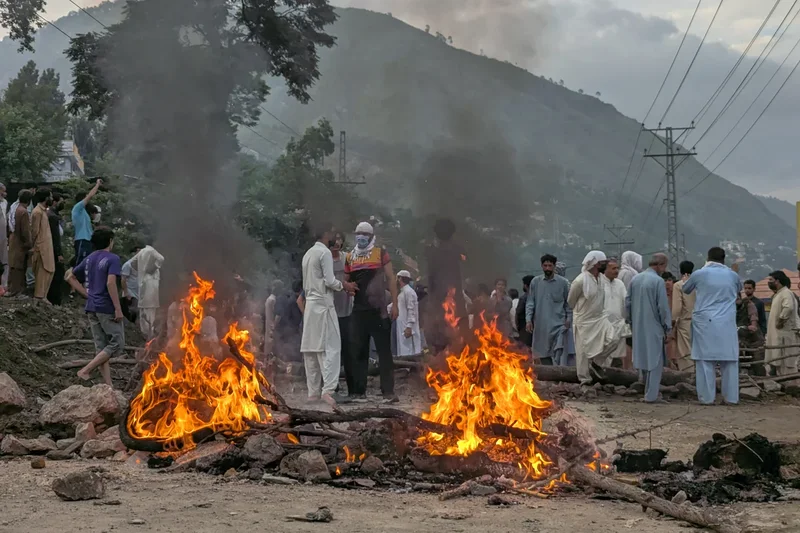
Pakistan has tightened restrictions on foreign journalists as criticism has mounted over a brutal crackdown on protests that have engulfed the Kashmir region for months.
The Ministry of Information and Broadcasting on Tuesday issued the “Foreign Media Facilitation Guidelines 2026” requiring journalists to take permission from the government before travelling outside the cities of Islamabad, Lahore and Karachi.
The crackdown in Kashmir has left dozens of people dead. People mobilised by a coalition of civil society and political groups called the Joint Awami Action Committee have been staging massive demonstrations to demand economic and governance reforms, sparking the worst political crisis in the region.
Islamabad has long projected Azad Jammu and Kashmir – as Pakistan calls its part of the Himalayan territory shared and disputed with India – as a model of self-governance with its own legislature, its own president, prime minister, and supreme court. But Islamabad retains ultimate control over major strategic matters and anyone running for office in the region must swear allegiance to the Pakistani nation.
One of the main demands of the protesters is doing away with the 12 seats reserved in the regional legislature for refugees from the Indian side of Kashmir.
As the unrest has grown, foreign media organisations reporting on it have faced increased scrutiny from the government.
The new guidelines require all journalists, including Pakistani citizens, working for foreign outlets to register online with the information and broadcasting ministry’s External Publicity Wing and submit requests for press accreditation cards – authorisation to access and cover official activities – to the government.
But neither registration nor accreditation would permit journalists to travel for reporting assignments outside Islamabad, Lahore and Karachi. They would be required to obtain no-objection certificates for producing news content, stories, videos, films, documentaries, or social media content from any other cities.
Registration or accreditation can be suspended where reportage will act “against the ideology, sovereignty, security, or public order of Pakistan”.
The new rules came after the ministry criticised the BBC and Al Jazeera for their reporting on the situation in Kashmir.
It called out Al Jazeera for “selective reporting” and for “misrepresenting” the election and voting process in Kashmir and engaging in “yellow journalism.” The ministry said the coverage came from handpicked polling stations and scripted statements.
The BBC claimed it was the first foreign media outlet to gain access to the restive region for a video report in which families of protesters killed in the crackdown spoke of brutalities committed by the security forces.
The security forces denied firing indiscriminately on peaceful protesters.
Kashmir’s information secretary Muhammad Rashid Hanif called the coverage “angled, biased and contrary to the facts”, saying the government “rejected” it.
The unrest started in June when the Joint Awami Action Committee called a protest against the reservation of 12 seats for refugees in the region's 45-seat legislative assembly. The government responded by banning the committee under anti-terrorism laws and launching a crackdown against its supporters.
The seats, created in the 1970s, are reserved for displaced people from Indian-administered Kashmir settled in Pakistan.
The protesters are calling for the abolition of the reserved seats, arguing that they undermine local representation as many of the people eligible to fill them don’t even live in the region.
They argue that all seats in the legislature should be filled by people who actually reside in the region.
Authorities haven’t disclosed the death toll from the crackdown but local estimates have put it at over 50. The Pakistani government has said that at least seven law enforcement personnel have been killed.