80-million-year-old snake brain reveals a surprising evolutionary secret
An 80-million-year-old fossil reveals that early snakes explored underground, terrestrial, and marine worlds much earlier than scientists realized.
- Date:
- August 5, 2026
- Source:
- University of Helsinki
- Summary:
- An exceptionally preserved snake fossil from Brazil reveals that early snakes were far more diverse than scientists once thought. Detailed brain reconstructions show that Tametara mirim was adapted for burrowing, while another ancient snake was suited to life above ground. Other fossils point to marine lifestyles as well. By 80 million years ago, snakes were already experimenting with very different habitats and sensory systems.
- Share:
More than 4,000 snake species live today, all descended from heavily modified lizard ancestors. Yet scientists still do not fully understand how snakes developed their long, limbless bodies. Because early snake fossils are rare, researchers have struggled to determine which environments and behaviors shaped their evolution.
For many years, the debate centered on two main possibilities. Some scientists proposed that snakes first became elongated and limbless while adapting to underground life, while others argued that the body plan emerged in aquatic environments. New research published in Nature suggests the answer was more complicated. Instead of following a single ecological route, early snakes appear to have occupied several habitats and developed different sensory adaptations.
"Our findings show that early snakes had already achieved remarkable ecological and morphological diversity by the Late Cretaceous, around 80 million years ago," says lead author Tiago Simões, Assistant Professor at Princeton University.
An Exceptionally Preserved Ancient Snake
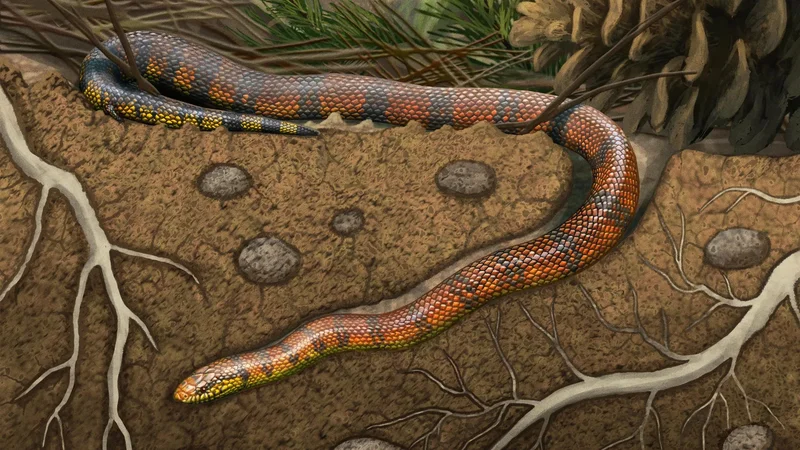
The researchers examined a newly identified snake species from Late Cretaceous deposits in southeastern Brazil dating to around 80 million years ago. Named Tametara mirim, the species is represented by one of the most complete fossil snake skeletons ever discovered.
Using computed tomography and cinematic 3D rendering, the team created a detailed digital reconstruction of the specimen. The scans revealed features of the skull, vertebrae, and brain endocast that would have been difficult to study from the exposed bones alone.
Postdoctoral researcher Simone Macrì and Research Director Nicolas Di-Poï, both at the University of Helsinki's HiLIFE Helsinki Institute of Life Science, directed the reconstruction and comparative study of the brain anatomy. Their work connected the neuroanatomy of early snakes with their sensory abilities, habitats and evolutionary history.
Fossil Brains Reveal Different Lifestyles
The team compared Tametara with Dinilysia patagonica, another fossil snake discovered in Argentina. The comparison showed that the two species had very different brain structures, suggesting they were adapted to distinct ways of life.
"The two had strikingly different brain shapes, both from each other and from most other snakes studied. Brain shape and bone microstructure pointed to the same conclusion: Tametara was adapted to burrowing, Dinilysia to life on the ground. Together with evidence from marine sediments, the findings reveal several shifts between burrowing, terrestrial and marine lifestyles in early snake evolution. Different lineages explored different habitats much earlier than previously thought," concludes Research Director Nicolas Di-Poï.
The findings indicate that early snake evolution involved repeated movement between underground, terrestrial and marine environments. Rather than progressing toward one standard body form or sensory system, separate snake lineages developed adaptations suited to different ecological settings.
"The brain tells a much richer story than the skeleton alone. By combining computed tomography-based brain reconstructions with data from living snakes, we could show that early snakes were not simply progressing toward one modern condition but experimenting with different sensory and ecological strategies. This means that early snakes did not follow a single evolutionary pathway," says Researcher Simone Macrì.
A Broader View of Snake Evolution
The study was led by Tiago Simões of Princeton University, with senior authors Nicolas Di-Poï of the University of Helsinki and Annie Hsiou of the University of São Paulo, together with an international team of collaborators.
Story Source:
Materials provided by University of Helsinki. Note: Content may be edited for style and length.
Journal Reference:
- Tiago R. Simões, Gabriela Sobral, Simone Macrì, Roy Ebel, Thiago S. Fachini, AgustÃn G. Martinelli, William R. Nava, Giovanna M. X. Paixão, Luis M. Chiappe, Nicolas Di-Poï, Annie S. Hsiou. Exceptional brain and ecological diversity in the earliest snakes.Nature, 2026; DOI: 10.1038/s41586-026-10809-9
Cite This Page:
ScienceDaily. Retrieved August 5, 2026 from www.sciencedaily.com