Chancellor of the Duchy of Lancaster is a grand and stately title but the office tends to be whatever the minister makes of it.
And all the signs are that Louise Haigh will exploit it for all it's worth – in handing such a fierce and loyal ally control of the all-powerful Cabinet Office, our new Prime Minister Andy Burnham has made clear what her real title is: The Enforcer.
From Burnham's perspective, this appointment makes perfect sense. He and the MP for Sheffield Heeley first met a decade ago and the two soon realised they shared a desire to move the party on from the centrism of the Blair years.
She proved her worth to Burnham as a pivotal player in the long-term plot to oust Sir Keir Starmer, and it was she who managed the future PM's by-election campaign in Makerfield, the emphatic result of which set the stage for his capture of the Labour leadership and arrival in Downing Street.
No one in government understands his thinking quite like Haigh. And with her down-to-earth take on politics, many see her as Burnham's representative on Earth.
However, Haigh comes with baggage. Just four months after Starmer made her one of the youngest female Cabinet minister ever appointed, at the age of 36, her stint as Secretary of State for Transport ended in ignominy.
Her November 2024 resignation was prompted by news reports that, a decade earlier, while working for insurance giant Aviva, she had misled police about the fate of a work-issued mobile phone.
Haigh reported the device as stolen in a mugging incident but claimed to have later discovered it in a drawer. When her activation of the 'missing' phone alerted her employer, police were called in and Haigh was charged with false representation, a form of fraud.
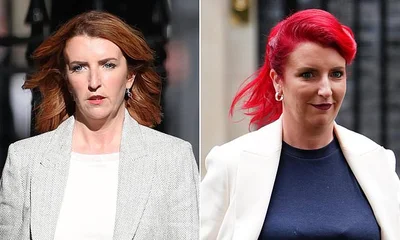
Louise Haigh has been appointed as Chancellor of the Duchy of Lancaster in Andy Burnham's new Cabinet
Ms Haigh is seen as Burnham's right hand man, after managing his by-election campaign in Makerfield that made him eligible to lead the Labour Party
The matter went to magistrates' court shortly before Haigh became an MP in 2015. She was convicted of fraud by false representation after pleading guilty and was given a conditional discharge.
In her resignation letter, she stuck by her version of events but admitted it had been a 'mistake' not to inform her employer promptly upon finding the phone.
Starmer predicted Haigh would have 'a huge contribution to make in the future' but little did he know then that her contribution would be helping to bring him down and install his replacement. Politics is a ruthless business.
Given her abrupt exit from government last time, Burnham could be forgiven for harbouring concerns about a repeat performance. After all, Haigh has not always exercised the wisest political judgment.
In October 2024, she called P\&O Ferries a 'rogue operator' for its 2022 decision to lay off 800 workers and replace them with cheaper agency hires.
The then-Transport Secretary told ITV News: 'I've been boycotting P\&O Ferries for two-and-a-half years and I would encourage consumers to do the same.'
The reaction was swift and ferocious, with P\&O immediately pulling out of a Government investment summit and briefly pausing a planned £1billion investment in the London Gateway port expansion.
Starmer was forced to rebuke his minister publicly to contain the fallout and get P\&O back on board.
The P\&O incident also provided an insight into Haigh's immature brand of student-union politics: Rather than work with a sizeable employer, she preferred to grandstand and virtue signal against the hated boss class.
This, more than her plotting prowess, is key to Haigh's political personality and her likely impact inside the Burnham Government.
It has been made clear by the now Prime Minister that dragging the Labour Party back to the Left is one of the major objectives of the Burnham project.
Louise Haigh has stopped dying her hair, but the truth is her roots remain a deep red
Haigh, who is the product of a family of trade unionists, will be pivotal to this mission, for – like the boss – her natural territory is Labour's soft-Left comfort zone, the place where difficult decisions are ducked and the party's unworldly, economically illiterate core vote is pandered to.
The extent of her radicalism was revealed in a 3,000-word essay she wrote in May for Renewal, a Leftist current affairs journal. In it, she set out an economic vision that should chill the blood of every ambitious and hard-working Briton.
After bashing Brexit – apparently it 'scarred our economy while dividing our people' – she lamented that 'the state's capacity to play an active role in economic development was hollowed out' during the Thatcher years, an approach which 'prioritised market allocation'.
Not only in Britain, but across the world, 'states retreated from direct economic co-ordination and relied more heavily on liberalised markets and complex regulatory regimes'. Haigh thinks this is a bad thing.
If you strip away the policy wonk verbiage, it's clear that she is yearning for a return to the bossy-boots socialism of government-knows-best, with its suffocating state interference in the commanding heights of the economy.
Haigh's prospectus is a manifesto for a lurch not only to the Left but into the past, a repudiation of Thatcherism and the free market and a reversion to the crippling Keynesian collectivism of the 1970s.
Haigh goes on to bemoan a policy of 'meeting near-term fiscal targets' to reassure the markets instead of 'delivering long-term economic improvements'.
For the socialist ideologue now installed at the heart of Downing Street, the current economic model needs to be ripped up, and that means 'looking at the role and mandate of organisations such as the Office for Budget Responsibility, the Treasury and the Bank of England'.
Again, it's all very bland jargon on the surface but its underlying meaning is positively sinister: Haigh wants to ditch or dilute the very safeguards that prevent government from taxing and spending the country into economic calamity. Or, in her own Orwellian words: 'The task is not to abandon fiscal discipline, but to redefine it.'
That this is who Burnham considers his right-hand woman is a red flag in all senses of the term. From her lofty perch in the Cabinet Office, Haigh will have considerable power to push the new Prime Minister's agenda through Whitehall, regardless of any misgivings from the Civil Service.
It's quite a rise for the Northern lass, whose parents separated when she was a teenager and she and her brother – the darts and snooker journalist Phil Haigh – moved in with their mother, who enrolled her in an all-girls' private school in Sheffield.
Haigh, whose father was a solicitor, went on to study at the London School of Economics, Nottingham University and Birkbeck College.
Before politics she worked as a waitress for seven years in Sheffield, served as a special constable with the Metropolitan Police, and was a shop steward for the Unite union.
Haigh was eventually selected for the safe seat of Sheffield Heeley in 2015, when the incumbent Meg Munn stood down.
She was appointed to a series of Shadow Cabinet posts under Jeremy Corbyn and Keir Starmer, including Northern Ireland, and it was in this role she met her partner Colum Eastwood, the MP for Foyle and former leader of the Social Democratic and Labour Party. Prior to that, she was in a brief relationship with TV presenter Nick Knowles.
Today, Haigh keeps her personal life in Sheffield separate from her political role in Westminster. She lives with her lurcher, Milo, and seeks solace from Westminster with old friends.
Haigh has stopped dyeing her hair but the truth is her roots remain a deep red. Be warned: If you're hard working, high earning, aspirational, or would like to keep just a little of your own money, Louise Haigh is coming for you.