Perseid meteor shower coming! Best viewing on August 12 and 13
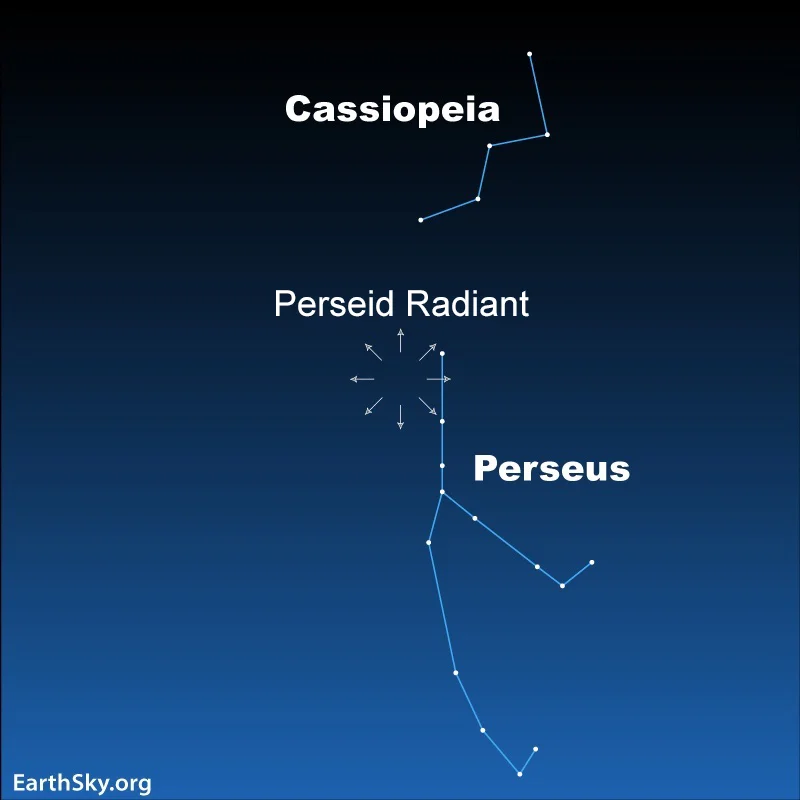
Want to see the most meteors possible? In 2026, the best time to watch the Perseid meteor shower is after midnight through dawn on August 12 and 13. You’ll have dark skies. And since the Perseids are often bright, you might see 50-100 meteors per hour. Remember, even one bright meteor can make your night! In this video, EarthSky founder Deborah Byrd shares 9 easy meteor-watching tips that can help you spot many more shooting stars. Whether you’re a first-time skywatcher or a seasoned observer, these simple techniques can make this year’s Perseid meteor shower unforgettable.
Our charts are mostly set for mid-latitudes in the Northern Hemisphere. To see a precise view – and time – from your location, try Stellarium Online.
Best sky sights for this week
Join EarthSky’s Marcy Curran for your skywatching best bets for this week. Saturn is rising late at night and is visible through dawn. The moon visits Saturn early in the week and then passes by the famous Pleiades star cluster around August 7. See what’s in store in the night sky this week.
Early August morning planets: Saturn, Mercury, Mars
Solar eclipse coming! Watch a video
On August 12, 2026, the moon will pass directly in front of the sun, creating one of nature’s most breathtaking sights: a total solar eclipse. Join EarthSky’s Deborah Byrd for a preview of this extraordinary event. See where the path of totality will cross Earth and find out how long the eclipse will last, what observers can expect to see and why total solar eclipses are among the most awe-inspiring events in the sky.
August, the best month of the year for skywatching, is here! Join EarthSky’s Deborah Byrd for a tour of August’s best sky sights, including the glorious Milky Way, a total solar eclipse, Mars beside Orion the Hunter, Mercury’s morning appearance, and the side-by-side return of brilliant Sirius and Jupiter. Watch here or on YouTube.
August 8 and 9: Moon visits a trio of bright stars and Mars
August 10 and 11 mornings: Moon near twin stars and Mars
Meet Marcy Curran, our voice of the night sky on EarthSky YouTube. Check out her popular short videos in the Sky category on our YouTube channel. When she's not making videos, Marcy is an EarthSky editor, helping to keep our night sky guide up-to-date and just generally helping to keep the wheels turning around here. Marcy has enjoyed stargazing since she was a child, going on family camping trips under the dark skies of Wyoming. She bought her first telescope in time to see Halley’s Comet when it visited the inner solar system in 1986. She co-founded her local astronomy club and remains an active board member. Marcy taught astronomy at her local community college for over 20 years. She and her husband live in Wyoming, in a rural location, with an all-sky camera and super-good horizon views! And, they built an observatory to capture images of the night sky.
“I can sometimes see the moon in the daytime” was a cosmic revelation that John Jardine Goss first discovered through personal observations at age 6. It shook his young concept of the universe and launched his interest in astronomy and stargazing, a fascination he still holds today. John is past president of the Astronomical League, the largest U.S. federation of astronomical societies, with over 24,000 members. He's earned the title of Master Observer and is a regular contributor to the video series, “Global Star Party.” He has authored the celestial observing guides “Exploring the Starry Realm,” and “Carpe Lunam,” and “Take Your First Steps, an Introduction to Amateur Astronomy.” John also wrote for twenty years the monthly stargazing column, Roanoke Skies, for the Roanoke Times, and currently writes a bimonthly column, Skywatch, for Blue Ridge Country magazine. He has contributed to Sky and Telescope magazine, the IDA Nightscape, the Astronomical League’s Reflector magazine, and the RASC Observer’s Handbook.
Deborah Byrd (asteroid 3505 Byrd) helps edit EarthSky.org and is a frequent host of EarthSky videos. Deborah created the EarthSky radio series in 1991 and founded EarthSky.org in 1994. Prior to that, she had worked for the University of Texas McDonald Observatory since 1976, and created and produced their Star Date radio series. She has won a galaxy of awards from the broadcasting and science communities, including having an asteroid named in her honor in 1990, a Public Service Award from the National Science Board in 2003, and the Education Prize from the American Astronomical Society in 2020. A science communicator and educator since 1976, Byrd believes in science as a force for good in the world and a vital tool for the 21st century. "Being an EarthSky editor is like hosting a big global party for cool nature-lovers," she says.
Kelly Kizer Whitt - EarthSky’s nature and travel vlogger on YouTube - writes and edits some of the most fascinating stories at EarthSky.org. She's been writing about science, with a focus on astronomy, for decades. She began her career at Astronomy Magazine and made regular contributions to other outlets, including AstronomyToday and the Sierra Club. She has nine published books, including a children's picture book, Solar System Forecast, and a young adult dystopian novel, A Different Sky.
Like what you read? Subscribe and receive daily news delivered to your inbox.
Thank you! Your submission has been received!
Oops! Something went wrong while submitting the form.