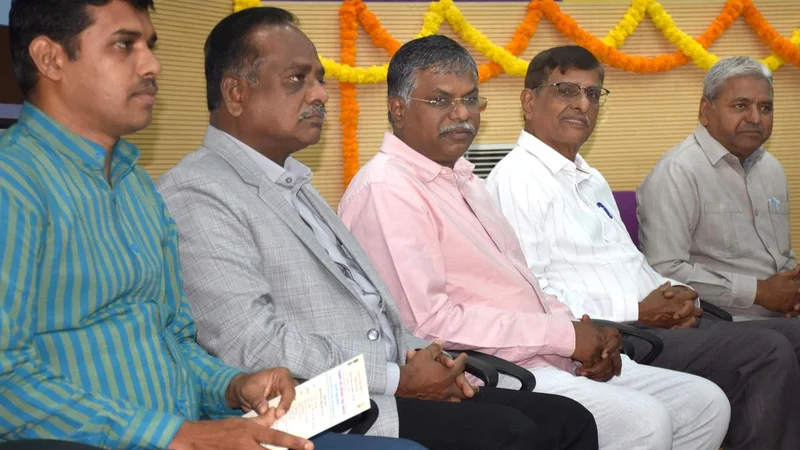
A two-day State-level workshop on “Kannada inscriptions in Karnataka and beyond,” organised by the Centre of Excellence for Studies in Classical Kannada (CESCK) under the Department of Higher Education at the Central Institute of Indian Languages (CIIL), Mysuru was inaugurated on Wednesday.
Inaugurating the programme, Prof. D.V. Paramashivamurthy, Vice-Chancellor, Kannada University said, “This workshop will facilitate a comparative study of the cultural and historical ties between Karnataka and regions outside the State. Inscriptions found in Andhra Pradesh, Tamil Nadu, and Kerala are crucial for understanding ancient Karnataka’s cultural linkages, art, architecture, and administration with neighbouring States.”
“Most inscriptions discovered in Karnataka are Dana Shasanas. These records provide evidence that grants were given not merely for ritualistic adherence, but to uplift the underprivileged. Detailed studies are needed to ascertain if similar grant inscriptions exist in neighbouring States,” the Vice-Chancellor suggested.
He stressed the need for examining whether the acts of sacrifice, heroism, hunting traditions, political affairs, and religious developments expressed in Kannada inscriptions are reflected in other regions.
“Inscription texts help us understand the prevalent religions and sectarian conflicts of the era and carry out comparative analysis. Through this workshop, the Centre of Excellence for Studies in Classical Kannada has set the stage for re-evaluating these records by bringing together prominent epigraphists from across South India,” he added.
Srinivas Padigar, a retired professor from Dharwad, who was the chief guest and gave a presentation featuring inscriptions from various historical sites, including the ‘Sri Utpatti Pidugu’ inscriptions at the Kudaveli Sangameshwara Temple in Alampur (Andhra Pradesh), the Jalasangi Kallesheshwara Temple in Bidar, the Kedareshwara Temple in Dharmapuri, and the Kailasanathar Temple in Kanchipuram. While these inscriptions have been published by the Kannada University, Hampi in the volumes of ‘Kannada Inscriptions of Andhra Pradesh’, certain errors remain in those publications that require editorial correction, he advised.
CIIL Director Basavaraja Kodagunti, highlighted the need for analysing inscriptions systematically.
Highlighting the vital role of inscriptions in reconstructing the long history, culture, and literature of Kannada, L.R. Prem Kumar, Coordinator, Classical Languages, said, “From Halmidi inscription of 450 CE to the inscriptions at Talagunda, Badami, Atakur, and Dekabbe, we can trace the evolution of the Kannada script, language, and poetic structure.”
“As described in Kavirajamarga—from the Kaveri to the Godavari— the influence of Kannada extended well beyond the modern borders of Karnataka. Owing to the cultural impact of the Chalukya, Rashtrakuta, Hoysala, and Vijayanagara dynasties, Kannada inscriptions are found in Kurkyala (Telangana), Thanjavur (Tamil Nadu), Maharashtra, Goa, Madhya Pradesh, and as far as Nepal.”
The organisers said the workshop serves as a key step toward reassembling these historical links and rediscovering the language’s historical expanse.
N.M. Talawar, Project Director of the Centre of Excellence for Studies in Classical Kannada, along with staff members of the Classical Kannada Institute, epigraphy enthusiasts, and scholars were present.
Published - August 05, 2026 07:19 pm IST