Palestinian-Israeli movement calls for multinational force in occupied West Bank
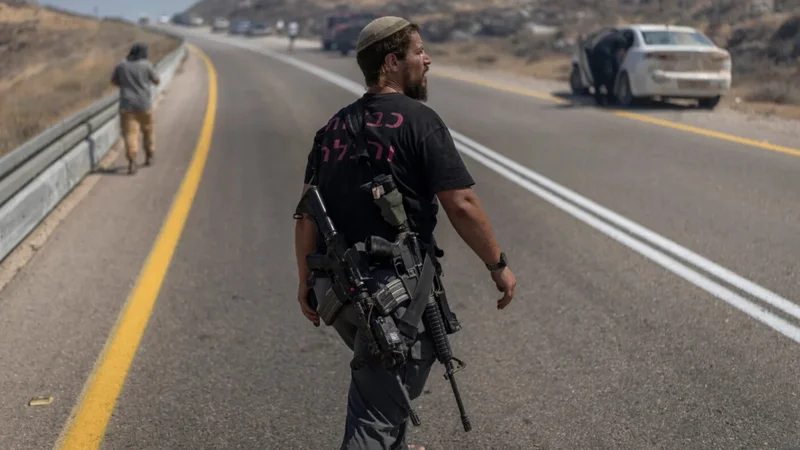
A joint Palestinian-Israeli movement launched a campaign on Tuesday calling for a multinational protection force to be deployed in the occupied West Bank amid escalating Israeli settler attacks.
A Land for All – Two States, One Homeland said growing settler violence, coupled with the Israeli government's failure to protect Palestinians, had made international intervention an urgent necessity.
The appeal was announced at a press conference in the village of Kafr Malik, east of Ramallah, where residents described months of settler attacks, restricted access to farmland and mounting fears of displacement.
The movement said an international protection force would not replace a political solution or the establishment of a Palestinian state. Instead, it would provide an immediate mechanism to protect civilians and help preserve the prospect of a future political settlement.
Launched under the slogan "Multinational Force in the West Bank — Now", the campaign argues that international condemnation of settler violence is no longer enough. It calls for a force mandated to protect civilians and document violations on the ground.
Rula Hardal, the Palestinian co-director of the group, said they sent a statement last week to international actors and diplomatic missions in Palestine and Israel, urging them to support the deployment of an international protection force for Palestinians in the West Bank following the escalation in settler violence.
'We see a government that is entirely backing the settler militia'
- Yael Berda, board co-chair of A Land for All – Two States, One Homeland
Hardal said Kafr Malik had been chosen for the press conference because it lies in the centre of the West Bank and has also been affected by settler violence, while remaining more accessible and relatively safer than many other Palestinian communities for both Palestinian and Israeli Jewish members of the movement.
"We are a Palestinian-Israeli political movement that advocates for a confederative two-state solution on the agreed international borders of 1967," Hardal told Middle East Eye.
"But we cannot continue speaking about the old classic two-state solution because the reality on the ground has changed over the last 30 years," she added.
The movement aims "to update and improve" the model by addressing issues including settlements, the right of return for Palestinian refugees, Jerusalem and security.
"This is something that we are working on in our political platform," she added.
‘Mass atrocities’
Meron Rapoport, an Israeli co-founding president of the movement, said the situation in the occupied West Bank had deteriorated sharply over the past year.
He accused the Israeli government and military of pursuing "a clear plan of ethnic cleansing" in the occupied territory.
"We hear about plans to go after the refugee camps. It is very clear. The time to wait, ask and beg Israel to protect the lives of Palestinians is over," he said during the press conference.
Other Israeli members of the movement echoed the call, saying they no longer believed the Israeli authorities were willing or able to protect Palestinians living under occupation.
Professor Yael Berda, co-chair of the movement's joint board, said Kafr Malik in particular is "a village that is undergoing a consistent threat of violence from settler militias".
She said the movement had organised the press conference in the town to show solidarity, call for an international protection force and remind the international community of its responsibility to protect civilians in the face of mass atrocities.
"Those mass atrocities include ethnic cleansing, and what we see is imminent ethnic cleansing happening. International pressure in the abstract is no longer enough.
"We see a government that is entirely backing the settler militia. We see a military that either can't or doesn't want to stop the settlers.
Confronting the ‘settler-colonial aggression’
For residents of Kafr Malik, the discussion was less about political proposals than the reality they say they face every day. Villagers described repeated settler attacks, blocked roads and growing restrictions on access to their farmland.
Abdel Fattah Hamayel, a resident of Kafr Malik, welcomed the solidarity visit.
"We appreciate this step, and we hope it will be built upon to help the Palestinian people confront this settler-colonial aggression," he said.
Hamayel said a single meeting could not fully convey the suffering experienced not only by residents of Kafr Malik but by Palestinian rural communities more broadly.
"In my opinion, this issue is no longer hidden from anyone. This government, through several fascist figures, declares this openly and clearly. The situation isn't easy for us because we face two main challenges," he said.
The first, he said, was the absence of an official Palestinian strategy or institutions with the capacity to confront the violence and support Palestinian farmers.
The second was that the attacks were taking place with the backing of Israel's far-right government, which he said had emboldened settlers who had "broken free from all moral standards".