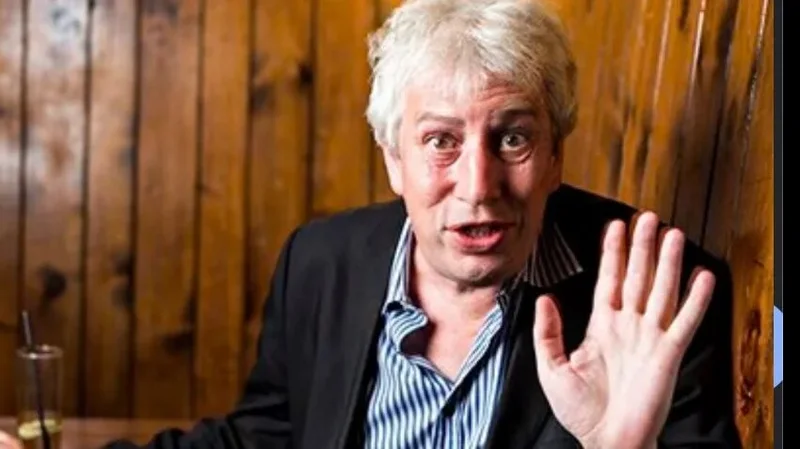
Rod Liddle played the politics of hatred - we should be honest about his legacy
This year, few public figures have enjoyed as resounding a send-off as the newspaper columnist Rod Liddle.
Mr Liddle, who died this week, is being hailed as a truth-teller for our times whose trenchant columns "upset all the right people".
There’s no denying that Liddle was a sometimes dazzling writer who grabbed the reader’s attention and never let it go.
Many tributes have emphasised this heaven-sent quality, and many have added that a kindly soul lurked behind the intimidating public personality.
But very few tributes even touched on the fact that Liddle was also a racist, a bigot and an Islamophobe. This open and undisguised bigotry was a core part of his public identity, his personality and his legacy.
"I have spent the morning trying to draw a cartoon of a black person without it being racist," Liddle opened one column for the Spectator. He went on: "It’s bloody difficult. Especially the lips."
In another Spectator article he falsely claimed that the "overwhelming majority" of violent crime in London was carried out by young African-Caribbean men.
Genocide denial
On Tuesday, this kind of writing was hailed as brilliant right across the British media and political establishment
Fraser Nelson, who as editor of the Spectator published hundreds of Liddle’s articles, said that "his jokes were built on judgment, rigour, compassion".
But is this true?
Take, for example, Liddle’s public defence of Myanmar’s massacre of Rohingya Muslims. On the pages of the Sun in September, 2017, he asked:"Are you sure we’re being told the full story about those Muslim Rohingya refugees who are flooding into Bangladesh from Burma? "All we get is a BBC correspondent crying in front of the refugee camps every night.
"It’s probably true that the Burmese government has been a bit, um, heavy-handed. But shouldn’t we be told a little more about the causes of the problem?"
Myanmar, bear in mind, is now charged with genocide.
It is well-documented that Burmese militias, backed by the army, had gone through Myanmar’s Rakhine province on a systematic campaign of slaughter, rape and destruction.
In the immediate aftermath of the events that Liddle dismisses so lightly, I travelled to neighbouring Bangladesh to get the stories of survivors.
One witness told me that the first action of soldiers upon arriving at his Rohingya village was to separate the local people into three groups.
Men, young women (including girls as young as five), old women or those one eyewitness described to me as "those who are not so beautiful."
The soldiers opened fire. "All the young men were shot at once. It took less than ten minutes," the eyewitness told me. The soldiers then walked over to the pile of dead bodies. Anyone who showed signs of life was hacked to death with a machete. The soldiers then opened fire on the older women.
Finally the younger women were then taken to the forest and gang-raped, before being burnt alive. This process was described by Liddle - long after all this was well-documented - as "a bit, um, heavy-handed".
The slaughter of the Rohingya was one of the most heinous crimes of the 21st century. Liddle used it to fill a jokey column in the Sun.
This wasn’t a joke. It was genocide denial.
Normalising hate
Liddle mocked, ridiculed and sneered at pretty well every minority group, but he reserved a special contempt for Muslims.
"A quick update on what the Muslim savages are up to," began one of Liddle’s "hilarious" articles.
Did Rod Liddle use his remarkable talents to leave the world a better and kinder place? I am not certain he did
As election fever grew in the autumn of 2019 Liddle confided to Spectator readers that, "My own choice of election date would be a day when universities are closed and Muslims are forbidden to do anything on pain of hell, or something." He explained: "That would deliver at least 40 seats to the Tories, I reckon."
Many of the tributes paid yesterday to Liddle emphasised his courage in mocking the establishment.
I’m not sure that’s right. In one Spectator article, he recalled how on a country walk he spotted a sign urging walkers to respect the Countryside Code.
The notice was illustrated by a picture of a woman wearing a burka. Liddle told his readers that the burka was "a coded message saying, essentially, this: 'You think this is your country, you sap? It is not. It is not even your country up here among the beech hangers and the silver birch and the purple ragwort and the fluttering brimstones. Even up here, it is not yours. Not any more. Get used to this new reality, quickly.'"
We shouldn’t deceive ourselves that this racist rant was a joke.
Liddle was playing the politics of hatred, using "humour" to tell Spectator readers that women in burkas are invaders who don’t belong in our country.
Elsewhere, Liddle dismissed the London borough of Tower Hamlets, home to a substantial Bangladeshi Muslim community, as a "fly-blown satrapy" and "suburb of Sylhet".
No wonder Rupert Lowe, leader of the racist Restore party, which calls for the mass deportation of immigrants, yesterday hailed Liddle as a "towering intellect and a friend".
"Islamophobia?" Liddle once rhetorically asked. "Count me in."
More recently one of Liddle’s articles carried the sub-headline "There’s not enough Islamophobia in the Conservative Party." After an outcry the Spectator changed the headline.
One only has to imagine the career-ending consequences for Liddle had he asserted that “there’s not enough antisemitism in the Labour Party.”
Spectator editor Michael Gove responded to the news of Liddle’s death as follows:"Rod Liddle was a journalist of genius. In the tradition of Swift, Cobbett and Orwell, he was a satirist who found society’s most sensitive spots and made merciless fun of our follies."
Gove is wrong. Jonathan Swift, William Cobbett and George Orwell, to adapt a longstanding reporters’ phrase, understood that their task was to "comfort the afflicted and afflict the comfortable".
Liddle targeted the weak and vulnerable, focusing especially on immigrants. His defenders argue that he was standing up for former working-class voters who have been forgotten and ignored by our main political parties.
It is true that they were forgotten for many years, and that Liddle gave them some kind of voice.
Legacy of racism
The criticism of Liddle concerns the way he set about it.
He targeted the immigrants themselves rather than focusing on the deep inequalities and injustices in British society that have left traditional working-class communities without hope and a decent future.
In this context, it is telling that his work invariably appeared in the oligarch media, whether the Murdoch press or the Spectator.
On Tuesday, the Times, which is owned by Murdoch, gave two full pages of praise for Rod Liddle. None of them dealt seriously with his racism, Islamophobia and the lazy, bigoted ignorance that caused him to deny the Myanmar genocide.
The gush from mainstream journalists and politicians like Nick Robinson, Jeremy Vine, Andrew Neil, Fraser Nelson, Conservative leader Kemi Badenoch, Reform leader Nigel Farage, Iain Dale, Robert Jenrick and many others makes me wonder whether something has changed fundamentally - and for the worse - about British society.
Samir Shah praised Liddle as a "warm-hearted and generous fellow", with no mention of his trademark bigotry and racism. This was a serious error of judgment from the chairman of the BBC.
Nearly 30 years have passed since the British politician Enoch Powell died. The obituaries rightly paid tribute to his formidable intellect, his exemplary war record, his political courage and much more besides.
Mainstream writers, politicians or broadcasters have either ignored Liddle’s racism and bigotry or dismissed it as a side issue, or even as a 'joke'
But they also examined at length the repugnant racist views which caused Edward Heath to sack him from the Tory shadow cabinet.
Yet, mainstream writers, politicians or broadcasters have either ignored Liddle’s racism and bigotry or dismissed it as a side issue, or even as a "joke".
Years ago in the Spectator magazine, I was a colleague of Rod Liddle. Sometimes he would turn out for my cricket team. He was amusing company and I think everybody liked him.
He was clever and sharp and less disorganised and shambolic than he pretended. He was a performer and he made us all laugh. And it’s true he could write hypnotically well.
But is that enough to make a great journalist, as so many have labelled him?
Rod undeniably had significant and unusual gifts. With such gifts comes responsibility and I wonder whether he used them well.
Did Rod Liddle use his remarkable talents to leave the world a better and kinder place? I am not certain he did.
The views expressed in this article belong to the author and do not necessarily reflect the editorial policy of Middle East Eye.