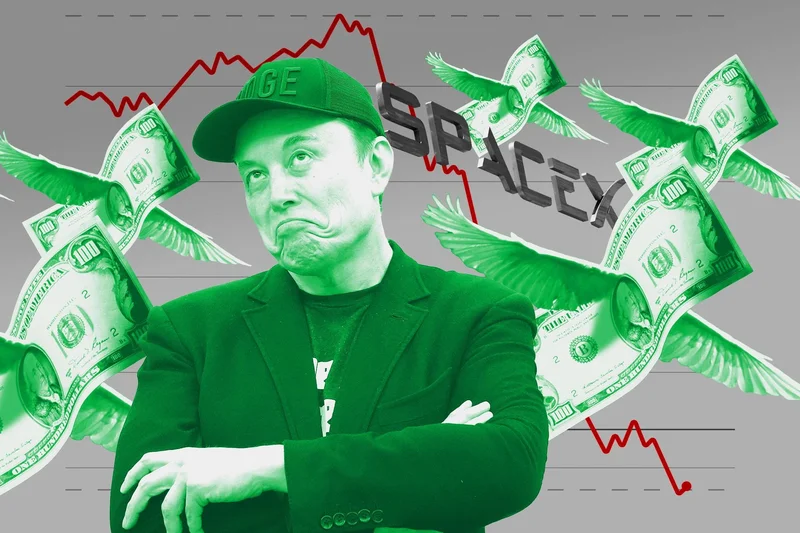
Once, I had some questions about why SpaceX, Elon Musk’s healthiest company, acquired xAI, his sickliest one. Now I have some questions about why we’re calling the whole thing SpaceX.
SpaceX is barely Space and mostly X
Elon Musk’s exploding rockets are a front for the real moneymakers.
SpaceX is barely Space and mostly X
Elon Musk’s exploding rockets are a front for the real moneymakers.
Look, what we have here, by revenue, is primarily a telecom company and a company that rents compute, according to SpaceX’s first quarterly earnings statement as a public company. The space sector of the business didn’t break a billion dollars this quarter and contributed only a touch over 10 percent of the company’s revenue. SpaceX remains its own biggest customer. There just aren’t enough other people who want its rockets. And, I dunno, maybe if the rockets were a primary focus of the company, SpaceX wouldn’t be in danger of blasting a new crater into the Moon with its space trash.
The lion’s share of the spending (and the hype) is nonetheless around what is graciously being referred to as “AI”
The telecom part — SpaceX calls it “connectivity” — is Starlink, the satellite internet service, which had $4.2 billion in revenue, and was the only part of SpaceX that did not have a loss from operations. And while Gwynne Shotwell, on the call, outlined plans for a phone service meant to compete with AT&T, Verizon, and T-Mobile, the lion’s share of the spending (and the hype) is nonetheless around what is graciously being referred to as “AI” to capture whatever contributions Grok may be making. Analyst Alexander Potter expects spending on the neocloud business, which leases data center capacity to AI companies, to climb to $65 billion next year, $17 billion more than he’d previously estimated, Bloomberg notes.
It was hard to miss how important leasing data center space was to SpaceX. Not only did it make more money than SpaceX’s rockets, it also drove more spending — $15.8 billion on AI alone in the second quarter. (By comparison, spending on the space and connectivity sectors was a touch over a billion each.) That business makes it a competitor with neocloud companies such as CoreWeave and Nebius.
Except that wasn’t originally the plan.
Musk built SpaceX’s Colossus 1 data center in Memphis for Grok, his also-ran AI that also occasionally refers to itself as MechaHitler and has a penchant for undressing women and children without their consent. But xAI had trouble running the complex, and decided to rent it out instead. In addition to encountering latency that made it hard to train in-house models, the center employed a mix of newer and older chips that created bottlenecks. On the earnings call, Musk said that only 10 percent of the compute SpaceX builds will go to Grok.
Revenue isn’t profit, and building data centers is expensive
SpaceX now has deals with Google, Anthropic, Reflection AI, and Cursor, an AI company Musk eventually chose to acquire. On the second quarter earnings call, SpaceX chief financial officer Bret Johnsen said those deals put the company “on a trajectory, including contribution from Cursor, to reach $100 billion of ARR, or annualized revenue run rate,” a financial measurement used to estimate how much money a company will receive in a year, based on an estimate from a shorter period of time. Musk was even more bullish, saying that “the $100 billion ARR in December is not a question mark,” and that the actual ARR might be higher.
That’s very nice. But revenue isn’t profit, and building data centers is expensive.
There are some problems with being in the bare-metal business of renting out compute — specifically, inevitable obsolescence, the vagaries of construction, and the fact that compute is basically a commodity, which means that companies compete on cost. The more data centers that get built, the more compute is available. With more compute available, companies can’t charge as much for their chips.
Musk has claimed that he took SpaceX public because he wanted to build data centers in space. Now, I might think that if I had trouble running a data center on the ground, I’d get better at it before I tried to do something an order of magnitude harder — something that had never been done before, even. But that is not how Musk thinks, I suppose.
This all sounds expensive, doesn’t it?
SpaceX has even proposed an orbital data center consisting of as many as 1 million satellites to the Federal Communications Commission. The application is light on technical details — we have no idea about satellite size or deployment schedule, for instance — which makes me think that it’s more for PR than anything else. Musk has also released a few details about the satellites — or, at least, some drawings of them. In this vision, a Musk-owned chip producer called Terafab will produce one terawatt of chips every year. A billion Optimus robots will do the work, at least once Musk figures out hands.
This all sounds expensive, doesn’t it? The end goal, Musk claims, is to build a mass accelerator on the Moon.
I don’t put much stock in this kind of thing, any more than I put much stock in Musk’s claims that Starlink will deliver “a majority of the world’s internet,” as he said on the earnings call. It’s all part and parcel of Musk’s general habit of talking about a sci-fi future as imagined by a bunch of mid-20th-century writers. Sure, there are a bunch of scientists suggesting Musk’s proposed space data centers are a bad idea. You can even argue about the feasibility of space data centers if you want. Remind me, did the Hyperloop ever get built? Say it with me now: It’s all vaporware till it ships, babe.
If we take away the pseudoscientific big talk, we are left with a company that launches rockets mostly for itself, has a fairly successful satellite internet business, and is basically running the risky and capital-intensive bare-metal business we’ve seen from a bunch of the neoclouds, as a result of its failures of its in-house AI. That’s not quite as dreamy as getting to Mars in six years, is it?
SpaceX’s insider lockups start expiring on August 6th, which is tomorrow
What it does do, however, is provide Tesla with an important customer, one that buys $295 million in Tesla Megapack battery storage. SpaceX has also been buying a bunch of Cybertrucks, Musk’s historic flop of an automobile. As of this writing, Tesla stock is down 25 percent since January of this year.
Musk can maybe charge a premium on his compute because of his political connections — I don’t think he’s planning on splashing out $100 million on the midterms for nothing. Maybe those political connections will make it easier for Musk to build terrestrial data centers — though those seem to be wildly unpopular across the entire political spectrum. Who knows, maybe the game plan is just, That’s a nice AI business you have there. Would be a real shame if something happened to it. Perhaps you should buy my compute, so nothing happens.
But maybe I’m just thinking too long-term. After all, SpaceX’s insider lockups start expiring on August 6th, which is tomorrow. If those insiders sell — as short-sellers expect them to — the already slumping stock will be even worse off. So reminding everyone of the mass accelerator on the Moon is maybe meant to rally the troops. Good thing Nasdaq changed its rules for SpaceX, so those losses will hit everyone with an index fund!
Actually, I have a science fiction thought about that. Hey Elon! Why don’t you take a flying fuck at a rolling donut? Why don’t you take a flying fuck at the Mooooooon?
Follow topics and authorsfrom this story to see more like this in your personalized homepage feed and to receive email updates.