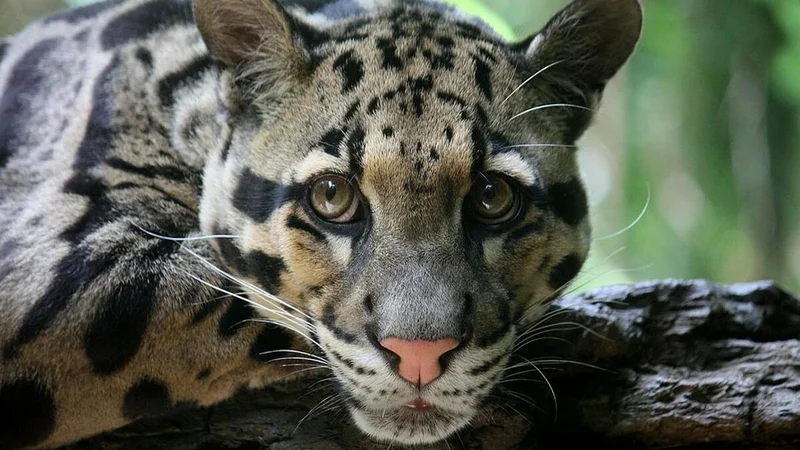
Meghalaya has launched a dedicated programme for its State animal—the mainland clouded leopard (Neofelis nebulosa).
On Tuesday (August 4, 2026), Chief Minister Conrad K. Sangma unveiled Mission Clouded Leopard. The feline is found in the State’s community-managed forests and in the forest landscapes of Nokrek, Balpakram, Baghmara, Narpuh and Nongkhyllem.
Also read: Understanding clouded leopards and their habitats
“The mission covers habitat protection and restoration, scientific research and long-term monitoring, stronger protection measures, landscape connectivity, capacity building of frontline staff, community participation, and public awareness. It will be guided by the Meghalaya Clouded Leopard Action Plan, now being prepared by the Forest and Environment Department,” the Chief Minister said.
“An ongoing scientific assessment has so far identified 21 individual clouded leopards in the Balpakram National Park. The assessment will be extended to all major habitats in the State, so that Meghalaya has, for the first time, a comprehensive population estimate of its State animal,” he said.
Distinct from the Sunda clouded leopard, which is found on the islands of Borneo and Sumatra, the mainland clouded leopard is listed as “vulnerable” on the International Union for Conservation of Nature (IUCN) Red List, and protected under Schedule I of the Wildlife (Protection) Act, 1972.
According to the Conservation Action Plan (CAP) for the caracal, fishing cat, and clouded leopard released by the Wildlife Institute of India on Tuesday, India supports one of the most important remaining populations of the mainland clouded leopard.
“Across its global range, important populations persist in Bhutan, Myanmar, Thailand, Peninsular Malaysia, and parts of northeast India. In contrast, populations in Bangladesh, Vietnam, Taiwan, and large parts of China have undergone severe declines, with several regions now supporting only small and isolated populations or facing local extinction,” the CAP said.
The principal threats to clouded leopards include habitat loss, degradation, and fragmentation resulting from infrastructure development, agricultural expansion, mining, plantations, and human settlements. Illegal hunting and trade in skins and body parts continue to threaten populations across several range countries, while prey depletion, human disturbance, road development, and climate change further exacerbate conservation challenges.
“These threats are particularly significant because clouded leopards depend upon extensive, connected forest habitats and occur at naturally low population densities. The overall goal of the CAP is to secure viable, connected, and genetically healthy clouded leopard populations while conserving the forest ecosystems upon which they depend,” the action plan read.
Published - August 05, 2026 11:20 pm IST