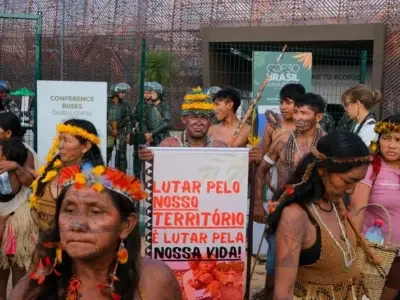
This post is part of Global Voices’ August 2026 Spotlight series, “Indigenous Rights” This series offers insight into the lives and experiences of Indigenous peoples, to build connections across regions, center Indigenous experiences, and share the stories of leaders, activists, and community members, and more. You can support this coverage by donating here.
Wherever you live on this planet, there is a strong possibility that your city, town or village is built on Indigenous lands. The Canadian non-profit Native Land Digital created an interactive atlas that shows where Indigenous societies have existed for centuries in the Americas and Oceania, as well as in northern and western Africa, northern Europe, Siberia, and East Asia. This mapping exercise of historical and contemporary Indigenous territories is still, however, incomplete. It is not just that it does not show all Indigenous presence in Sub-Saharan Africa and Asia. The exercise would still be incomplete without integrating the fundamentally global importance of Indigenous histories and perspectives, which this GV thematic programming seeks to do this month.
I am a Maya researcher from the Yucatan Peninsula in Mexico (which means that I am an Indigenous person), and I currently live, work, and learn in W8banakiak wdakiw8k, the traditional unceded territory of the Abenaki people, in what is today southern Quebec, Canada. This land acknowledgement aims to be more than a conventional gesture and, rather, to be a show of respect and gratitude to the people who have welcomed and shared their cultural and historical knowledge with me as an Indigenous guest in their home.
We, Indigenous peoples, are persons and societies that descend from those who lived in a particular territory before its colonization and settlement by other peoples, or before the creation of modern nation states which incorporated said territory. Although the term “Indigenous” etymologically means “born from the place,” it has been exclusively applied in history to societies framed by Western powers and national governments as “natural,” “rustic,” “savage,” “primitive,” or “uncivilized.” This makes ours a particular type of stateless society within modern nation-states — type of racialized society often considered too “different,” “rudimentary,” and “unmanageable” to be accepted as a self-determined nation within current state structures.
We have often been identified or called Indios or “Indians,” “Aboriginals,” “Natives,” “Bushmen,” “Berbers,” or “Tribals.” However, we have more recently demanded to be called by the names we choose, usually reclaiming our own historical names, for example, Original Peoples, First Nations, Adivasi, Maya, Inuit, Sami, Ainu, Māori, Khoisan, Amazigh, among others.
Our Indigenous languages, identities, forms of knowledge and ways of life have been maintained and transformed for hundreds of years despite territorial dispossession, forced assimilation, political and economic exclusion and, in quite a few cases, cultural genocide. Even after the fall of empires and political decolonization, we, Indigenous peoples, continue to struggle for recognition and to protect and advance our fundamental rights in the world. These rights hinge on territorial access and political self-governance, and on maintaining our livelihoods and our relationship with the land, both within and across national borders.
Contrary to conventional thought, rather than presenting Indigenous stories as past or marginal stories, I want to highlight their importance as global stories. Their significance stems from the fact that while Indigenous peoples represent approximately 6.2 percent of the global population, the territories we continue to occupy, maintain and steward amount to 25 percent of the planet’s landmass, and house a significant portion of earth's biodiversity. The importance of this biodiversity for the future survival of our species cannot be underestimated. A key fact in this story is that while the “primitivism” or “lack of technology” attributed to Indigenous peoples has often been argued as an explanation for this conservation of natural diversity, recent studies demonstrate that it is, in fact, the multifaceted and intricate Indigenous landscape management which has originated, cared for, and expanded such diversity. It has thus become crucial to heed the knowledge, cultural practices and experiences of these diverse peoples in whose hands this crucial resource has not only been preserved but keeps thriving. This commitment to the protection of the land and all the life that inhabits it (which we consider our other-than-human relatives: animals, plants, mountains, waters) frequently puts lives in danger, with reports showing that environmental activists kidnapped and murdered are disproportionately Indigenous earth defenders.
Today we are around 476 million people in the world who identify or are identified as belonging to an Indigenous people, nation and/or community. Our societies have in many cases inhabited and thrived in the same lands for hundreds, if not thousands, of years. We have often found ourselves living outside of (and resisting the pressure to be fully assimilated by) mainstream national cultures, yet we have also contributed to global cultural and scientific advancement. Indigenous peoples have added maize, tea, potato, peanut, maple syrup, chilli, quinoa, avocado, cacao, stevia, aspirin, quinine, and other products, to the diets and the pharmacies of the world, as well as to the development of canoeing, kayaking, lacrosse, hockey, the Enlightenment, constitutional federalism, legal pluralism, multi-crop agriculture, land management, botany, among other fields of human endeavour.
Indigenous worlds are as diverse as our languages, which represent the majority of the 7,000 still spoken in the world. They are, however, threatened by racial and political discrimination, and by economic marginalization. Through Rising Voices, a Global Voices program, we support communities of Indigenous activists in their efforts to reclaim, maintain and increase visibility for their languages.
We, Indigenous peoples, inhabit the Arctic regions, the plains, the pine and the rain forests, the deserts, the savannas, the mountains, the coasts, the islands, as well as some of the largest cities in the world. Mexico City, Guatemala City, Winnipeg, Vancouver, Toronto, Barcelona, Sydney, Los Angeles, Auckland, Rio de Janeiro, Hokkaido, and Lima, among others, are home to thousands if not millions of Indigenous people today.
Although Indigenous peoples have made significant advances to be recognized as distinct members of the global community at the beginning of this century — with the adoption of the Declaration of Rights of Indigenous Peoples by the United Nations Assembly in 2007 — we continue to face constant pressure by national governments, multinational companies, extractive industries, and even carbon capturing schemes, wind and solar energy farms, and data centers to give up control over the use of our territories. These are still seen as “empty lands,” which is the same principle that justified colonization and genocide in a not-so-remote past.
Like those of many other excluded communities, Indigenous perspectives are fundamental to the construction of better worlds founded on diversity, relationality and reciprocity. These perspectives are, however, almost never present in mainstream media, and when they are, they tend to show a dehumanized image of Indigenous peoples plagued by either racist stereotypes or by over-simplification, romanticization, and exoticization. This is fortunately changing, and with this August’s thematic programming by Global Voices the hope is that more people will have a chance to know first-hand the Indigenous voices that are part of our global network.