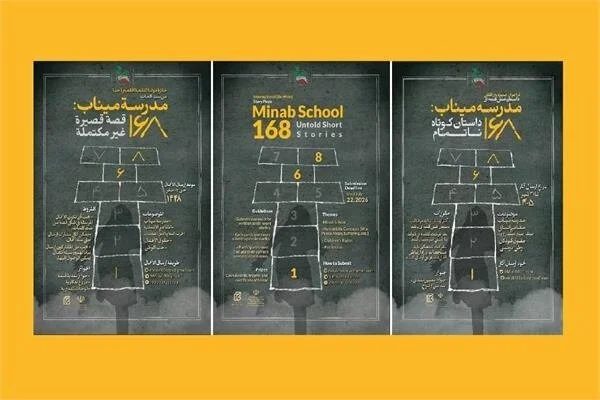
Over 16,000 entries received for Minab school literary award
TEHRAN- The secretariat of the first International Six-Word Story Award, titled “Minab School – 168 Unfinished Short Stories” has announced an overwhelming response to its inaugural call for entries, attracting participants from across the globe.
According to the Public Relations Office of the Deputy for Cultural Affairs at the Ministry of Culture and Islamic Guidance, 3,354 writers from 38 different countries submitted a total of 16,158 entries.
The global reach of the competition was highlighted by submissions from a diverse array of nations, including Iran, Argentina, Germany, the United States, Indonesia, Armenia, Uruguay, Australia, Spain, Afghanistan, Algeria, Italy, Brunei, Belgium, Belarus, Burkina Faso, Pakistan, Portugal, Tunisia, China, Russia, Romania, Japan, Chile, Serbia, Iraq, France, Philippines, Cameroon, South Korea, Congo, Lebanon, Libya, Mali, Egypt, Nicaragua, India, and Yemen.
Organized by the Office of Literature and the Persian Language, the prize focuses on the core themes of children's rights, peace, patriotism, and hope. The competition is characterized by its rigorous minimalist format, challenging writers to craft a complete narrative in exactly six words—a form that demands extreme brevity while maintaining a deep capacity for interpretation and resonance.
The secretariat stated that due to the high volume of submissions and the necessity for a meticulous judging process, the closing ceremony is expected to be held by the end of the current season. Detailed information regarding the date and venue will be announced via the official communication channels.
The entries are currently being evaluated by a panel of esteemed domestic and international experts. The winners will be honored at the closing ceremony with trophies, plaques, and prestigious cash prizes, marking a new chapter in the realm of concise fictional literature.
On February 28, the Shajareh Tayyebeh girls' elementary school in Minab, Hormozgan province, became the site of a devastating massacre as the United States and Israel initiated their strikes against Iran.
While dozens of girls and boys aged between 7 and 12 were beginning their lessons, the school was targeted by a missile strike that caused the building to collapse, trapping children and teachers beneath the rubble. Iranian authorities confirmed a final death toll of 168 people, with at least 95 others wounded, marking one of the most harrowing incidents of the conflict's opening day.
Despite attempts by US and Israeli authorities to distance themselves from the carnage as images of the tragedy spread across social media, detailed forensic and digital investigations have painted a starkly different picture.
An analysis by Al Jazeera’s digital investigations unit, utilizing over a decade of satellite imagery and recent video clips, revealed that the school was a clearly distinct civilian facility, separated from any adjacent military sites for at least ten years. Furthermore, witness accounts and satellite-based analyses confirmed that the school was triple tapped by three separate, deliberate strikes, leaving no doubt about the nature of the attack.
The international community has faced mounting evidence regarding the responsibility for this atrocity, with investigations from major global outlets including The New York Times, BBC Verify, CBC, and NPR all concluding that the United States was responsible for the strike.
These findings have raised fundamental questions about the intelligence used to justify the bombing, as the patterns of the strike suggest a direct targeting of a civilian educational institution. The Minab school tragedy now stands as a somber testament to the immense human cost of the aggression and a focal point for those demanding international accountability.
SAB/