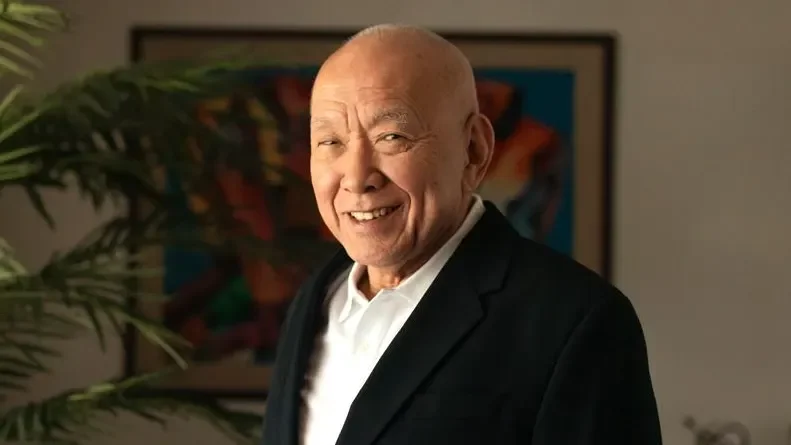
The pandemic forced DigiPlus Interactive chairman Eusebio Tanco to place his chips on offering bingo online. Now with rivals circling, he’s upping his bet with a new superapp and overseas expansion.
This story is part of Forbes’ coverage of Philippines’ Richest 2026. See the full list here.
Back in January 2022, as the Philippines hit a record daily Covid-19 case count, Eusebio Tanco, chairman of gaming company DigiPlusInteractive, pushed his chips into place. The company, then called Leisure & Resorts World, had racked up over 2 billion pesos ($39 million at the time) in net losses following two years of lockdowns that had all but shuttered its 163 bingo halls and gaming cafes across the archipelago.
“We needed to do something,” recalls Tanco, 76, sporting his trademark sneakers and blue jeans in an exclusive interview at his office in the Makati financial district. He launched BingoPlus, an interactive gaming platform built from scratch, to complement the idle bingo slot machines. “The pandemic accelerated our move to go online,” he says.
The pivot drove the company’s recovery—DigiPlus posted a modest 600.7 million pesos ($9.8 million) in net income in 2022—and laid the foundation for a new way of doing business. Over the next three years, the company extended its online offerings in the Philippines to include sports betting and casino games like slots and live dealer games. Helped by the explosive adoption of mobile wallets during the pandemic, the total number of registered users rose exponentially, hitting 40 million last year.
In 2024, DigiPlus became the country’s biggest online gaming outfit by gross gaming revenue (GGR), a key industry metric that reflects the total amount of money wagered minus the winnings paid out to players. It retained that status in 2025 with record sales of 83.1 billion pesos ($1.3 billion)—up 12% from the previous year—contributing over a fifth of the country’s GGR of 396 billion pesos, according to data from regulator Philippine Amusement and Gaming. “We didn’t expect it to become that big that quickly,” acknowledges Tanco, who’s called Yosi (pronounced Yoh-see), short for Eusebio, by his friends and business associates.
With his gaming sites, BingoPlus, ArenaPlus and GameZone, now household names in the Philippines, he’s looking to leverage that success. Expanding overseas, investing in a bricks-and-mortar casino and developing a superapp that will offer the gamut from e-commerce to insurance, are all on the table. “These will shape what DigiPlus can become in the future, which can go beyond gaming and entertainment,” says Tanco.
“We needed to do something. The pandemic accelerated our move to go online.”
This next pivot comes at a time when DigiPlus’ inroads into online betting have rivals circling. In July, the betting sites of homegrown casino groups, ports billionaire Enrique Razon Jr.’s Bloomberry Resorts and property-to-liquor tycoon Andrew Tan’s Newport World Resorts, went live. Two months earlier, Okada Manila, owned and operated by a subsidiary of Japan’s Universal Entertainment, had launched its digital platform Okada Play. The sector has also drawn property and airline tycoon Lance Gokongwei, who in June invested 2 billion pesos of his personal fortune into Pasig City-based PhilWeb, which builds and manages gaming platforms, operates physical gaming stations and distributes gaming content.
It’s not just rivals who are closing in, so are regulators. Last year, the Philippine central bank, bowing to public concerns about online gambling, ordered the country’s financial institutions and e-wallet operators to remove all links to gaming sites from their platforms. Now online punters can only log in to a gaming site directly if they want to play. Earlier, in July 2024, the government had cracked down on offshore gambling firms that had proliferated with several operating without a license.
The removal of gaming apps in e-wallets, which took effect last August, hit the industry’s gross gaming revenue, which fell by more than a third in the six months until December. The ban also took a toll on the company’s shares, which have halved from a year ago, impacting Tanco’s fortune. He appears on the Philippines’ Rich List at No. 20 with a net worth of $735 million.
At The Table
Digiplus interactive is now the largest online gaming company in the Philippines.
To mitigate the effects of the ban, Tanco more than doubled gaming content by introducing variants of Blackjack and Baccarat and local games such as Pinoy Drop Ball, a digital version of the Filipino carnival game. He also expanded Digiplus’ payment-partner network, which now includes Banktech Australia’s Pay&Go, PayPal and Filipino boxing icon Manny Pacquiao’s e-wallet app, MannyPay. DigiPlus also tapped Pacquiao as brand ambassador for both its GameZone platform, where customers can play card and casino games against real opponents, and ArenaPlus, a sports-betting site that streams local and international sports events.
Simultaneously, it launched a marketing campaign to lure back customers who previously had accessed its platform through mobile wallets such as GCash and PayMaya, in particular high value users, who accounted for a fifth of DigiPlus users, but contributed 80% of revenue before the ban. The measures are bearing fruit, says the company, which projects a return to pre-ban monthly revenue levels within the year.
Not everyone is as optimistic. “I do not think they can hit pre-delinking levels by the end of the year. That’s just me being conservative after seeing flat quarter-on-quarter revenue growth in the first quarter of 2026,” says Richard Laneda, an analyst at Pasig City-based COL Financial, by email. While “management’s push to increase average revenue per user and not go for market share may result in a more gradual recovery in revenues,” he adds, “they will be able to maintain profitability in a very competitive environment.”
By the same token, Tanco is stepping up his ambition to build an entertainment ecosystem. In June, DigiPlus completed the second and final tranche of its investment in International Entertainment Corp. (IEC), a Hong Kong-listed company that owns and operates the 286-room New Coast Hotel Manila, an integrated hotel and casino complex. DigiPlus paid HK$1.6 billion ($204 million) for five-year convertible notes issued by the IEC, which will give it close to a 54% stake in the Hong Kong operator if it converted into equity, or if not converted, are redeemable at 108% at maturity after five years.
Tanco says the alliance will combine IEC’s hotel and casino expertise with DigiPlus’ strengths in digital gaming, technology and customer engagement. Still, he insists his primary focus remains online. A week after completing the deal, IEC subsidiary New Coast Leisure moved into online gaming in a revenue-share partnership with DigiPlus’ Total Gamezone Xtreme, which runs sports betting and casino-style online games.
Betting Boom
Philippine gross gaming revenue has steadily recovered since the pandemic amid a surge in online gaming.
A superapp, Tanco says, is another idea as the company explores ways of extending its digital platform to offer multiple products and services. Tanco has hired a team of software engineers from China to help remodel DigiPlus. That’s in addition to key senior hires in the past year to bolster DigiPlus’ digital push: software engineer Hu “Tommy” Jiangguo as CEO, finance veteran Ping Chen as president, and former Ant Group executive Li “Rick” Jiaqi as chief digital officer.
Building DigiPlus into a superapp won’t happen overnight, says Jonathan Ravelas, managing director at Manila-based consultancy firm eMBM. “It’s a long-term goal and the immediate hurdle is diversifying the profile of its users, who are there to gamble, not for anything else, like to shop.” Still, he adds, “Amazon started with books before becoming a retailer for almost everything.”
The superapp would also feature Digiplus’ entertainment offerings. In addition to live streaming of sports events, bingo and other games, DigiPlus recently partnered with Philippine-based GMA Network, controlled by tycoons Felipe Gozon, Gilberto Duavit Jr. and Menardo Jimenez, to produce a slate of so-called micro dramas—40 episodes that run one to two minutes each—for mobile phones. Over time, its entertainment portfolio could span concerts and musical shows, according to Tanco, who says there’s no timeline yet for launching the superapp.
Confident of replicating Digiplus’ success elsewhere, Tanco is also placing his chips overseas; he secured an online gaming license last year in Brazil, where casinos are banned, and one this year in South Africa. Both markets have high mobile phone penetration and rapid digital-payment growth, he says, and like the Philippines, young populations. They are also the largest online gambling markets by gross gaming revenue in their res-pective regions, according to Tanco.
“Going international is always a big risk, especially in markets that are that far from home.”
Brazil’s online gambling market is projected to hit at least $12 billion by 2030, according to gaming technology developer EGT Brazil, versus $7 billion in 2025. South Africa’s online gambling revenue is expected to climb to $4.4 billion from $2.7 billion in that period, says Portugal-based gaming consultancy BetBrainers. That compares with the Philippines, where online gaming is expected to balloon by $8 billion to $11 billion by 2030, according to India’s Redseer Strategy Consultants, noting that among 60 e-gaming license holders in the Philippines, DigiPlus is the clear market leader today.
Three weeks after it launched GamePlus, its first international platform, in Brazil in September, DigiPlus halted operations in order to tailor its offerings for local players, according to the company. It relaunched the site in June, and aims to start taking bets in South Africa next April. John Gatmaytan, chairman of Luna Securities, believes DigiPlus has a good chance of succeeding overseas. “The platform is malleable and can be tweaked to suit the local market,” he says. “The challenge is what tweaks it must do to differentiate itself from online gaming operators in those markets.”
Polish investor Tomasz Juroszek, whose family foundations own about 1.4% of the company says that DigiPlus is better off staying focused on its home ground. “For me, the biggest opportunity for DigiPlus is still the Philippines,” he says. In his view, there’s room in the country to expand market share, improve products and increase margins. “Going international is always a big risk, especially in markets that are that far from home.”
In early July, in an open letter to the company’s board, Juroszek pushed for a stock buyback program, arguing that the share price—trading at roughly a third of the median valuation of other globally listed B2C gaming operators—reflected external headwinds rather than company fundamentals. “Revenue has already stabilized sequentially, the balance sheet remains a fortress with over 20 billion pesos of cash and virtually no debt, and as these transitory pressures normalize, we expect the return to growth in 2027 to bring the company’s trading multiples back towards industry standards,” Juroszek wrote. The board responded a week later, extending a 12-month share repurchase backed by a 5.4-billion-peso budget.
For Tanco, DigiPlus is the crown jewel among the family’s businesses that include insurance, education, energy, logistics and real estate. The gaming outfit was started by his friend and Tanco first joined its board as a non-executive director in 2011. He became chairman in 2019 after buying a 5% stake for 435.6 million pesos through a private placement. He increased his stake to 15.8% in 2022 in a subsequent private placement, which cemented his position as the company’s largest individual shareholder.
The eldest of seven children, Tanco says his father, Agustin, a naturalized Filipino from Fujian, China, started out as a cement and metal trader before venturing into textile manufacturing. In 1972, Agustin expanded into insurance, acquiring the country’s first domestic non-life insurance company, Yek Tong Lin Fire and Marine Insurance, which he later renamed Philippine First (PhilFirst) Insurance.
“Whether good or bad, it’s better to make a decision than not at all.”
Unlike other traditional Chinese families at the time, Tanco was given leeway to choose his own course. He earned a bachelor’s degree in economics from Ateneo de Manila University, an elite private school, then opted for a master’s degree in economics at the London School of Economics and Political Science. A few weeks into the program he was acutely homesick, but, as Tanco recalls, returning home was not an option; his father stonewalled him saying that he’d already bragged to his friends that his son was studying at LSE.
When he returned to the Philippines in 1973, Tanco was tasked with overseeing the insurance business and to help manage the family’s textile operations. Believing manufacturing was key to economic development in the Philippines, he bought an integrated textile mill in the late 1970s but shut it down within a decade. “I thought I was getting ahead with my integrated mill,” Tanco recalls with a laugh. “It was a mistake,” but one, he says, that became a life lesson.
“The factors of production were stacked against us. Power is expensive. Labor isn’t cheap. We don’t produce our raw materials,” Tanco explains. “I got out of manufacturing and turned to investments that have a competitive advantage.”
He invested in Manila-based Asian Terminals when its first asset, Manila South Harbor, was privatized in 1992, and joined its board a year later. He was appointed president in 1995, and led Asian Terminals to add three more ports to its portfolio, which included securing a 25-year agreement to build and operate a container terminal in the Port of Batangas, south of Manila. The 20.1-billion-pesos (2025 revenue) company was delisted in April though Tanco retains a substantial stake.
But the business Tanco, by his own admission, is most passionate about is STI Education Systems Holdings, one of the country’s largest private school operators with a network of 66 campuses, serving over 130,000 students. Tanco initially invested in its core asset, Systems Technology Institute, in the late 1990s, which he later acquired from its founders. “Education is the best equalizer to economic disparity,” he says. He’s grown STI’s portfolio through acquisitions, including the purchase of accounting school Philippine School of Business Administration in 2024.
While Tanco remains hands-on at DigiPlus and Asian Terminals, he’s turned over the management of other family ventures to his children. The insurance and healthcare arms are run by his son, Joseph Augustin Eusebio, or Jaeger, who was appointed president of PhilFirst Insurance in 2025. The 45-year-old is also president and CEO at PhilhealthCare (the HMO subsidiary of Philippine-American Life and General Insurance Co., acquired by Tanco in 2009), where he’s launched the country’s first prepaid healthcare plans, a mobile app and a teleconsultation platform. The aim, Jaeger says, is to make healthcare more accessible in the Philippines.
Tanco’s daughter Maria Vanessa Rose, 48, who holds both an M.B.A. and a doctorate degree in education from the University of Southern California, is more involved on the education side, serving as director at STI Education.
“Dad’s most important advice has been, just decide,” says Jaeger. “Whether good or bad, it’s better to make a decision than not at all.”
Tanco on his part is clear about the way forward for DigiPlus and is determined to go all-in. “There’s still so much we can do,” he says. “We’re creating a whole ecosystem, not just gaming.”