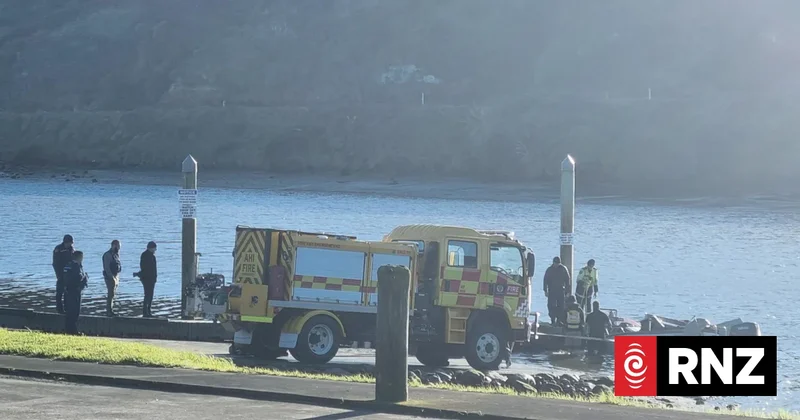
A coroner has highlighted the correct use of lifejackets and Maritime New Zealand advice on the crossing river bars in a report into a double-drowning on the Pātea Bar last year.
Rachael Schmidt-McCleave's report describes CCTV footage showing a "large wave" appearing just as a fibreglass trailer-boat attempted to cross the bar, its "momentum taking it into the wave" and the vessel becoming "vertical and landing on its stern" before capsizing, trapping two passengers below.
Six-year-old Zane Te-Arepa Milham-Maraki and his stepmother Patricia Wiltshire, also known as Patricia Tolley, drowned in the 15 June 2025 accident.
The youngest of 11 children, Te-Arepa Milham-Maraki lived fulltime in Pātea with his father Shane Milham - who was the skipper of Miss Molly and was loved by both parents.
His mother, Carolynn Maraki, described him as "an affectionate kid, easily entertained and easily impressed, a really good kid and always talking to people".
Zane loved going fishing with his dad.
On the morning of 15 June 2025, Milham was aiming to take Wiltshire, also a regular fishing companion of his, and Milham-Maraki out on the 5m Miss Molly.
Conditions were reasonable and relatively calm with light winds, and both Wiltshire and Zane were wearing lifejackets, although the boy's was the incorrect size and wrong design.
At about 10am, after assessing the Pātea Bar - rated the second most dangerous in New Zealand - and watching other vessels successfully navigate it, Milham attempted to make the crossing but was hit by a large wave.
After the capsizing, Milham managed swim out from underneath the boat and tried to rescue Wiltshire who he could hear yelling for help.
"He reached within the boat and grabbed what he believed to be Ms Wiltshire's personal floatation device. He tried to pull Ms Wiltshire out but was unsuccessful. He could not see or locate Zane," the coroner Rachael Schmidt-McCleave's report said.
A member of the public alerted the Coast Guard a boat had overturned and emergency services were called and boats in the area alerted.
About 15 minutes later one of these pulled Milham from the water.
Two boats were used to tow Miss Molly to the boat ramp jetty where police were waiting.
Milham told them Zane and Wiltshire were under the boat.
Subsequently, a rescue diver from Taranaki Rescue Helicopter searched the upturned boat and located Zane. He was wearing a lifejacket with the top two buckles unbuckled, and the bottom one buckled up.
Nearby vessels observed Wiltshire surface from under Miss Molly approximately 50 metres away from the jetty. She was retrieved from the water but was deceased.
Police investigated the incident and decided not to press charges, returning the matter to Maritime NZ. It also decided against enforcement action.
Marine Accident Inspector Greg Marsden provided evidence for the police.
He found although Miss Molly presented in a "poor overall condition", especially with regard to the ship's systems, "it maintained structural integrity, propulsive power and steerage at the time of the capsize".
Marsden concluded that the condition of the vessel did not contribute to the incident or the capsize, but said if he had been asked to inspect it for insurance purposes he would have found it "unsuitable for underwriting due to it being unseaworthy and unsafe due to the likelihood of failure of the ship's systems and the general arrangement of the vessel".
Matthew Wood, principal advisor - recreational craft at Maritime NZ, addressed safe lifejacket use for police.
He found Zane's Personal Flotation Device (PFD) the wrong size and was not correctly fitted. Further, the type of device he was wearing only aided buoyancy, and a person needed to actively work to keep their head out of the water.
The lifejacket Zane was wearing would have negatively impacted on his ability to float and keep his head above water, Wood concluded.
In its report, Maritime NZ described Milham as an experience boatie who had crossed the bar many times over the previous decade.
It agreed with Marsden's assessment of Miss Molly: "whilst the vessel was poorly maintained and potentially overweight in the transom, there is no evidence to suggest that the condition of the vessel caused or directly contributed to the vessel capsizing".
Maritime NZ found that Milham's decision making on 15 June 2025 did not appear to significantly deviate from the guidance contained in the MNZ Code of Practice for Bar Crossings.
On the question of Zane's PFD, Maritime NZ agreed it was the wrong size and type and "not intended for use in potentially dangerous waters such as crossing a bar".
But the agency found it wasn't so loose it could slip off him and that although Zane was found floating face down it was not known whether he was in the same position when he died.
"Therefore, in the absence of any witnesses to Zane's final moments, Maritime NZ could not consider it conclusively established that the choice of size and type of PFD directly contributed to Zane's death."
Coroner Schmidt-McCleave said her report highlighted several potential areas of risk in Miss Molly attempting a cross of the Pātea river bar, including the condition of the vessel, Zane's inappropriate and ill-fitting PFD, the weight distribution in the vessel, and its engine size.
However, based on the expert reports available, she was unable to conclude on the balance of probabilities that any of these factors directly contributed to the deaths of Zane and Wiltshire.
Schmidt-McCleave made no formal recommendations, but wanted to draw the public's ongoing attention the guidance on lifejacket use and the crossing of river bars contained on the Maritime NZ website.
She extended her condolences to the friends and family of Zane "clearly a much loved and loveable little boy", and those of Wiltshire.